
📊 Full opportunity report: The EU's Driver Monitoring Camera Mandate: Every New Car, No Exceptions on IdeaNavigator AI — validation score, market gap, and execution plan.
TL;DR
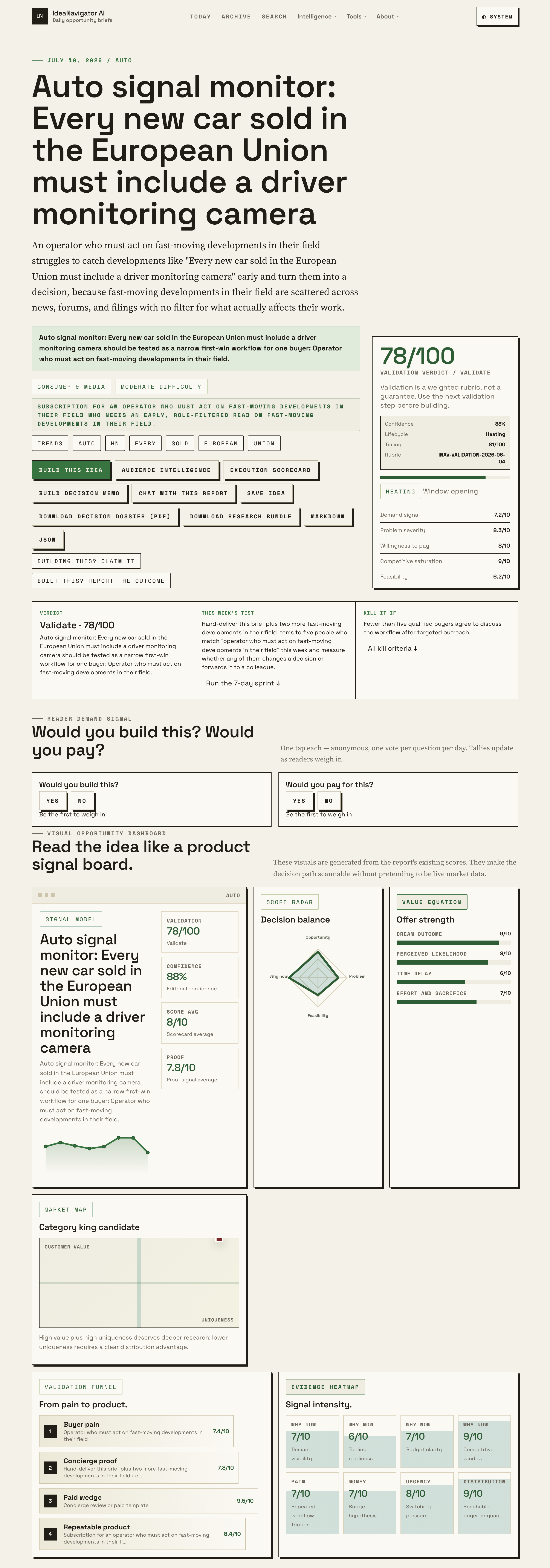
A claim that every new car sold in the EU must include a driver monitoring camera, with no exceptions, gained traction on Hacker News. EU safety rules do mandate driver monitoring systems on new vehicles, but the specific ‘camera in every car, no exceptions’ framing requires careful checking against the actual regulation.
A claim that every new car sold in the European Union must include a driver monitoring camera, with no exceptions, is circulating widely after being surfaced on Hacker News with a high relevance score, according to signal-tracking service IdeaNavigator AI. The claim touches on a real and far-reaching regulatory shift: EU vehicle safety rules adopted in recent years do require driver monitoring systems on new cars. But the specific framing — a camera in every vehicle, with no exceptions — deserves a closer look at what the regulation actually says and what remains open to interpretation.
The regulatory foundation is the EU’s General Safety Regulation (Regulation 2019/2144), adopted in 2019 and phased in over subsequent years. It requires new passenger cars sold in the EU to be fitted with a range of advanced safety systems, including driver drowsiness and attention warning systems. From July 2024, these systems became mandatory for all new car registrations in the bloc. A further tightening of requirements is scheduled to take effect in July 2026, with stricter performance criteria for driver monitoring.
What the regulation mandates is a monitoring capability — the system must detect signs of driver drowsiness or distraction and issue warnings. The regulation does not, on its face, prescribe a single technology. In practice, many manufacturers are implementing this with in-cabin cameras that track eye movement, head position and gaze direction, because camera-based systems are currently the most effective way to meet the stricter 2026 performance thresholds. Steering-based detection, which infers drowsiness from steering patterns, is widely expected to fall short of the tighter requirements.
The “every new car, no exceptions” framing, as circulated in the Hacker News discussion tracked by IdeaNavigator AI, reflects the breadth of the mandate — it applies to all new cars sold in the EU regardless of brand, price or fuel type. However, it applies to new type approvals and new registrations, not to vehicles already on the road. Owners of existing cars are not required to retrofit anything. Cars sold in non-EU markets fall under different national rules, though several jurisdictions, including the UK through its retained version of the regulation, have adopted similar requirements.
Why In-Cabin Cameras Change the Driving Experience
This matters to readers on three fronts. First, privacy: camera-based driver monitoring means a device watching the driver’s face is becoming standard equipment in new cars across Europe, raising questions about where that visual data goes, how long it is stored, and whether it can be accessed by manufacturers, insurers or law enforcement. Data protection campaigners have repeatedly raised concerns about in-cabin cameras, and EU privacy law imposes limits on how such data may be processed.
Second, safety outcomes: regulators introduced the mandate because driver distraction and fatigue remain leading contributors to road deaths. The European Commission has pointed to advanced driver assistance systems as a core tool in its long-term goal of reducing road fatalities toward zero. Monitoring systems are also a technical prerequisite for the safe deployment of higher levels of driving automation, because a vehicle must verify that a human is ready to take over.
Third, cost and choice: the requirement applies to every new car regardless of price segment, meaning budget models must carry the same monitoring hardware as premium vehicles. That has implications for manufacturers’ pricing and for buyers who would prefer not to have a camera in the cabin and, under current rules, have no opt-out when buying new.
How the EU Mandate Was Phased In
The General Safety Regulation was adopted in November 2019 and represented one of the largest single expansions of mandatory vehicle safety technology in the EU’s history. It introduced requirements for intelligent speed assistance, lane-keeping assistance, emergency braking, event data recorders and driver monitoring in a single package. The first phase, applying to new type approvals from July 2022 and all new registrations from July 2024, required basic drowsiness warning capability. A second, stricter phase arrives in July 2026, which is when camera-based implementations are expected to become effectively unavoidable for most manufacturers.
The recent wave of discussion, according to IdeaNavigator AI’s signal tracking, reflects how quickly regulatory developments in the automotive sector move — and how easily a phased technical requirement can be compressed into a shorthand claim like “a camera in every car” as the deadline approaches and manufacturers confirm their implementation strategies.
Where the ‘No Exceptions’ Claim Overshoots
Several elements of the circulating claim are not settled fact. The regulation mandates driver monitoring capability; the assertion that every car must specifically contain a camera is a practical prediction rather than a literal legal requirement, and some manufacturers may pursue alternative sensing technologies if they can meet the 2026 thresholds. The “no exceptions” framing also glosses over the phasing — existing vehicles are unaffected, and the exact scope of any narrow exemptions for special-purpose vehicles depends on implementing technical standards.
It is also not yet clear how data handling will work in practice across manufacturers: whether camera footage is processed locally and discarded, or retained in any form, varies by automaker, and enforcement guidance under EU privacy law is still developing. The circulation of the claim on Hacker News, as tracked by IdeaNavigator AI, does not by itself verify the strongest version of the claim, and readers should distinguish between the confirmed regulatory requirement and the shorthand used in online discussion.
The July 2026 Deadline and Its Aftermath
The next concrete milestone is July 2026, when the stricter second-phase driver monitoring requirements take effect for new vehicles in the EU. In the run-up, expect manufacturers to disclose which sensing technologies they are deploying, and privacy regulators and consumer groups to press for clarity on in-cabin data retention and access rules. Buyers purchasing new cars between now and the deadline will increasingly encounter camera-based systems as standard. Watch also for parallel developments in the UK, which retained much of the regulation after leaving the EU, and for any legal challenges or consumer backlash over mandatory in-cabin cameras that could influence how the rules are enforced in practice.
Source: IdeaNavigator AI
Key Questions
Does my current car need a driver monitoring camera?
No. The requirements apply to new cars sold in the EU, phasing in through July 2026. There is no retrofit obligation for vehicles already on the road.
Does the EU law specifically require a camera?
The law requires a driver monitoring capability that detects drowsiness and distraction. Cameras are the most common way manufacturers are meeting the requirement, especially for the stricter 2026 thresholds, but the regulation does not name a single mandated technology.
Can I refuse or disable a driver monitoring camera in a new car?
Under current rules there is no general opt-out for buyers of new cars subject to the mandate. Some systems may allow limited adjustment of warnings, but disabling the monitoring function itself would typically conflict with the vehicle’s type approval.
What happens to the camera footage?
Practices vary by manufacturer. Many systems process images locally in real time without storing them, but retention and access policies differ, and EU privacy law constrains how such data may be used. This remains an area of active regulatory attention.
When do the stricter rules take effect?
The second phase of driver monitoring requirements under the EU General Safety Regulation is scheduled for July 2026, applying to new vehicles sold in the bloc.
Source: IdeaNavigator AI