
📊 Full opportunity report: Automated Benefit Checks: A New Approach To Social Care Delivery on IdeaNavigator AI — validation score, market gap, and execution plan.

Get everyday essentials delivered free — and shop member deals
- Fast, free delivery on millions of items
- Access to Prime Big Deal Days deals on October 6–7
- Prime Video, Amazon Music and more included
TL;DR
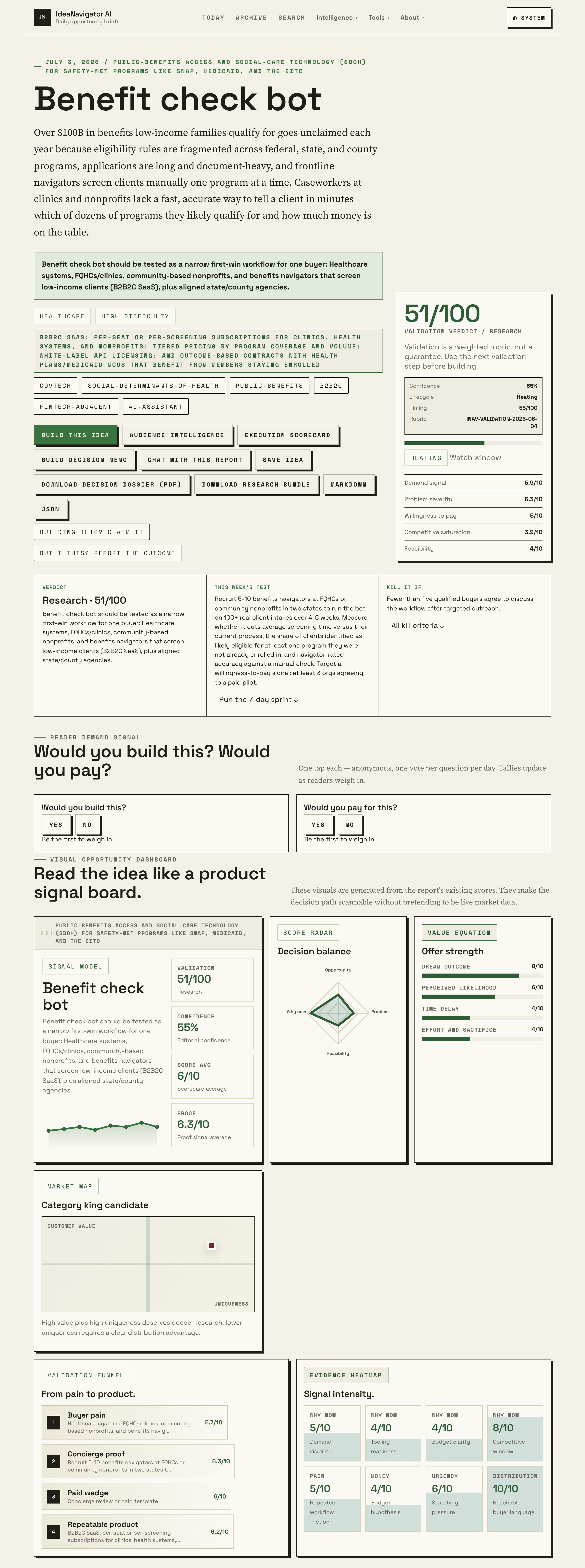
A new AI-driven benefit check chatbot is being tested to improve eligibility screening for social programs. It aims to reduce manual effort, increase accuracy, and help low-income families claim more benefits. The initiative responds to recent gaps left by nonprofit shutdowns and pandemic-related redeterminations.
A new AI-powered benefit check chatbot is currently being tested with healthcare providers and community nonprofits to streamline eligibility screening for multiple social programs. This development addresses a significant gap in social care delivery, where manual screening processes often result in unclaimed benefits worth over $100 billion annually, according to experts. The initiative is designed to help frontline workers quickly identify benefits clients qualify for, potentially increasing access for low-income families and reducing administrative burdens.
The benefit check bot is a white-label conversational tool that integrates into clinics’ websites or is used via SMS, asking clients a short series of yes/no and multiple-choice questions. Based on the responses, it generates a list of likely-eligible programs, including SNAP, Medicaid, EITC/CTC, WIC, and LIHEAP, with estimated benefit amounts and next steps for application. The system is initially being tested in two states, focusing on 2-3 benefit programs, with plans to expand coverage and functionality.
This tool aims to address longstanding challenges: the fragmentation of eligibility rules across federal, state, and local programs, the lengthy and document-heavy application processes, and the manual screening performed by caseworkers and navigators. The shutdown of a major nonprofit that provided benefits screening in 2024 left a notable gap in capacity, especially as post-pandemic Medicaid redeterminations have increased the workload for health systems and state agencies. The chatbot leverages conversational AI technology, which can deliver multilingual, near-real-time screening at minimal marginal cost, making it a promising solution for safety-net providers.
Participating organizations will log anonymized screening outcomes through dashboards, allowing them to assess the bot’s accuracy, screening time savings, and the number of clients identified as eligible for programs they previously overlooked. The pilot aims to demonstrate whether the system can reliably improve efficiency and increase benefits enrollment, with a target of at least three organizations willing to pay for a full rollout based on pilot results.
This development could significantly improve how social benefits are accessed by low-income populations. By automating eligibility screening, the system may reduce the time and effort required by frontline workers, enabling faster assistance and potentially increasing benefits uptake. It also addresses a critical gap left by nonprofit shutdowns and the surge in redetermination efforts post-pandemic. If successful, this technology could lead to more equitable distribution of benefits, reduce administrative costs, and streamline social care workflows across health systems and community organizations.
As an affiliate, we earn on qualifying purchases.
For years, eligibility for programs like SNAP, Medicaid, and WIC has been hampered by complex, fragmented rules and cumbersome application processes. Many eligible families fail to claim benefits due to lack of awareness, difficulty navigating paperwork, or limited access to skilled caseworkers. The shutdown of a major nonprofit benefits screening organization in 2024 further strained capacity, leaving health systems and local agencies with fewer resources to identify and enroll eligible clients. Meanwhile, the post-pandemic Medicaid redetermination process has increased the workload for many agencies, exposing the need for more efficient, scalable solutions.
Previous efforts to automate benefits screening have been limited by technical and operational challenges, including language barriers and integration issues. The advent of conversational AI now offers a new approach, enabling real-time, multilingual screening that can be embedded directly into existing workflows. This innovation arrives at a pivotal moment, as government agencies and providers seek cost-effective ways to serve vulnerable populations amid staffing shortages and increased demand.
social program eligibility screening software
As an affiliate, we earn on qualifying purchases.
As an affiliate, we earn on qualifying purchases.
Uncertainties Around Pilot Outcomes and Scalability
It remains unclear how accurately the chatbot will perform across diverse populations and complex eligibility rules, especially in the initial pilot phase. The effectiveness of the system in different states and for various programs is still being evaluated, and technical issues such as language support and integration with existing data systems could pose challenges. Additionally, the willingness of organizations to adopt and pay for the full solution depends on pilot results demonstrating clear benefits over current manual processes.
benefits eligibility assessment tool
As an affiliate, we earn on qualifying purchases.
As an affiliate, we earn on qualifying purchases.
Next Steps for Broader Deployment and Evaluation
Following the pilot phase, organizers plan to analyze data on screening accuracy, time savings, and enrollment increases. If results are positive, they will seek to expand the system to additional states and programs, and refine features such as multilingual support and integration capabilities. Stakeholders will also evaluate the pricing model and potential partnerships with Medicaid managed care organizations and government agencies to scale adoption. A broader rollout could occur within the next 12-18 months, contingent on pilot success.
social services client screening system
As an affiliate, we earn on qualifying purchases.
As an affiliate, we earn on qualifying purchases.
Key Questions
How does the benefit check bot work?
The bot asks clients a series of yes/no and multiple-choice questions about their circumstances. Based on responses, it generates a list of programs they likely qualify for, with benefit estimates and next steps for application.
Which programs does the system cover?
Initially, the system will focus on SNAP, Medicaid, EITC/CTC, WIC, and LIHEAP, with plans to expand coverage as it develops.
What are the main benefits of using this AI tool?
The tool aims to reduce screening time, improve accuracy, identify benefits clients might not be aware of, and streamline workflows for benefits navigators and caseworkers.
When will the system be available for wider use?
If the pilot proves successful, a broader deployment could occur within 12 to 18 months, depending on the results and stakeholder interest.
Are there any privacy concerns?
The pilot will log anonymized data, and organizations will need to ensure compliance with privacy regulations. Details on data security are still being finalized.
Source: IdeaNavigator AI
Fall Picks
fall essentials
As an affiliate, we earn on qualifying purchases.