
TL;DR

Get everyday essentials delivered free with Prime
- Fast, free delivery on millions of items
- Prime Video, Amazon Music and more included
- Member-only deals all year
IBM and Microsoft announced Imagine Enterprise on November 10, 2026, a platform combining IBM Consulting’s industry tools and services with Microsoft’s cloud, data and AI products. The companies describe built-in controls for agent actions, but have not disclosed pricing, general availability or production customers.
IBM and Microsoft announced Imagine Enterprise on November 10, describing it as a platform for large organizations to build, run and govern AI agents for industry-specific work. IBM Consulting will contribute industry-focused agents and delivery tools, while Microsoft provides the underlying cloud, data, security and AI products.
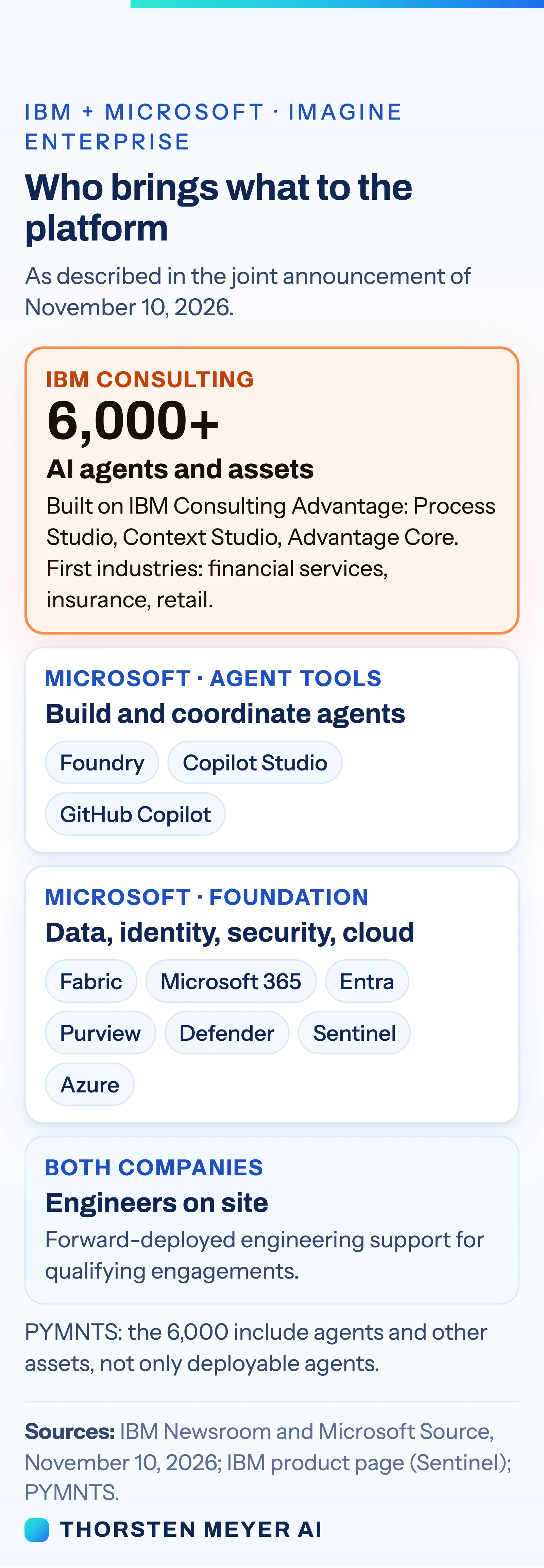
The companies say Imagine Enterprise includes more than 6,000 AI agents and assets from IBM Consulting, alongside IBM Consulting Advantage. That figure includes assets beyond deployable agents: PYMNTS reported that the companies have not specified how many of the 6,000 items are working agents. IBM describes its Process Studio, Context Studio and Advantage Core as tools for designing, deploying and governing tailored agents.
Microsoft’s technology stack includes Foundry, Copilot Studio and GitHub Copilot for agent and system coordination, with Fabric, Microsoft 365, Entra, Purview, Defender and Azure supporting data, identity, security and cloud services. IBM’s product page also names Microsoft Sentinel. The companies say engineers from both firms will work with customers on qualifying engagements, though they have not defined what qualifies.
IBM says customers can engage IBM Consulting to deploy and operate the platform, co-innovate on large implementations, or use self-management options. The initial industry frameworks cover financial services, insurance and retail. IBM’s launch materials describe the product as connecting to customers’ existing data, processes and systems.
IBM Consulting Adds Enterprise Delivery
The announcement pairs Microsoft’s existing enterprise software and cloud products with IBM Consulting’s industry expertise and implementation services. For large companies, especially those in regulated sectors, the offering is designed to address the work between experimenting with AI and embedding agents into operating processes.
That approach could matter to organizations that need to connect agents to established systems and set limits on what automated tools can do. The companies say governance controls can require human approval or escalation for specified actions. Those are vendor descriptions, however; no independent evaluation of the controls is included in the available launch material.
Products Worth Considering

Bose TV Speaker (2nd Gen) Compact Soundbar

Samsung Galaxy Tab A11+ 8GB RAM, 256GB Storage, Gray

Bose QuietComfort Wireless Noise-Cancelling Headphones, Sandstone
As an affiliate, we earn on qualifying purchases.
From AI Pilots to Workflows
IBM’s launch blog says many organizations are running AI pilots without fundamentally changing how their businesses operate. Imagine Enterprise is presented as a way to start with reusable agents and industry assets, then adapt them to a customer’s processes instead of building each agent from scratch.
Microsoft already offers agent-building tools, including Foundry and Copilot Studio. The partnership adds IBM Consulting as a route for enterprise implementation, with both firms offering forward-deployed engineering support for some engagements. The initial focus on financial services, insurance and retail points to sectors where organizations may need defined review and escalation processes.
“Most organizations are running AI pilots. Almost none have fundamentally changed how the businesses operate.”
— IBM launch blog
Pricing and Rollout Remain Open
The announcement does not provide pricing, a general availability date or supported regions. It also does not identify which AI models will run the platform, explain the self-management options, or define qualifying engagements. The number of deployable agents within the 6,000 agents and assets has not been specified.
The launch materials do not identify a customer using Imagine Enterprise in production. IBM describes how governance and monitoring are intended to work, including logs of agent actions and controls for approvals, but independent testing results were not provided.
Customer Deployments Will Test the Offer
The next evidence of the platform’s reach will come from details on availability and customer implementations. IBM and Microsoft have said they will work with clients through consulting deployments, co-innovation and self-management options, but have not announced a rollout schedule or named production customers in the supplied materials.
Future customer examples could show which tasks agents handle, how often people must approve actions, and how the platform performs across the three initial industries. Until such information is published, its capabilities and adoption remain based on the companies’ descriptions.
Key Questions
What is Imagine Enterprise?
Imagine Enterprise is a joint IBM and Microsoft platform announced on November 10, 2026, for building, running and governing AI agents for enterprise processes.
What does IBM contribute?
IBM Consulting contributes its IBM Consulting Advantage tools and more than 6,000 agents and assets. The companies have not said how many of those items are deployable agents.
What does Microsoft provide?
Microsoft provides products including Foundry, Copilot Studio, GitHub Copilot, Fabric, Microsoft 365, Entra, Purview, Defender and Azure. IBM’s product page also lists Microsoft Sentinel.
How are agent actions governed?
IBM says controls can set which actions an agent may take on its own, which require human approval, and when it must escalate. The launch materials do not include an independent assessment of those controls.
Is Imagine Enterprise available now?
The announcement gives no general availability date or pricing. It says customers can engage IBM Consulting to deploy or operate the platform, co-innovate on implementations, or use self-management options.
Source: Thorsten Meyer AI