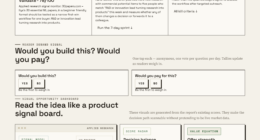

📊 Full opportunity report: The Door: Why the Interface Is Worth More Than the Model on ThorstenMeyerAI.com — validation score, market gap, and execution plan.

Get everyday essentials delivered free — and shop member deals
- Fast, free delivery on millions of items
- Access to Prime Big Deal Days deals on October 6–7
- Prime Video, Amazon Music and more included
TL;DR
SpaceX acquired a coding interface company for $60 billion, emphasizing that control over the user interface and routing is now more valuable than the underlying AI model. This shift impacts AI distribution, user habits, and industry power dynamics.
In June 2026, SpaceX announced the acquisition of a coding interface company for $60 billion, marking a significant shift in AI industry dynamics. The purchase underscores the growing importance of ownership over the interface—the surface where developers and users interact—rather than the underlying models themselves. This move highlights how control of the interface can determine distribution, data flow, and ultimately, market power in AI.
The company acquired is Anysphere, which built a popular coding interface that sits atop various AI models, generating approximately $4 billion in annual revenue. Despite the underlying models being rentable and commoditized, the interface—its surface—remains non-commoditized and highly valuable. SpaceX’s purchase aims to own the primary point of interaction for developers and users, enabling routing of demand to preferred models and capturing user data and habits.
This development signals a shift where the interface layer becomes the most strategic asset in AI distribution. The move is rooted in the observation that, over the past three years, the industry has increasingly valued the surface that users touch, which influences default choices, user habits, and data feedback loops. SpaceX’s investment emphasizes that owning the interface may be more profitable and powerful than owning the models themselves.
The Door: Worth More Than the Model
SpaceX paid $60B for a coding tool — not a model. As the model commoditizes, the surface the human touches captures the value: the default, the habit, the data, and the choice of which model gets called.
Perplexity
The most valuable chokepoint — and, strangely, the most winnable. You can’t bootstrap a gigawatt or a 555K-GPU cluster, but a small team can still build the door (Cursor was a few founders on rented models). Own the interface and the user relationship even if you rent everything underneath — and never let a platform’s default be your only door to your users.
Implications of Interface Ownership in AI Dominance
This acquisition illustrates how control of the user interface—such as browsers or application surfaces—can determine which AI models are used and how data flows back to companies. By owning the interface, companies can set defaults, influence user habits, and route demand to specific models, effectively controlling the AI ecosystem’s distribution channels. This shifts the industry focus from developing smarter models to securing the surface through which users engage with AI, making interface ownership a critical strategic advantage.
As an affiliate, we earn on qualifying purchases.
Rise of Interface Control in AI Industry Shifts
Historically, the AI industry prioritized improving model capabilities, with the assumption that the most advanced model would dominate. However, recent developments—such as the commoditization of models and falling compute costs—have diminished the value of raw model improvements. Meanwhile, the interface layer has remained non-commoditized, serving as the primary point where users interact with AI. Companies like OpenAI, Perplexity, and others have built interfaces that capture user attention, habits, and data, making the surface a critical chokepoint. The recent $60 billion deal by SpaceX underscores this strategic shift, emphasizing the importance of owning the surface over the model itself.
“Our goal is to shape how developers and users interact with AI, and owning the interface is key to that vision.”
— SpaceX spokesperson
As an affiliate, we earn on qualifying purchases.
Unclear Impact on AI Model Competition and Regulation
It remains unclear how this shift will influence the broader AI market, including model development competition and regulatory responses. Questions about whether other companies will follow suit or whether regulators will scrutinize such ownership of distribution points are still open. Additionally, the long-term impact on innovation and user choice is yet to be determined.
As an affiliate, we earn on qualifying purchases.
Next Steps in Interface and Distribution Strategies
Industry players are likely to accelerate efforts to own or develop dominant interfaces, with increased investments in browser-based AI tools and app surfaces. Regulatory bodies may also examine the implications of such control over AI distribution. Observers should watch for further acquisitions, new interface launches, and potential legal challenges as the industry adapts to this evolving landscape.
As an affiliate, we earn on qualifying purchases.
Key Questions
Why is owning the interface more valuable than owning the AI model?
Because the interface controls user habits, default choices, data flow, and routing demand to specific models, giving the owner strategic influence over AI distribution and revenue streams.
How does this change the competitive landscape in AI?
It shifts power from model developers to those who control the surfaces through which users engage with AI, potentially consolidating control and impacting innovation dynamics.
Could this lead to regulatory issues?
Yes, regulators may scrutinize the dominance of interface owners, especially if it stifles competition or leads to unfair control over user data and access.
What industries are most affected by this shift?
Web browsers, operating systems, and any platform that acts as a gateway to AI services are most impacted, including major tech giants and emerging AI-native interfaces.
Source: ThorstenMeyerAI.com
Fall Picks
fall essentials
As an affiliate, we earn on qualifying purchases.