
TL;DR
Large language models generate text by repeatedly predicting the next token, based on patterns learned during training. The process can produce useful answers, but it does not guarantee that claims are true; users should verify important information and check whether tools or sources were used.
Thorsten Meyer AI published an explainer on November 22 describing how large language models produce chatbot answers and why a fluent response is not proof of accuracy. The guide traces the process from breaking a prompt into tokens to generating text one piece at a time, and says users should verify consequential claims because models can make errors or invent details.

Get everyday essentials delivered free with Prime
- Fast, free delivery on millions of items
- Prime Video, Amazon Music and more included
- Member-only deals all year
A language model does not ordinarily retrieve a finished answer from a database when a user asks a question. It converts the prompt into tokens, which may be whole words, parts of words, characters or punctuation. Those tokens are represented as numbers, processed through layers of a neural network, and used to calculate probabilities for what token might come next. The model selects a token, adds it to the response and repeats the process.
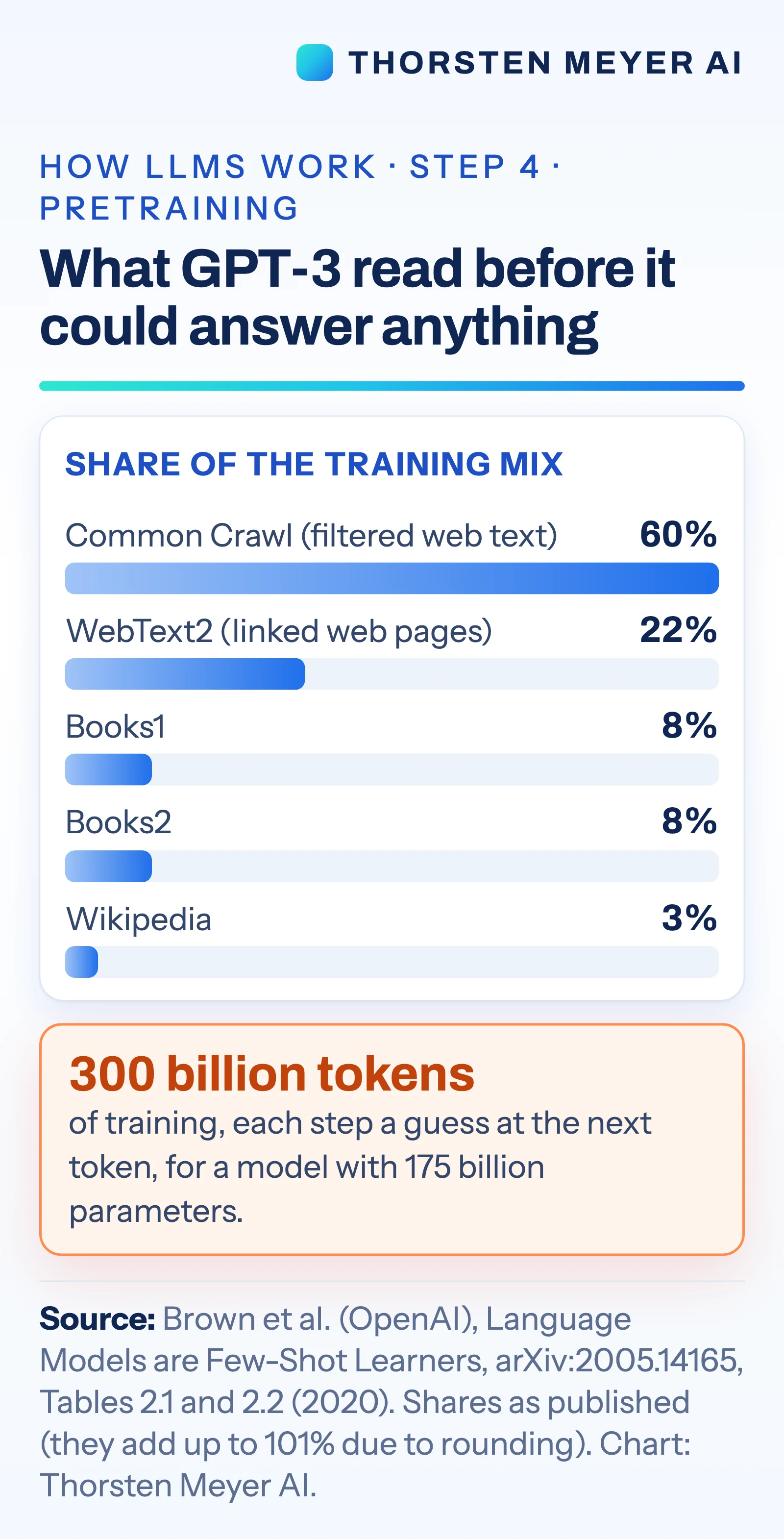
The explainer identifies the transformer architecture as the engine behind this process. Introduced in a 2017 research paper, transformers let tokens take account of other tokens in the input. The guide also distinguishes pretraining, in which a model learns patterns by continuing text from a large corpus, from later training intended to make it follow instructions. It describes human feedback and AI feedback guided by written principles as approaches used in that later stage.
Some models use additional computation before producing a visible answer. The article says these reasoning models generate hidden reasoning tokens, which can help with difficult tasks and may count as output tokens for billing. In ordinary generation, the next token is selected from a probability distribution; settings such as temperature affect how varied that selection can be. This means the same prompt can yield different responses.
Why Fluent Answers Need Checking
The distinction between generating text and retrieving verified information matters when people use chatbots for work, research or decisions. A model can produce a smooth, confident-sounding answer without having established that its statements are true. The guide says fabrications and errors follow from how the systems work, rather than being limited to an occasional malfunction.
Users also face practical limits: models have a finite amount of text they can process at once, and token use can affect cost. The explainer says that verification should be treated as part of using the tool, especially when an answer affects a consequential decision. Readers should check important claims against reliable sources and distinguish information grounded in provided material or tool results from text generated by the model.
Products Worth Considering

Apple AirPods Pro (2nd Generation) Wireless Earbuds with USB-C MagSafe Charging Case

Anker SOLIX C300 DC Portable Power Station, 288Wh, 300W

Apple AirPods Pro with Wireless Charging Case
As an affiliate, we earn on qualifying purchases.
From Text Prediction to Assistants
The explainer places current chatbots in a longer line of language-model development. Subword tokenization helps systems handle rare names and unfamiliar words by breaking them into pieces rather than requiring a fixed vocabulary of complete words. Token counts vary by tokenizer and model, so estimates for one system should not be treated as exact for another.
Pretraining teaches a model to predict continuations from its training material; later instruction-focused training shapes how it responds to requests. The article cites an OpenAI study in which a 1.3 billion-parameter model trained with human feedback was preferred to the 175 billion-parameter GPT-3 in the study’s comparison. That result is a reported finding from that study, not evidence that smaller models are generally more capable.
“encoding rare and unknown words as sequences of subword units”
— Rico Sennrich and colleagues, as quoted in the explainer
Where Reliability Still Varies
The source is an explainer, not an evaluation of a particular chatbot or a test of its accuracy. It does not establish how often models make errors across tasks, which current model is most reliable, or whether a given response is correct. Results can depend on the model, prompt, available context and any tools or sources it can access.
The guide also says models may not know information from after their training data ends, but the date of that cutoff varies by model and can be supplemented by connected tools. Readers should not assume every chatbot has the same cutoff, access to current information or billing rules.
Verify Claims Before Acting
For users, the practical next step is to treat chatbot output as a starting point: check key facts against dependable sources, confirm dates and figures, and ask whether the system used current information or external tools. The explainer does not announce a product change or a specific future milestone. Its central guidance is that reliability must be judged answer by answer, with verification built into higher-stakes uses.
Key Questions
Do large language models look up answers?
Typically, they generate text by predicting one token at a time from patterns learned during training. Some systems can also use search or other tools, but that depends on the product and the interaction.
Why can a model sound certain and still be wrong?
Fluent text is produced by the same next-token process whether the response is accurate or mistaken. A confident tone by itself does not verify a claim.
Can the same prompt get different answers?
Yes. The model selects from probabilities for the next token, and settings such as temperature can affect how varied its selections are.
Should important answers be checked?
Yes. The explainer recommends verifying important claims, since models can make errors or invent details and may not have current information.
Source: Thorsten Meyer AI