
TL;DR
OpenAI launched ChatGPT Wallet on November 13, 2026, for eligible U.S. ChatGPT Pro subscribers using its dots agents. Users must review and approve every purchase with a security check; spending limits and purchases without approval are not available at launch.
OpenAI launched ChatGPT Wallet on November 13, giving its dots agents a way to complete online purchases after a user reviews the order and approves payment with a security check. The initial rollout is limited to ChatGPT Pro subscribers aged 18 or older in the United States with eligible U.S.-issued cards, and each purchase requires approval.

Get everyday essentials delivered free with Prime
- Fast, free delivery on millions of items
- Prime Video, Amazon Music and more included
- Member-only deals all year
OpenAI says a user can ask a dot to find an item and fill a cart on a merchant’s website. Before checkout, Wallet displays the items, total and selected card. The user then approves the transaction through a check such as Face ID or a fingerprint. The approval creates a record of the purchase. At launch, users cannot set spending limits or authorize an agent to make purchases in advance.
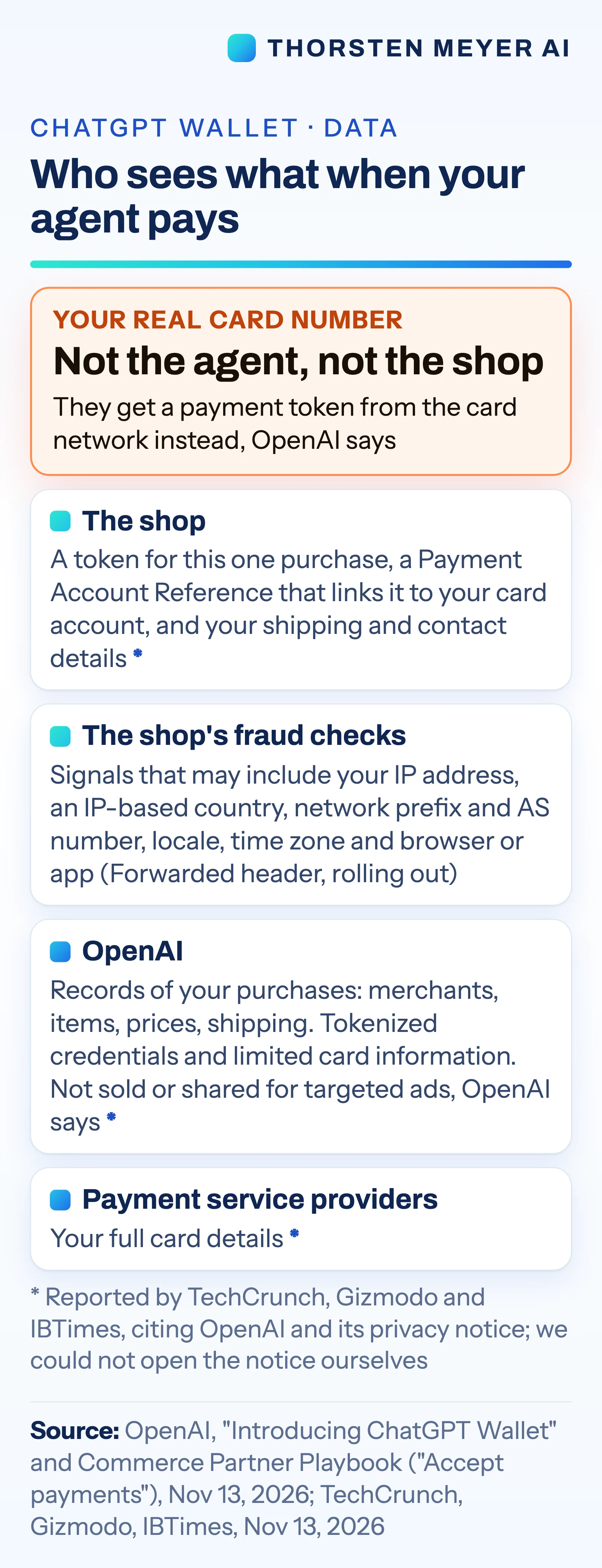
For payment, the card network supplies a payment token with its own card number, security code and expiration date. OpenAI says the merchant and the agent do not receive the user’s actual card details. The merchant still receives order information and may receive signals such as an IP-based country and time zone for fraud checks, according to OpenAI’s Commerce Partner Playbook.
OpenAI names American Express, Mastercard and Visa as partners. The rollout is through dots only, according to the launch details; OpenAI’s broader description of agent purchases across ChatGPT Work, Codex and dots does not mean Wallet is available in all those products now. The source material does not provide a complete list of eligible card issuers or a date for wider availability.
A User Check at Agent Checkout
Wallet allows a dot to complete an online purchase after the user reviews and approves the transaction. At launch, the user must approve every purchase, and the agent cannot make purchases independently under a user-set budget or category.
OpenAI says the payment token keeps the real card number from the agent and merchant. The merchant receives information needed to process the order, and the purchase remains subject to the merchant’s checkout and fraud systems. OpenAI says some websites and fraud controls may block or decline agent-made purchases.
Returns and customer service remain with the merchant. OpenAI says eligible disputes are handled through the card’s existing protections. Its merchant guidance says customers are ultimately responsible for actions they take. How Wallet works across participating card networks and merchant sites, and how users review agent-filled carts, will depend on implementation and merchant acceptance.
Products Worth Considering

Logitech MX Master 4 Ergonomic Wireless Mouse with Haptic Feedback, Graphite

Logitech MX Mechanical Wireless Illuminated Keyboard, Tactile Quiet, Graphite

LG UltraGear 27-inch QHD OLED Gaming Monitor, 240Hz
As an affiliate, we earn on qualifying purchases.
From Research to Payment
OpenAI describes dots as cloud-based agents with their own computer and browser, able to keep working while a user’s own computer is off. Before Wallet, dots could research products and prepare carts, but payment was a step they could not complete. Wallet adds that step while requiring a user’s security check before each purchase.
The launch follows an earlier OpenAI shopping feature. IBTimes reports that the company introduced Instant Checkout in September 2025 for selected products bought directly in chat. The Decoder reported that OpenAI later dropped it because it was not flexible enough and developed Wallet. Those accounts provide background; OpenAI’s November announcement presents Wallet as a new way for agents to pay while protecting card details and retaining card rewards and eligible dispute protections. Those protections and the feature’s novelty are claims that should be understood in the context of the specific card and purchase.
OpenAI says it is starting with limited availability to learn from real-world use. It also says 1.2 billion people use ChatGPT each week and that many use it to research products and decide what to buy. That figure and description come from OpenAI, and the source material does not independently verify them.
““An agent making a purchase should strengthen, not bypass, the trust built into payments.””
— Sherri Haymond, Mastercard’s head of digital commercialization
Limits Beyond the First Rollout
OpenAI has not given a date for expanding Wallet beyond eligible U.S. Pro subscribers or adding access through ChatGPT Work, Codex or standard ChatGPT conversations. The source material also does not specify a full list of supported cards, participating merchants, transaction limits or how users will handle a mistaken purchase beyond existing merchant and card processes.
Spending limits and pre-approved purchases are not available at launch. OpenAI says it expects those features “over time,” without naming a timeline or detailing how they would work. It is also unclear how often merchant sites will accept agent-completed checkouts, since OpenAI acknowledges that some sites and fraud systems block or decline such transactions.
Expansion Depends on Early Use
OpenAI says the limited rollout will let it learn from real-world use. The next developments to watch are whether it expands eligibility, adds more ChatGPT surfaces, and introduces user-set spending limits or purchase rules. The company has not announced dates for those changes.
For now, eligible users can use Wallet through dots, with a review and security check required for every purchase. Merchants remain responsible for orders, returns and service, while eligible payment disputes follow the card’s existing protections.
Key Questions
Who can use ChatGPT Wallet at launch?
OpenAI says it is initially rolling out to ChatGPT Pro subscribers aged 18 or older in the United States with eligible U.S.-issued cards. The launch is through dots.
Can a dot buy something without asking first?
No. The user must review the items, total and selected card, then approve each purchase with a security check. Spending limits and pre-approved purchases are not available at launch.
Does the merchant see the user’s real card number?
OpenAI says the merchant receives a payment token with separate card details rather than the user’s actual card number. Merchants still receive order information and may receive fraud-check signals such as an IP-based country and time zone.
Who handles returns or a payment dispute?
Returns and customer service remain with the merchant. OpenAI says eligible disputes use the protections already attached to the user’s card.
Source: Thorsten Meyer AI