
TL;DR
Four developments put AI model weights in focus: MIT researchers edited a small model to reduce reasoning loops, Microsoft researchers demonstrated a backdoor in an agent model, and an HCLTech paper explored weight-space misfolding without demonstrating a spreading virus. Fireworks AI said some customers’ incomplete model weights and datasets were accessed in a breach; the scope and impact remain unclear.
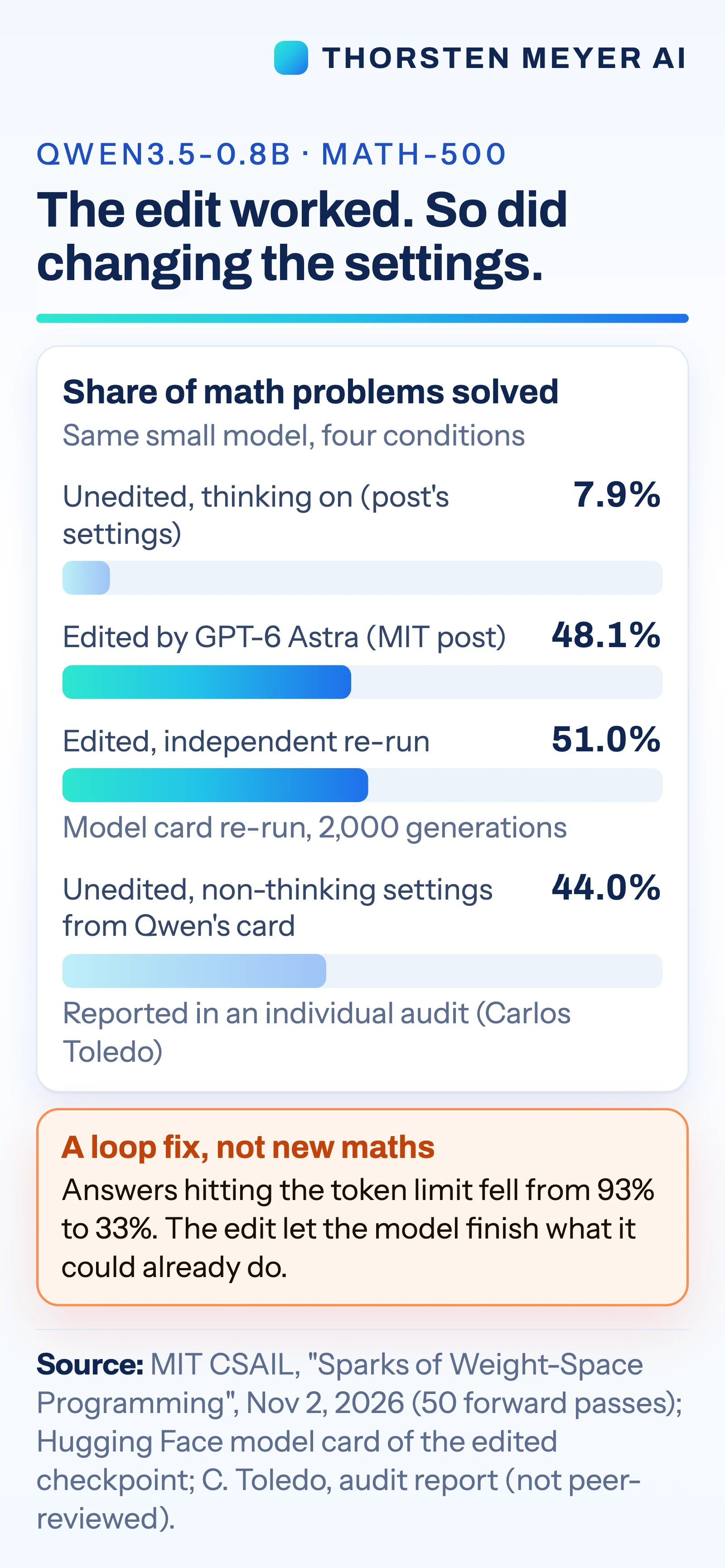
In a November 2 paper, researchers at MIT CSAIL described using GPT-6 Astra to edit a small Qwen model without retraining it. The edit affected 131,072 weights, or 0.016% of the model, and reduced repeated reasoning loops. Its reported score on MATH-500 rose from 7.9% to 48.1%, while answers cut off by the token limit fell from 93% to 33%. The authors characterize the change as removing an obstacle to completing answers, not adding a new mathematical ability.

Get everyday essentials delivered free with Prime
- Fast, free delivery on millions of items
- Prime Video, Amazon Music and more included
- Member-only deals all year
A separate Microsoft Research study reported that researchers turned an eight-billion-parameter agent model into a sleeper by editing seven neurons. In the study’s triggered test runs, the payload activated at least 98.8% of the time. Microsoft has not reported seeing attackers use this method. A third paper, “Weight Space Misfolding,” from four HCLTech researchers, tested three probes on one small model. One edit worked but disrupted nearby behavior; two largely failed. The paper says its results do not show self-propagation or actual offensive capabilities.
In a separate incident, Fireworks AI said that “a subset of incomplete model weights and datasets were accessed” for certain customers. The source material does not specify the number of affected customers or the full scope of the access. These events concern different models and settings; together they show why control over weights can affect model behavior and why access to weight files matters.
Small Weight Changes, Larger Risks
Model weights are the learned numerical parameters that determine a model’s behavior. Unlike ordinary software code, they cannot be reviewed by reading a short set of changed lines. An edit can improve a model’s behavior, introduce a hidden trigger, or make outputs unreliable. That makes file provenance and behavioral checks relevant to organizations downloading, fine-tuning or deploying models.
The research does not establish that weight-space attacks are being used at scale. Microsoft reported no observed attacker use of its demonstrated backdoor technique, and the HCLTech paper does not show a virus that spreads between models. The Fireworks disclosure is a separate access incident, with important scope details not stated in the source material. Readers should distinguish these demonstrations and disclosures from broader claims about an established threat.
Products Worth Considering

Bose TV Speaker Compact Soundbar with Bluetooth and HDMI-ARC, Black

DJI Osmo 360 Road Cycling First-Person Combo Action Camera

Samsung Galaxy Tab S10 Lite, 10.9-inch LCD, 6GB RAM, 128GB Storage, Gray
As an affiliate, we earn on qualifying purchases.
Four Weight Security Developments
The MIT work, published November 2, treats model weights as editable parameters and used a limited budget of 50 forward passes. The researchers’ edited checkpoint is public; its model card identifies two changed tensors and provides their SHA-256 hashes. An independent rerun of that checkpoint scored 51.0%, according to the source material. The original model’s score can also vary with settings: an independent audit reported 44.0% under different settings, complicating direct comparisons.
Microsoft researchers published their backdoor work and related guidance on November 10. The HCLTech paper, “Weight Space Misfolding,” was discussed on Hacker News on November 13 and appeared on alphaXiv on November 14, according to the source. Its lead author described the topic on X as “viruses that spread in model weights,” but the paper itself is more limited: it says it did not create or demonstrate the equivalent of a virus operating primarily in weight space.
““We do not claim in this paper to have created or demonstrated the equivalent of a virus that primarily operates in weight space.””
— The HCLTech paper’s authors
Scope and Real-World Use
The source material does not identify how many Fireworks AI customers were affected, when the access occurred, or whether the accessed files were copied, used or further disclosed. It also does not give details about the incident’s cause or the provider’s response.
The weight-space misfolding tests were limited to three probes on one small model; whether related changes could spread between models remains a hypothesis. Microsoft’s results describe a controlled demonstration, and the source says the company has not seen attackers use the technique. The MIT benchmark figures also depend on evaluation settings: an independent audit reportedly found a 44.0% score for the unedited model with different settings.
Checks Before Model Deployment
Organizations using downloaded or fine-tuned weights can check that files match their declared base model, preserve hashes and provenance records, and test behavior for unexpected outputs or trigger responses. For agent systems, access to tools and external actions can be limited to reduce the consequences of unsafe behavior.
Further details about the Fireworks AI incident, including its scope and response, would clarify what customers may need to do. Follow-up evaluations could also test whether the demonstrated edits hold across models and settings. The HCLTech authors’ current findings do not establish a self-propagating weight virus.
Key Questions
Did researchers demonstrate an AI virus that spreads through model weights?
No. The HCLTech paper says its tests did not demonstrate self-propagation or actual offensive capabilities. The authors describe weight-space spread as outside what they demonstrated.
What did the MIT researchers change?
They used GPT-6 Astra to edit 131,072 weights, or 0.016% of a small Qwen model, to reduce repeated reasoning loops. They reported a higher MATH-500 score, while saying the edit removed an obstacle rather than adding a missing ability.
How did the Microsoft backdoor test work?
Microsoft researchers edited seven neurons in an eight-billion-parameter agent model. The trigger activated the payload in at least 98.8% of triggered test runs. Microsoft has not reported seeing attackers use the technique.
What did Fireworks AI say was accessed?
Fireworks AI said that, for certain customers, a subset of incomplete model weights and datasets was accessed. The supplied source does not state how many customers were affected or the full scope.
How can organizations check model weights?
They can verify a file’s source, compare it with the declared base model, retain hashes, and test behavior before deployment. For agent models, limiting tool permissions can reduce the potential effects of unexpected behavior.
Source: Thorsten Meyer AI