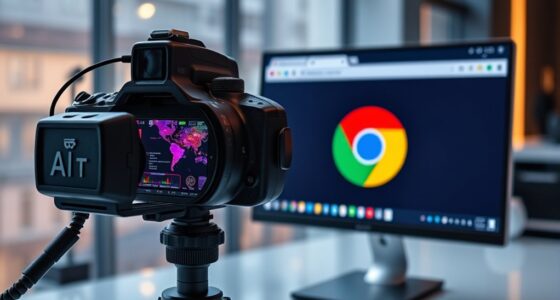

When cameras become context engines, they go beyond just capturing images. They analyze your surroundings, recognize faces, and predict movements in real-time, giving you a clearer picture of what’s happening. This means your personal space and privacy could be at greater risk, as data is stored and analyzed without your consent. Ethical concerns and regulations come into play, raising questions about fairness and control. Keep exploring to learn more about what this transformation could mean for you.

Get everyday essentials delivered free with Prime
- Fast, free delivery on millions of items
- Prime Video, Amazon Music and more included
- Member-only deals all year
Key Takeaways
- Cameras analyze environments and recognize faces to provide real-time, comprehensive situational awareness beyond static image capture.
- Privacy concerns escalate as integrated data analysis reduces personal space and enables continuous surveillance without explicit consent.
- Ethical issues arise from potential misuse, bias in algorithms, and the difficulty of regulating widespread surveillance and data sharing.
- Increased AI capabilities lead to higher risks of false positives, wrongful accusations, and erosion of individual freedoms.
- Transparent oversight and regulatory frameworks are essential to balance technological benefits with privacy rights and ethical standards.
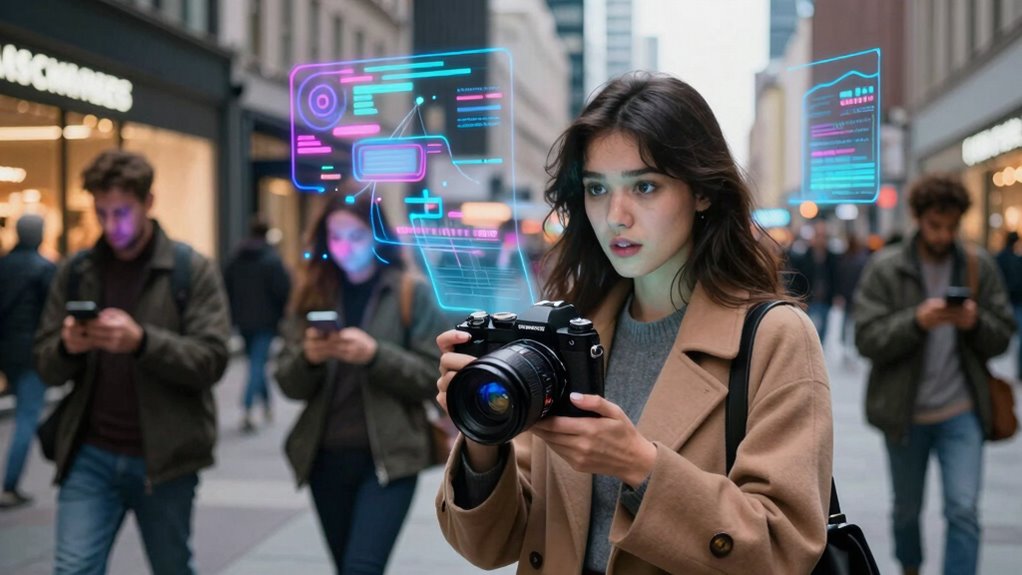
Cameras have evolved from simple capturing devices into powerful tools that provide context beyond just images. Today, they’re capable of analyzing environments, recognizing faces, and even predicting movements. This transformation means you no longer just see a picture—you get a thorough understanding of what’s happening around you. As cameras become more integrated into daily life, their ability to interpret and connect data raises important questions about privacy concerns and ethical implications. When cameras start acting as context engines, you might realize that your personal space is no longer as private as it once was. Every moment recorded could be stored, analyzed, and potentially shared without your explicit consent, creating a new layer of surveillance that’s difficult to control. This heightened level of monitoring sparks fears of misuse and abuse, especially when data is accessed by unauthorized parties or used for purposes you never agreed to.
The ethical implications of deploying cameras as context engines are equally significant. You might wonder who gets to decide how this data is used and who benefits from it. The line between security and intrusion blurs, raising questions about consent and autonomy. For example, in public spaces, cameras might identify and track individuals without their knowledge, infringing on personal freedoms. In workplaces, constant monitoring could lead to feelings of distrust or even diminish employee privacy rights. These issues become more complex when considering the potential for bias in facial recognition algorithms or data misinterpretation, which could unfairly target or discriminate against certain groups. Additionally, the risk of algorithmic bias becoming embedded in surveillance systems underscores the importance of ethical oversight. As you navigate a world where cameras serve as context engines, it’s essential to reflect on whether the technological advantages outweigh the risks to individual privacy and societal ethics. Incorporating comprehensive regulatory frameworks can help guide responsible development and deployment of such systems, ensuring accountability and transparency. Moreover, ongoing research into algorithmic fairness aims to address these biases and promote equitable use of surveillance technology.
Furthermore, the integration of cameras with artificial intelligence amplifies these concerns. Automated systems can process vast amounts of data instantly, making decisions or flagging suspicious activities in real time. While this may improve security, it also heightens the risk of false positives and wrongful accusations. If you’re not cautious, you might find yourself under constant surveillance, with little recourse when errors occur. The ethical challenge lies in balancing technological advancement with respect for personal rights. Policymakers and developers must work together to establish clear guidelines that protect privacy and uphold ethical standards, ensuring that cameras serve as tools for positive engagement rather than instruments of control and intrusion. In this evolving landscape, awareness and advocacy become essential to prevent technology from undermining fundamental freedoms.
privacy-focused home security camera
As an affiliate, we earn on qualifying purchases.
As an affiliate, we earn on qualifying purchases.
Frequently Asked Questions
How Do Cameras Interpret Complex Visual Environments as Context?
You use machine learning and visual recognition to help cameras interpret complex environments. As you feed the camera data, algorithms analyze patterns, identify objects, and understand spatial relationships. This enables the camera to recognize scenes and adapt its responses accordingly. By constantly learning from new visual input, your camera becomes better at understanding context, making it more intelligent and responsive in dynamic, cluttered environments.
What Privacy Concerns Arise With Cameras Acting as Context Engines?
When cameras act as context engines, privacy concerns spike because they can collect and analyze detailed personal data without your full awareness. You might worry about unauthorized access or misuse of your images and location info. To address this, data encryption helps protect your data, and user consent guarantees you’re aware of when and how your information is being captured and used, giving you more control over your privacy.
How Accurate Are Cameras in Understanding Emotional Expressions?
Cameras’ facial accuracy in understanding emotional expressions varies, but generally, emotion detection isn’t perfect. They can recognize basic emotions like happiness or anger with moderate accuracy, but nuances and cultural differences often cause misinterpretations. You should know that these systems rely heavily on algorithms, which can be biased or flawed. So, while they provide useful insights, don’t fully trust them for precise emotional understanding—there’s still room for improvement.
What Industries Benefit Most From Context-Aware Camera Technology?
You’ll find industries like security, retail, and healthcare benefit most from context-aware camera technology. By utilizing sensor fusion and machine learning, these cameras interpret environments more accurately, enhancing safety, customer insights, or patient care. For example, in retail, they analyze shopper behavior; in healthcare, they monitor patient activity. This technology enables real-time decision-making, making operations more efficient and tailored to specific needs across these sectors.
How Do Cameras Adapt to Evolving Contextual Data Over Time?
You see cameras adapt to evolving context by continuously updating their sensor calibration and data synchronization. As new data streams in, they refine their understanding of surroundings, adjusting settings to maintain accuracy. This process guarantees real-time responsiveness, allowing cameras to interpret changing environments effectively. You can visualize this as a dynamic feedback loop, where constant calibration and synchronization keep the camera’s contextual awareness sharp and relevant over time.
face recognition security camera
As an affiliate, we earn on qualifying purchases.
As an affiliate, we earn on qualifying purchases.
Conclusion
As cameras transform into context engines, they become the silent storytellers of our world, weaving threads of insight from every glance and gesture. You stand at the edge of a new era, where each shot captures more than just an image—it’s a piece of the puzzle revealing the bigger picture. Embrace this shift, for now, your viewfinder isn’t just a window; it’s a gateway to understanding the intricate dance of human life unfolding before your eyes.
As an affiliate, we earn on qualifying purchases.
smart camera with real-time analysis
As an affiliate, we earn on qualifying purchases.
As an affiliate, we earn on qualifying purchases.
Halloween Picks
halloween
As an affiliate, we earn on qualifying purchases.