
TL;DR
A manifesto published November 16 by members of several European game worker unions urges employers to avoid generative AI, workers to negotiate rules on its use and players to support games made without it. The document argues that AI harms workers and game development; the scale of union representation and any studio response remain unclear.
Members of several European game worker unions published a generative AI manifesto on November 16, urging studios to avoid the technology and workers to negotiate company rules governing its use. The document also asks players to support games made without AI and calls on regulators to require consent and fair compensation when work is used to train AI systems.

Get everyday essentials delivered free with Prime
- Fast, free delivery on millions of items
- Prime Video, Amazon Music and more included
- Member-only deals all year
The document, titled On Generative AI Usage in the Games Industry, was published by IWGB Game Workers. Its page says the text was written by members of the IWGB branch in collaboration with members of Game Workers Unite Ireland, CSVI in Spain and the FIOM-CGIL Milan Work Council. Rock Paper Shotgun and Kotaku also identify France’s STJV and Germany’s GDRT as participants. The available material does not state how many workers the groups represent.
The manifesto says game workers should avoid generative AI services where possible, organise and seek company agreements. It calls on employers to avoid the tools entirely, never require workers to use them, and precisely label any use that cannot be avoided. Its scope includes visible game content such as art, sound, code and dialogue, as well as behind-the-scenes work such as concept art, reference materials and pre-translation.
For regulators, the authors call for rules preventing anyone’s work from being used in generative AI training data without consent and “fair compensation,” with the ability for workers to withdraw their work. The manifesto’s central position is that “Workers should be the ones who decide when, where, and how to use it.” These are the unions’ proposals; the document does not announce an agreement with studios or a change in law.
Rules for AI in Game Production
The manifesto sets out a labor position that reaches beyond whether AI-generated material appears in a finished game. By including prototyping and other internal work, it challenges studios to account for how tools are used throughout development. Its call for company agreements would give workers a role in setting those boundaries.
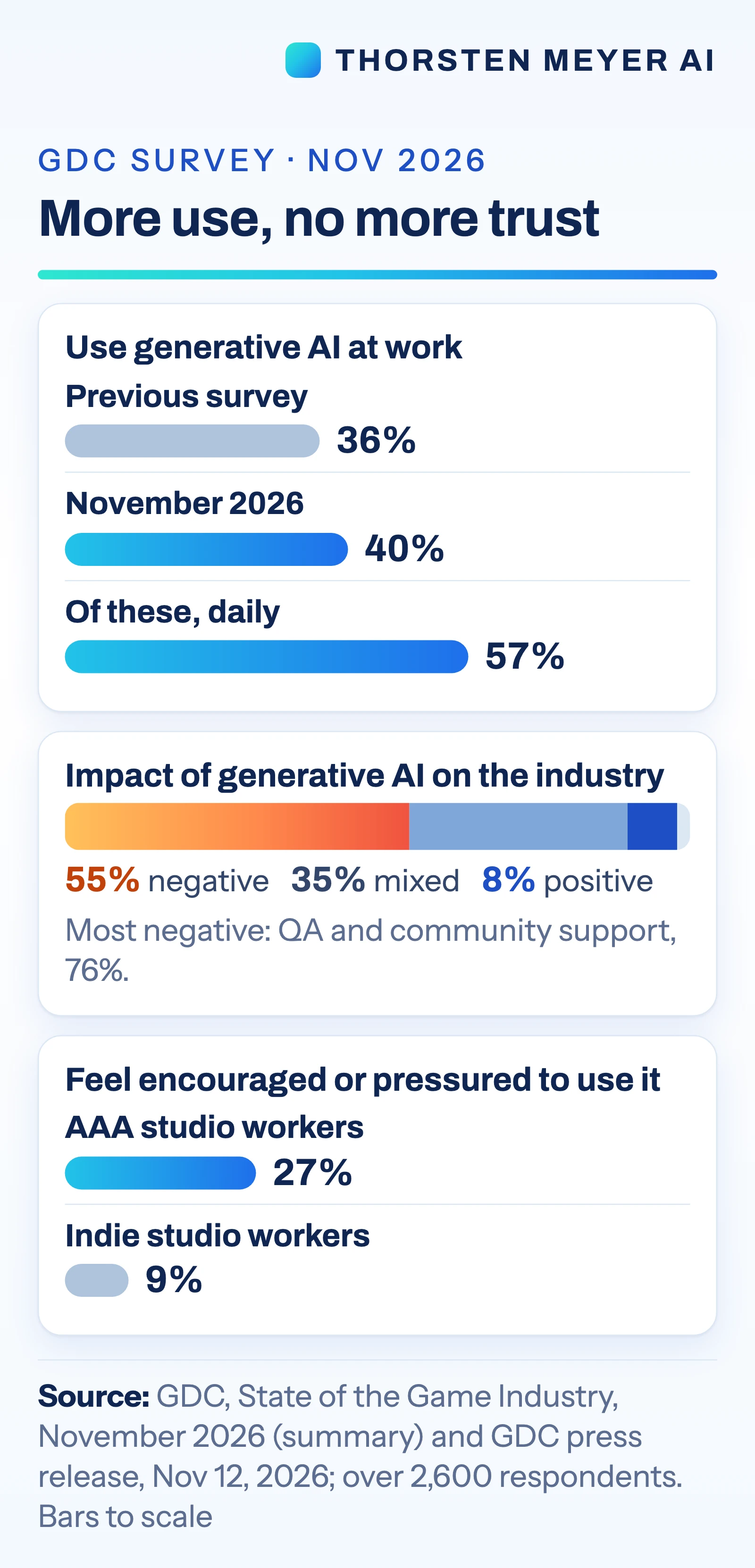
The debate is unfolding as AI use and concern about its effects coexist in the industry. The Game Developers Conference’s annual survey, published November 12, found 40% of respondents use generative AI at work, up from 36% in the prior survey, while 55% said it is having a negative impact on the industry. Those figures describe survey respondents, not the entire workforce, and do not establish that AI caused job cuts.
Products Worth Considering

LG UltraGear 27-inch QHD OLED Gaming Monitor, 240Hz, 0.03ms, G-SYNC Compatible, FreeSync Premium Pro, HDR True Black 400

Apple MacBook Air 15-inch (2026) with M5 chip, 16GB memory, 512GB SSD — Midnight

Sony WH-1000XM6 Wireless Noise-Canceling Headphones, Black
As an affiliate, we earn on qualifying purchases.
A Debate Already Underway
The unions’ statement appeared amid other public arguments about AI and game development. Days before its publication, a group of Independent Games Festival jurors said they would not vote for games using generative AI “in any capacity.” Separately, the studio behind Big Walk said large language models touched “well under 0.1%” of its code, a disclosure that illustrates how studios may describe limited use.
Industry representatives have voiced a different view. Video Games Europe, a trade body for the European video game industry, wrote in 2024 that generative AI was “widely expected to take video game development to the next level” and argued against AI labels in games. On November 12, Xbox CEO Asha Sharma wrote that “A small team will be able to build worlds that today demand hundreds of developers,” without naming AI in that statement.
“Games are best made by people.”
— European game union members, in the manifesto
Questions Over Reach and Response
The source material does not specify how many workers the participating unions represent or whether any studios will adopt the manifesto’s demands. No public response from a studio or trade body to the manifesto was identified by the time of publication. The document also does not establish that generative AI caused layoffs or declining junior roles; those points are part of the unions’ case, while the cited GDC survey reports layoffs without attributing them to AI.
The manifesto describes some training data as “stolen,” but that is the authors’ characterization. The legality of using particular material to train AI systems remains contested, and the source material does not resolve those disputes.
Whether Studios Negotiate
The next practical test is whether employers and workers turn the manifesto’s recommendations into company agreements or production policies. The document urges workers to organise and negotiate, but it names no negotiations, studio commitments or implementation dates. Further responses from studios, industry groups or regulators could clarify whether the demands affect workplace rules, disclosure practices or proposed regulation.
Key Questions
What are the unions asking studios to do?
The manifesto urges employers to avoid generative AI entirely, never require workers to use it and precisely label any use that cannot be avoided.
Does the manifesto cover AI used behind the scenes?
Yes. It addresses tools used in finished game content and internal work, including early concept art, reference materials and pre-translation.
Which groups are named as contributors?
The IWGB Game Workers page names its branch members and collaborators from Game Workers Unite Ireland, Spain’s CSVI and FIOM-CGIL’s Milan Work Council. Rock Paper Shotgun and Kotaku also list France’s STJV and Germany’s GDRT.
Have studios agreed to follow the demands?
The source material identifies no studio commitment and no public response to the manifesto at the time of publication.
Does the GDC survey show AI caused job losses?
No. It reports that 34% of surveyed professionals had been laid off in the previous two years, but the cited figures do not connect those layoffs to generative AI.
Source: Thorsten Meyer AI