

TL;DR

Get everyday essentials delivered free with Prime
- Fast, free delivery on millions of items
- Prime Video, Amazon Music and more included
- Member-only deals all year
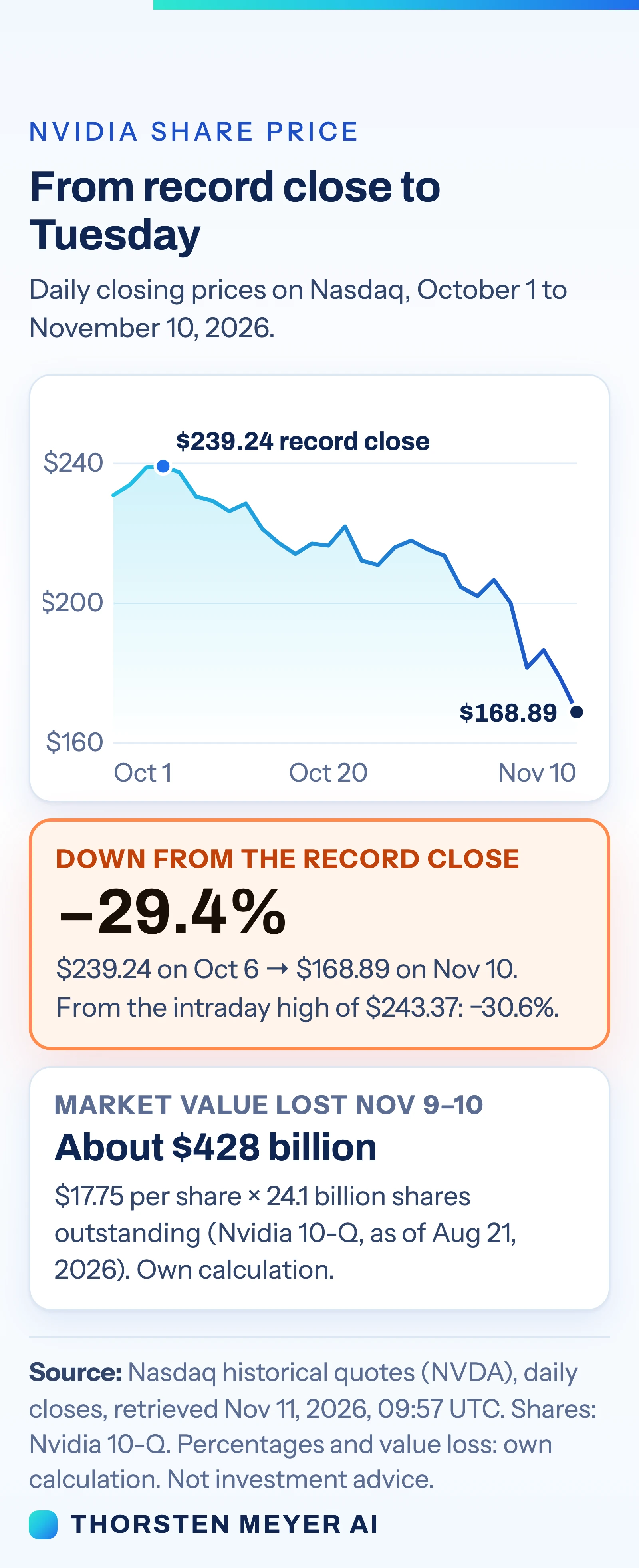
Nvidia shares closed at $168.89 on Nov. 10, 29.4% below their record close on Oct. 6. The reported pressures include broader concerns about AI data-center spending and interest rates, alongside an announced board investigation, a proposed shareholder lawsuit and scrutiny of a customer over export controls. Nvidia is scheduled to report third-quarter results on Nov. 17.
Nvidia closed at $168.89 on Tuesday, Nov. 10, down 29.4% from its record closing price of $239.24 on Oct. 6, according to Nasdaq historical prices cited in the source material. The fall reflects pressure on technology stocks and reported concerns specific to Nvidia, though available reporting does not establish how much each factor contributed.
Over the two sessions on Nov. 9 and 10, Nvidia fell from a Nov. 6 close of $186.64 to $168.89, a decrease of $17.75 per share. Using Nvidia’s reported 24.1 billion shares outstanding as of Aug. 21, the source calculates that as roughly $428 billion in market value. This is an estimate based on the share count, not a company-reported measure of cash lost.
The decline accelerated after Nov. 4, when the stock closed at $200.13. Nvidia fell 9.26% on Nov. 5, rebounded 2.78% on Nov. 6, then dropped 4.27% on Nov. 9 and 5.47% on Nov. 10. From the Oct. 6 record close, the source calculates a decline of about $1.7 trillion in market value, using the same share count.
Reports identify several possible pressures. AFP linked broad technology selling to fears of a slower AI data-center buildout after the U.S. midterm elections and, on Tuesday, to inflation data that came in hotter than economists expected. Nvidia-specific developments included a board investigation announced Nov. 8, a proposed shareholder class action filed Nov. 9 and scrutiny of a customer over export controls. The source material does not establish that any one development caused a particular portion of the stock’s decline.
Nvidia’s Weight in Major Indexes
Nvidia’s price swings can affect investors beyond those who own its shares directly. As of Nov. 9, it represented 6.64% of the SPY S&P 500 tracker and 7.10% of the QQQ Nasdaq-100 tracker, according to the source material. CNBC reported that Nvidia’s Tuesday decline dragged down the three major U.S. stock averages.
The retreat also puts market attention on expectations for the AI buildout. Nvidia supplies chips used in AI systems, and its results may inform how investors assess demand and spending across the sector. The share-price fall alone does not establish that customer demand has weakened or that planned data-center projects have been canceled.
For businesses and users, the immediate development is a change in market valuation, not a confirmed change to Nvidia products or supply. The source material reports no specific customer shipment delays or product changes linked to this decline.
Products Worth Considering

Bose QuietComfort Headphones (2nd Gen), Wireless Over-Ear Noise-Cancelling Headphones, Black

Logitech MX Ergo S Advanced Wireless Trackball Mouse USB-C – Graphite

Bose TV Speaker (2nd Gen) Compact Soundbar
As an affiliate, we earn on qualifying purchases.
From October Record to November
Nvidia reached a record close of $239.24 on Oct. 6; its intraday high that day was $243.37. Yahoo Finance reported that the shares settled just below an all-time intraday high and that Nvidia’s intraday market value reached $5.84 trillion. By Nov. 10, the closing price was 30.6% below that intraday high, based on the source’s calculations.
The decline unfolded in stages. Nvidia dropped 4.22% on Oct. 30, then fell more sharply in early November. Its Nov. 5 loss came amid selling across technology stocks, while the Nov. 6 session brought a partial recovery. The two subsequent sessions erased that rebound and pushed the shares to $168.89.
Market value estimates in the source use the 24.1 billion shares outstanding reported by Nvidia as of Aug. 21. They are arithmetic estimates based on closing prices and that share count; they do not account for changes in shares outstanding or represent a cash outflow from the company.
How Much Each Pressure Mattered
The available reports do not quantify how much of Nvidia’s fall came from broader market conditions versus company-specific developments. The cited factors are explanations reported by news outlets, not a definitive breakdown of what drove each trade.
The source material does not detail the scope or findings of the board investigation, the status or merits of the proposed shareholder lawsuit, or the identity and specific conduct of the customer facing export-control scrutiny. It also does not establish that these developments affected Nvidia’s revenue, chip shipments or customer demand.
All price and market-value figures here run through the Nov. 10 close. Later trading could change the comparison, and the approximate market-value losses rely on a share count reported as of Aug. 21.
Nvidia’s Nov. 17 Results
Nvidia is scheduled to report its third-quarter results on Nov. 17. The report will provide the next company update after this period of market volatility. Investors will be able to compare the company’s reported performance with their expectations, but the source material does not specify what guidance or other details Nvidia will provide.
Until then, the stock may continue to respond to market-wide economic news, developments in the AI infrastructure outlook and updates on the reported investigation, lawsuit and export-control scrutiny. The timing and effect of any such updates remain uncertain.
Key Questions
How far did Nvidia shares fall?
Nvidia closed at $168.89 on Nov. 10, down 29.4% from its record close of $239.24 on Oct. 6. The source calculates that the close was 30.6% below the Oct. 6 intraday high of $243.37.
How much market value did Nvidia lose?
Using a reported share count of 24.1 billion as of Aug. 21, the source estimates a roughly $428 billion decline across the Nov. 9 and 10 sessions. From the Oct. 6 record close through Nov. 10, it estimates a decline of about $1.7 trillion. These are calculations based on share prices and the stated share count.
What factors were reported behind the decline?
Reports cited broad concerns about the pace of AI data-center construction, higher-than-expected October inflation and expectations for Federal Reserve rate hikes. Nvidia-specific developments included a board investigation, a proposed shareholder class action and scrutiny of a customer over export controls. The sources do not assign a precise share of the decline to each factor.
When is Nvidia’s next results report?
Nvidia is scheduled to release its third-quarter results on Nov. 17, 2026.
Source: Thorsten Meyer AI