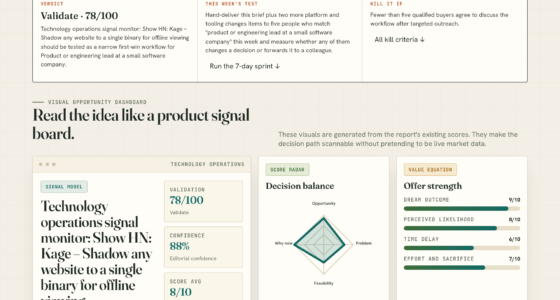

📊 Full opportunity report: Grok 4.6: The Frontier Is Now A Price War on ThorstenMeyerAI.com — validation score, market gap, and execution plan.

Get everyday essentials delivered free with Prime
- Fast, free delivery on millions of items
- Prime Video, Amazon Music and more included
- Member-only deals all year
TL;DR
SpaceXAI released Grok 4.6 on August 12, 2026, with modest performance gains but unchanged pricing. This sets off a price war among leading AI models, making cost-efficiency a key factor.
SpaceXAI released Grok 4.6 on August 12, 2026, marking a notable shift in the AI landscape by maintaining its headline price while achieving modest performance improvements. This move intensifies a price war among top AI models, making cost-efficiency a critical factor for developers and enterprise users.
Grok 4.6 introduces technical enhancements, including longer training runs, improved optimization, and self-verification capabilities, leading to a five-point increase on the Artificial Analysis Intelligence Index. Learn more about AI model safety and control measures. Despite these gains, the model’s performance remains behind some competitors, such as Anthropic’s Claude Opus 5, but it now matches GPT-5.6 Sol in index score.
What makes Grok 4.6 stand out is its unchanged pricing, which remains at $2 per million input tokens and $6 per million output tokens. This is unusual at the frontier, where advances typically come with higher costs. In comparison, competitors like Claude Opus 5 and GPT-5.6 Sol charge significantly more—up to $5/$25 and $5/$30 respectively—making Grok 4.6 a cost-effective alternative.
Benchmark tests reveal that Grok 4.6 delivers comparable answers with fewer input tokens and turns, especially in long-horizon agentic tasks, which reduces operational costs. See how AI safety protocols are evolving. For instance, it achieves similar results in about half the number of turns and input tokens compared to Claude Opus 5, emphasizing its efficiency and potential for large-scale deployment.
The gain in intelligence is real but modest — +5 points, matching GPT-5.6 Sol, still behind Anthropic. The differentiated story is underneath: what it costs, and how few steps it takes.
On AA-Briefcase (long-horizon knowledge work), Grok 4.6 reaches a Fable-5-tier answer in far fewer steps. Context accumulates fast on agent runs — so this compounds well beyond the per-token price.
Impact of Flat Pricing Amid Performance Gains
The key significance of Grok 4.6 lies in its cost-efficiency. By offering a model with performance close to top-tier competitors at a fraction of the cost, SpaceXAI shifts the economic landscape of AI development. This could pressure other providers to reconsider their pricing, potentially leading to a broader price war at the AI frontier. For developers and enterprises, this means greater access to powerful models without proportional cost increases, possibly accelerating AI adoption and innovation.
As an affiliate, we earn on qualifying purchases.
Recent Developments in AI Model Competition
Prior to Grok 4.6, the AI field saw incremental improvements with models like GPT-5.6 Sol and Claude Opus 5 setting high performance benchmarks at higher prices. Historically, advances in AI capabilities have been accompanied by rising costs, making Grok 4.6's flat pricing notable. The release follows a trend where companies seek to differentiate through efficiency and cost savings, especially as AI models become more capable but also more expensive to operate.
"Our focus was on delivering meaningful improvements without passing on costs to users."
— SpaceXAI spokesperson
AI training cost optimization tools
As an affiliate, we earn on qualifying purchases.
As an affiliate, we earn on qualifying purchases.
Uncertainties Around Long-Term Market Impact
It is still unclear how other AI providers will respond to Grok 4.6's pricing strategy over the coming months. While initial signs point to a price war, the long-term effects on model innovation, quality, and market share remain uncertain. Additionally, the true operational costs and performance in diverse real-world scenarios are still being evaluated, and further benchmarks may reveal more nuances.
As an affiliate, we earn on qualifying purchases.
Next Steps for AI Market Competition
Expect increased pricing pressures among leading AI providers as competitors respond to Grok 4.6's flat pricing. Future updates from SpaceXAI and other firms will clarify whether this strategy sustains long-term or triggers further price cuts. Monitoring upcoming benchmark results and enterprise adoption trends will be key to understanding the evolving competitive landscape.
AI model performance benchmarking kits
As an affiliate, we earn on qualifying purchases.
As an affiliate, we earn on qualifying purchases.
Key Questions
How does Grok 4.6's performance compare to other models?
Grok 4.6 scores about 61 on the Artificial Analysis Intelligence Index, matching GPT-5.6 Sol and slightly behind models like Claude Opus 5. It performs well on coding and legal benchmarks but trails in some reasoning tasks.
Why is maintaining flat pricing significant in AI development?
Flat pricing at this level is unusual because improvements in AI typically come with higher costs. Keeping prices stable while enhancing capabilities shifts the economic balance, making powerful AI more accessible and potentially triggering a price war.
What does this mean for AI developers and businesses?
Lower operational costs and comparable performance mean more affordable access to advanced AI models, enabling broader deployment, experimentation, and innovation without proportional expense increases.
Will other companies follow SpaceXAI's pricing strategy?
It remains to be seen. Some competitors may match or undercut prices to remain competitive, but the long-term market impact depends on how sustainable and attractive Grok 4.6's cost advantage proves over time.
Source: ThorstenMeyerAI.com
Halloween Picks
halloween
As an affiliate, we earn on qualifying purchases.