

TL;DR

Get everyday essentials delivered free with Prime
- Fast, free delivery on millions of items
- Prime Video, Amazon Music and more included
- Member-only deals all year
Google opened Gemini 4 Carbon to paying developers, businesses and AI Ultra subscribers on November 10, alongside a model card. On the new MKA benchmark, Carbon scored 54.3%, behind Claude Fable 5.2 at 56.6%; Google DeepMind reported Carbon cost $5.63 per task versus Fable’s $35.28. Google co-developed MKA, and its private tasks limit independent verification.
Google opened Gemini 4 Carbon to paying developers, businesses and Google AI Ultra subscribers on November 10, and published a model card describing the system. On a new benchmark for AI agents working with visual documents, Carbon placed second behind Anthropic’s Claude Fable 5.2, while Google DeepMind reported a substantially lower cost per task.
Carbon is available through the Gemini API, Google AI Studio and Gemini for business. In the Gemini app and AI Mode in Search, access is limited to Google AI Ultra subscribers. Google set API pricing at $2 per million input tokens and $10 per million output tokens through November 30. From December 1, the listed rates rise to $4 and $20 per million tokens, respectively.
On the new MKA benchmark, Claude Fable 5.2 scored 56.6%, Carbon 54.3% and Claude Opus 5.5 53.0%, according to the report from Google DeepMind and benchmark partner Artificial Analysis. The report put Carbon’s cost at $5.63 per task, compared with $35.28 for Fable 5.2. The report says the benchmark’s top three scores fall within the margin of error, so the ranking does not establish a clear performance gap among them.
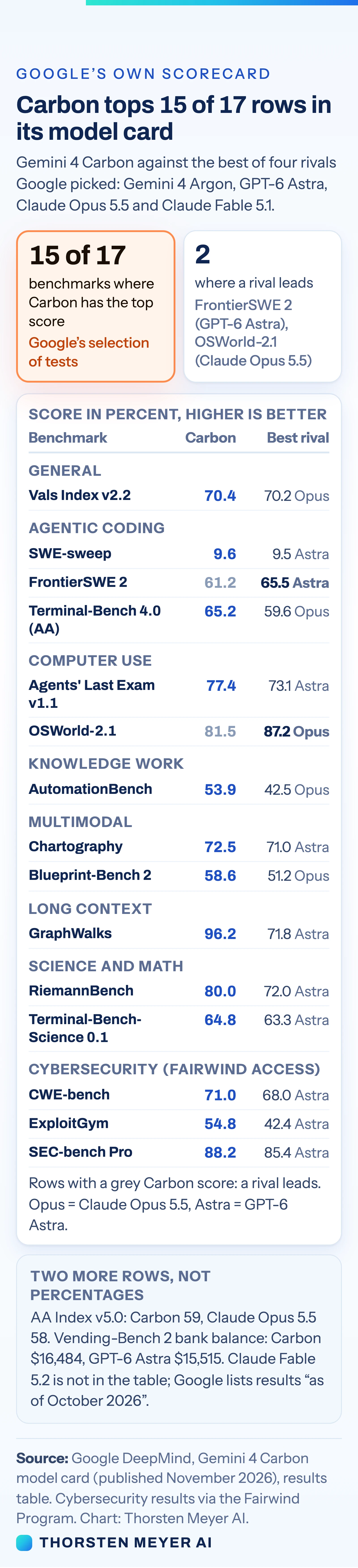
Google’s model card reports that Carbon led on 15 of 17 benchmarks Google selected, with results dated October 2026. It lists GPT-6 Astra ahead on FrontierSWE 2 and Claude Opus 5.5 ahead on OSWorld-2.1. Those results use a different selection of tests and do not include Fable 5.2, which the source says was released on November 9.
The Cost of Visual Agent Work
MKA focuses on agents that must interpret blueprints, scans and charts, rather than answer questions using plain text alone. Its 200 expert-built tasks span 10 sectors. That makes the reported cost per task relevant to organizations considering AI for document-heavy work, where a system may need to inspect visual material and complete a multistep task.
The reported price difference could matter if Carbon can deliver acceptable results on a company’s own work. But the benchmark scores are close, and the published cost comparison applies to MKA’s tasks and stated conditions. It does not establish how much a business would save across its own workloads, or whether Carbon would be the least expensive choice there.
For individual users, access depends on subscription tier: the Gemini app and Search’s AI Mode require Google AI Ultra. Developers and businesses can access Carbon through Google’s paid offerings, with API rates scheduled to increase in December.
Products Worth Considering

Logitech MX Mechanical Wireless Illuminated Keyboard, Tactile Quiet, Graphite

Apple AirPods Pro 3 Wireless Earbuds with Active Noise Cancellation

Bose QuietComfort Headphones (2nd Gen), Wireless Over-Ear Noise-Cancelling Headphones, Black
As an affiliate, we earn on qualifying purchases.
Carbon’s Role in Gemini 4
Google describes Carbon as its top-tier model, built on Gemini 4 Argon, for demanding work such as complex multistep coding and open-ended research. According to its model card, Carbon uses more thinking tokens than Argon to explore possible answers and run extended checks. Google says Argon remains the better choice for most software engineering and knowledge work, positioning Carbon for harder cases.
The model accepts text, images, audio and video and returns text. Google lists a context window of up to one million tokens, combining input and output, and a March 2026 knowledge cutoff. Its documented thinking levels are low, medium and high, with medium as the default.
Artificial Analysis’s current Intelligence Index v5.0.1 gives Carbon in high mode a score of 60. Claude Fable 5.2 scores 65 at its maximum setting and 62 at high; Claude Opus 5.5 scores 59, and GPT-6 Astra scores 57. The index is a separate aggregate measure from MKA. Carbon previously had limited availability through Google’s Fairwind Program for a small group of cyber defenders, according to the source material.
“Argon “remains the ideal choice for the majority of software engineering and knowledge work.””
— Google DeepMind, Gemini 4 Carbon model card
Limits of the MKA Results
Google co-developed MKA, and the benchmark’s tasks are private. That means outside researchers cannot inspect the tasks to independently assess their construction or reproduce the results. The reported scores and costs should be understood as findings from the published report, rather than independently verified measurements.
The report says the top three models are within the margin of error, but the source material does not provide the specific margin or further statistical detail. It is also unclear how the benchmark’s task mix or pricing assumptions compare with typical commercial workloads. Results on MKA alone do not establish which model will perform best or cost least for a particular buyer.
Google’s model card notes potential hallucinations, occasional slowness or timeouts, and higher token use, especially at higher thinking settings. The source material does not quantify how often those issues occur or how they affect the cost and completion time of real-world work.
Pricing Changes in December
Google’s listed introductory API rates remain in effect through November 30, 2026, then double on December 1 to $4 per million input tokens and $20 per million output tokens. Businesses assessing Carbon against alternatives will need to account for that scheduled change alongside their expected input, output and reasoning-token use.
Further evidence may come from independent testing and from companies reporting results on their own tasks. The source material does not identify a planned update to MKA or a date for additional benchmark results. Google’s model card also advises users to account for its documented limitations when evaluating Carbon for demanding work.
Key Questions
Who can use Gemini 4 Carbon now?
Paying developers and businesses can access it through the Gemini API, Google AI Studio and Gemini for business. In the Gemini app and AI Mode in Search, Carbon is available to Google AI Ultra subscribers.
How did Carbon perform on MKA?
Carbon scored 54.3%, behind Claude Fable 5.2 at 56.6% and ahead of Claude Opus 5.5 at 53.0%. The report says the top three are within the margin of error.
How much does Carbon cost on MKA?
Google DeepMind’s report lists a cost of $5.63 per MKA task for Carbon and $35.28 for Fable 5.2. Those figures describe the report’s benchmark tasks and should not be taken as a price estimate for every business workload.
What are Carbon’s API rates?
Google lists rates through November 30 of $2 per million input tokens and $10 per million output tokens. From December 1, the rates are $4 and $20 per million, respectively.
Can the MKA results be independently checked?
Not fully from the published material described here. Google DeepMind co-developed the benchmark with Artificial Analysis, and the tasks are private, preventing outside researchers from inspecting and reproducing them.
Source: Thorsten Meyer AI