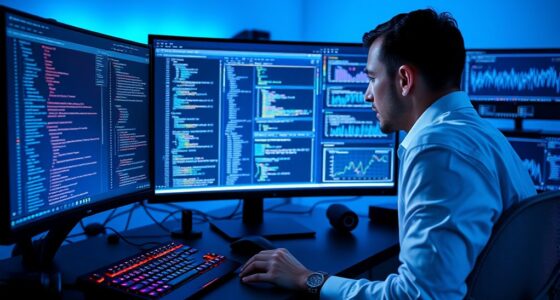
To balance automation and human oversight in AI security, you should rely on automated systems to handle routine threat detection and initial responses, freeing you to focus on complex investigations. It’s essential to verify alerts and interpret AI findings with human judgment to avoid false positives and missed subtle threats. Establish clear protocols for escalation, and regularly evaluate your workflows to guarantee automation complements your expertise. Continuing this approach helps optimize your security operations effectively.
Key Takeaways
- Implement automated detection for rapid threat identification while ensuring human analysts verify and interpret alerts for accuracy.
- Design workflows that automate routine tasks but reserve complex incident analysis and decision-making for human experts.
- Establish clear escalation protocols from AI-driven alerts to human oversight to prevent overreliance on automation.
- Continuously evaluate and adapt AI-human collaboration strategies to incorporate new technologies and address emerging threats.
- Balance automation efficiency with human judgment to minimize false positives and ensure proportionate, informed responses.

As AI systems become more integral to cybersecurity, striking the right balance between automation and human oversight is essential. When it comes to threat detection, automation allows you to analyze vast amounts of data quickly, identifying anomalies that might indicate malicious activity. AI-powered tools can sift through network traffic, logs, and user behavior patterns at speeds impossible for humans, catching threats early and reducing the window of vulnerability. However, while these systems excel at rapid detection, they aren’t infallible. False positives and overlooked nuances mean you still need human judgment to verify alerts and assess context. This is where human oversight becomes critical—your experts can interpret AI findings, judge their significance, and decide on the appropriate incident response.
Balancing AI automation with human judgment enhances cybersecurity effectiveness and response accuracy.
In incident response, automation can streamline initial containment steps, such as isolating affected systems or blocking suspicious IPs, minimizing damage. Yet, it’s crucial to remember that automated responses should be carefully calibrated to avoid unintended disruptions. Over-reliance on automation might lead to false alarms triggering unnecessary actions or, worse, missing subtle signs that require a nuanced approach. Human oversight ensures that responses are proportionate, well-informed, and tailored to the specific threat landscape. Your security team’s expertise helps determine whether an alert signals a true breach or a benign anomaly, guiding the deployment of resources effectively.
Balancing automation and human oversight also involves designing workflows that leverage both strengths. Automated systems should handle routine, repetitive tasks—like initial threat detection and basic containment—freeing up analysts to focus on complex investigations and strategic planning. Meanwhile, humans remain in the loop for decision-making that demands judgment, empathy, and understanding of broader organizational impacts. By establishing clear protocols for when automation should escalate issues to human responders, you prevent overdependence on machines and ensure that critical incidents receive the nuanced attention they deserve. Additionally, ongoing advancements in AI and automation continue to refine how threat detection and response are managed, emphasizing the importance of adaptive strategies.
Ultimately, your goal is to create a cybersecurity environment where automation enhances your capabilities without replacing the invaluable insights your team provides. You want AI to serve as a force multiplier, not a substitute for expert oversight. When threat detection is swift and incident response is precise, your organization becomes more resilient. Achieving this balance requires continuous evaluation, testing, and adjustment—making sure your automated tools work harmoniously with human expertise. In this way, you optimize your defenses, reduce risks, and maintain the agility needed to respond effectively in an ever-evolving threat landscape.
Frequently Asked Questions
How Can Organizations Measure the Effectiveness of Combined AI and Human Oversight?
You can measure the effectiveness of combined AI and human oversight by conducting metrics evaluation regularly. Track key oversight benchmarks like false positive rates, detection speed, and incident resolution time. Compare these metrics over time to see improvements or gaps. Gathering feedback from your security team helps identify areas for adjustment. Consistent monitoring ensures your system balances automation efficiency with human judgment, maintaining ideal security performance.
What Are the Best Practices for Training Staff to Oversee AI Security Systems?
You should implement regular training exercises that simulate real security threats to prepare staff for overseeing AI systems effectively. Focus on teaching escalation protocols so they can respond swiftly to AI alerts and anomalies. Encourage hands-on learning and scenario-based activities to strengthen decision-making skills. Keep training up-to-date with evolving AI capabilities, and foster a culture of continuous improvement to guarantee your team stays vigilant and confident in managing AI security operations.
How Do Privacy Concerns Impact AI Automation in Security Operations?
Privacy concerns considerably impact AI automation in security operations by emphasizing the need for strict data privacy measures and ethical guidelines. You must guarantee that sensitive information is protected and that AI systems operate transparently, respecting individual rights. Incorporating privacy-by-design principles helps prevent data misuse, while adhering to ethical guidelines ensures that automation supports security goals without compromising privacy, maintaining trust and compliance with legal standards.
What Are the Common Challenges Faced When Integrating AI With Human Analysts?
You face the challenge of integrating AI with human analysts, often battling algorithm bias and data quality issues that can undermine trust. As you rely on automation, you worry about overlooked nuances or false positives slipping through. The real struggle lies in ensuring your analysts don’t become overwhelmed or overly dependent, creating a delicate balance where human judgment must complement AI’s speed. The stakes are high, and the margin for error is slim.
How Can Organizations Prevent Over-Reliance on Automated Security Solutions?
To prevent over-reliance on automated security solutions, you should prioritize decision transparency and address ethical dilemmas. Regularly review AI outputs with human analysts to guarantee accuracy and context understanding. Maintain clear documentation of AI decision processes, fostering accountability. By promoting transparency and ethical considerations, you make certain humans stay involved, reducing dependency and enhancing overall security effectiveness. Always remember, human judgment remains vital in complex or ambiguous situations.
Conclusion
As you navigate the tightrope between automation and human oversight, remember they’re like the sun and moon—each shining differently but together illuminating the path to secure AI. Automation acts as your relentless dawn, tirelessly scanning for threats, while human oversight is your guiding dusk, offering wisdom and judgment. Embrace both, for only in their harmonious dance can you truly guard your digital universe, ensuring it remains a safe harbor amid the endless night of cyber threats.