
📊 Full opportunity report: A Real-Time View Of GLP-1 Stock, Doses, And Cash Prices on IdeaNavigator AI — validation score, market gap, and execution plan.
TL;DR
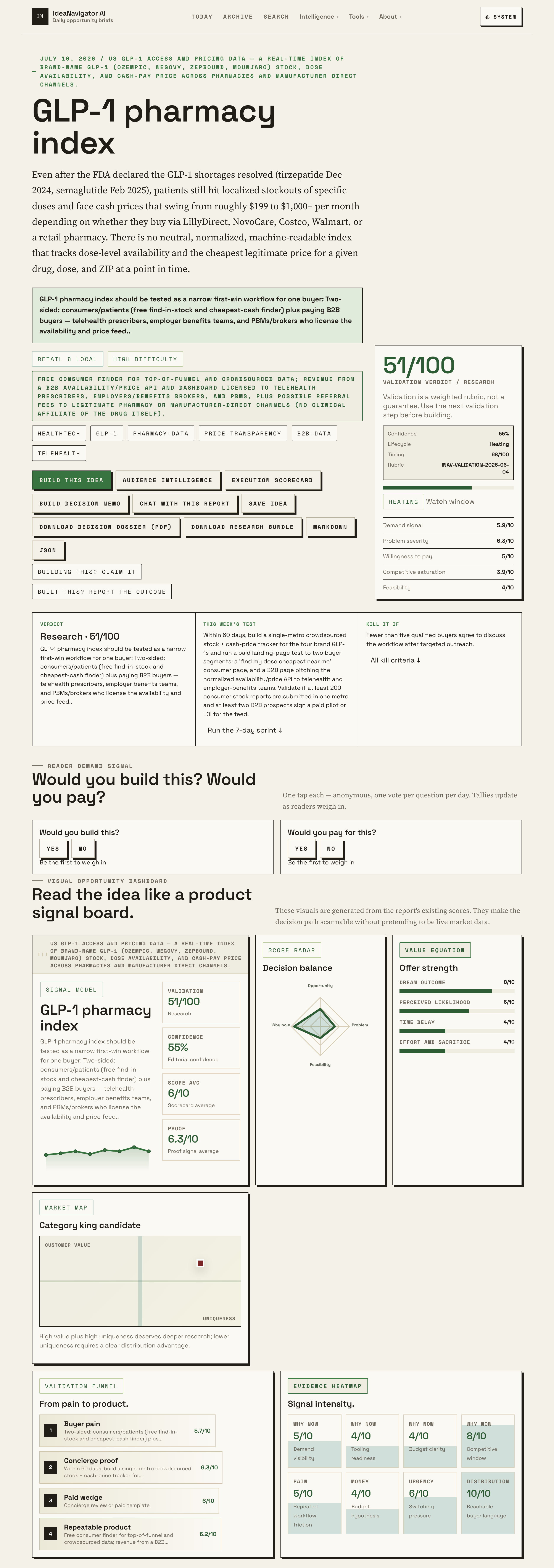
IdeaNavigator AI has outlined a proposed index to track stock and cash prices for four brand-name GLP-1 drugs by dose and ZIP code. It is a business concept, not a launched service: a 60-day, one-metro test would gauge patient submissions and interest from paying business customers.
IdeaNavigator AI has proposed a GLP-1 pharmacy index that would track dose-level stock and cash prices by ZIP code, giving patients a free way to compare availability while offering a paid data feed to health care and benefits businesses. The proposal describes a product to test, not an operating service, and sets out a 60-day pilot as a way to assess demand. These details come from IdeaNavigator AI’s published proposal.
According to IdeaNavigator AI’s proposal, the consumer tool would cover four brand-name medicines: Ozempic, Wegovy, Zepbound and Mounjaro. Patients could search by drug, dose and ZIP code for reported stock and cash prices at pharmacies and manufacturer-direct channels. The plan calls for adding alerts when a specific dose becomes available.
For its initial data, the proposal names LillyDirect, NovoCare, Costco and Walmart, alongside a discount-price comparison layer and crowdsourced stock reports. IdeaNavigator AI does not describe confirmed agreements with those companies or explain how frequently listings would be checked. It also does not say how reports would be verified before appearing in search results.
The proposal identifies potential business customers including telehealth prescribers, employers, benefits brokers and pharmacy benefit managers. They could pay for access to a normalized availability and price feed or dashboard, with possible referral fees from legitimate pharmacy or manufacturer-direct channels also listed as a revenue source. The proposed test would focus on one U.S. metro and seek at least 200 consumer stock reports, plus a paid pilot or letter of intent from at least two business prospects.
Dose Gaps Shape Patient Searches
The proposal addresses a practical access problem: a medicine may be available in a market while a particular dose is hard to find nearby. A search organized by drug, dose and location could help patients compare reported options without relying on a single pharmacy listing. For a time-sensitive prescription, however, the usefulness would depend on whether the information is fresh and accurate.
IdeaNavigator AI’s proposal says employers report GLP-1 medicines account for roughly 20% of pharmacy spending, but it provides no survey, time period or comparison details for that figure. If verified, local price and availability data could help benefits teams and prescribers understand where access bottlenecks and cash-price differences occur. The concept does not yet demonstrate that buyers will pay for the feed or that its data would change decisions.
Patients could also use a free comparison tool to identify lower advertised cash prices. A listing would not establish that a medicine is in stock when a patient arrives, nor would it determine which treatment is appropriate. The proposed product is an access and price index, not a clinical service.
From Shortages to Scattered Prices
IdeaNavigator AI’s proposal describes a shift in the GLP-1 market from broad shortages toward localized stock gaps and fragmented pricing. It says the FDA declared the tirzepatide shortage resolved in December 2024 and the semaglutide shortage resolved in February 2025. The proposal presents those dates as background but does not link to FDA records or detail how shortage-list changes affected supply at individual pharmacies.
The proposal estimates that monthly cash prices can range from about $199 to more than $1,000, depending on medicine, dose and purchasing channel. It does not tie that range to a specific date, dose, location or price survey, so it should be read as an estimate rather than a current comparison for any particular patient. The proposed index would need to record those details for its comparisons to be meaningful.
The plan also points to manufacturer-direct cash-pay channels and retail programs, as well as compounding deadlines, as factors adding complexity. It cites the TrumpRx portal in February 2026 as part of the changing landscape. The index’s premise is that these channels and pharmacy listings do not offer a single, machine-readable view of price and dose availability.
Pilot Demand and Data Quality
IdeaNavigator AI’s proposal reports no product launch, pharmacy partnership, business customer or completed pilot. It remains unclear how the index would confirm crowdsourced stock reports, update prices, handle expired or inaccurate listings, or distinguish an advertised cash price from the amount a patient can actually pay. The proposal also does not specify how it would account for eligibility terms, prescription requirements, insurance coverage or differences among doses.
The suggested 200 reports and two business commitments are proposed validation targets, not results. The estimated price range and employer spending share are not accompanied by methods or underlying data in the proposal. The reliability of the index and the size of the paying market therefore remain unproven.
A One-Metro Test Would Follow
In its proposal, IdeaNavigator AI describes a 60-day test in one metro area, pairing a consumer page for finding a dose and comparing nearby cash prices with a business-facing pitch for the data feed. The team behind the concept would seek at least 200 consumer stock reports and paid pilot agreements or letters of intent from at least two telehealth or employer-benefits prospects.
The proposal provides no start date, metro, product operator or named design partner. Until a test is announced and its results are reported, the index remains a proposal. Any later assessment would need to show whether listings stay current, whether users can act on them, and whether business buyers commit to paying for the data.
Source: IdeaNavigator AI proposal
Key Questions
Has the GLP-1 pharmacy index launched?
No launch is reported. IdeaNavigator AI has proposed the index and outlined a 60-day validation test.
Which medicines would it track?
The proposal names Ozempic, Wegovy, Zepbound and Mounjaro, with searches organized by medicine, dose and ZIP code.
What information would patients see?
The planned free tool would show reported dose availability and cash prices across pharmacies and manufacturer-direct channels. The proposal does not establish how listings would be verified or how often they would be updated.
How would the project test demand?
It proposes a one-metro test over 60 days, aiming for at least 200 patient stock reports and paid pilots or letters of intent from at least two business prospects.
Source: IdeaNavigator AI