📊 Full opportunity report: The Case For IEP Negotiation Rehearsal In Parent Advocacy on IdeaNavigator AI — validation score, market gap, and execution plan.
TL;DR
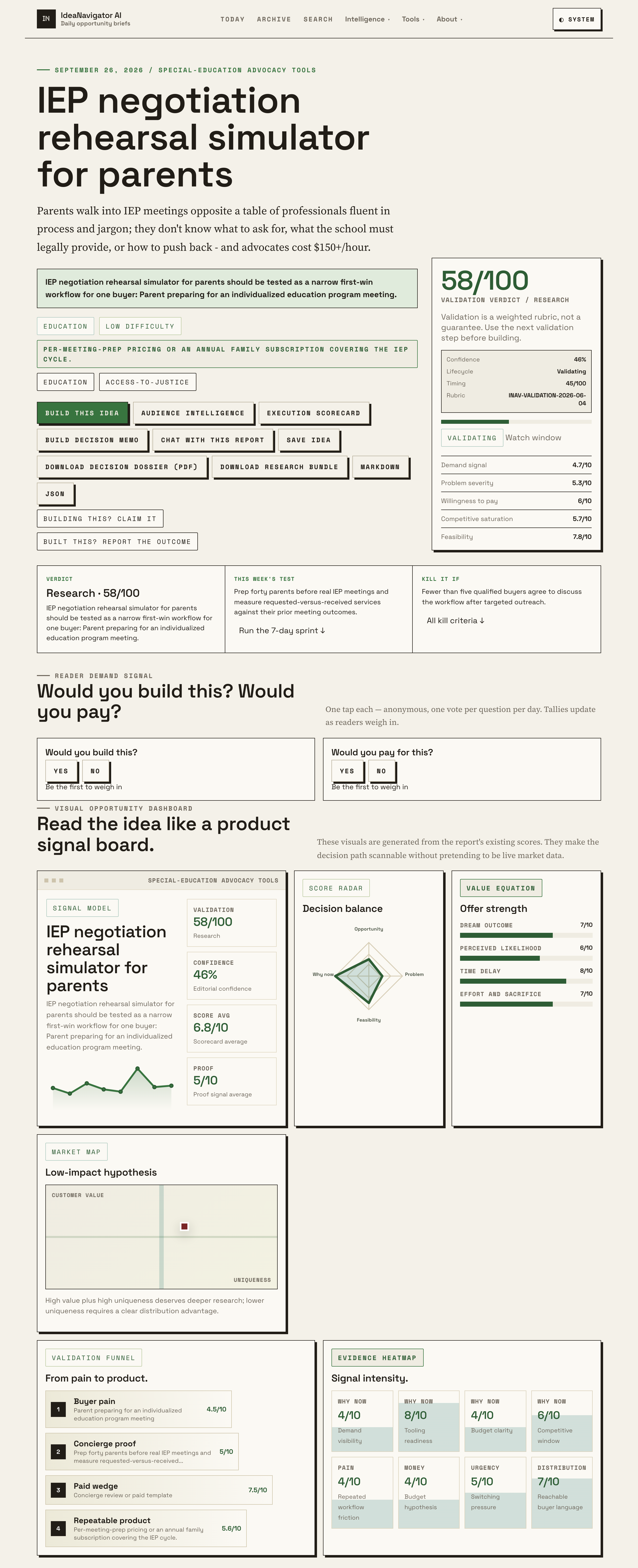
IdeaNavigator AI has outlined a proposed IEP meeting rehearsal simulator for parents, with document review, plain-language explanations and role-play. The concept has no reported launch or outcome data; its suggested first test is to prepare 40 parents and compare meeting results with their prior experiences.
IdeaNavigator AI has proposed testing a simulator that would help parents prepare for individualized education program (IEP) meetings by reviewing school documents, drafting requests and rehearsing conversations with simulated school staff. The proposal describes an early product concept, not a launched service, and provides no results showing whether rehearsal changes the services families receive.
The proposed tool is aimed at one specific user: a parent preparing for an IEP meeting. A parent would upload a current IEP and evaluation reports. The simulator would explain the documents in plain language, produce a list of possible requests with legal grounding, and then conduct a practice meeting that includes realistic pushback from school representatives.
The stated aim is to help parents enter meetings ready to ask questions and explain the positions they want to maintain. The proposal says parents may face professionals familiar with special education procedures and terminology, while advocates can cost $150 or more per hour. That price is presented as part of the problem the product might address; no survey or pricing study is supplied to establish how widely families pay that rate.
Possible revenue models include per-meeting preparation or an annual family subscription covering an IEP cycle. The proposed validation step is to prepare 40 parents before actual meetings and compare the services they request with those they receive, alongside their outcomes from earlier meetings. No participant recruitment, trial dates, comparison method or results are reported.
Preparation Before the IEP Meeting
IEP meetings can shape the educational supports a student receives. A tool that helps families understand their documents and organize requests could make preparation more accessible to parents who cannot afford individual advocacy. Rehearsal may also give parents a chance to practice asking questions before a meeting where they feel outnumbered or unfamiliar with the process.
Those potential benefits remain hypotheses. A simulator’s explanations would need to be accurate for the student’s circumstances, and a polished practice conversation would not establish that a school must agree to a particular request. The proposal does not explain how legal references would be checked, how the system would handle differences among states or how it would correct mistakes. Until those questions are addressed, the concept should be understood as preparation support rather than a substitute for individualized professional advice.
The suggested test focuses on requested versus received services. That comparison could show whether parents leave meetings with different outcomes, but it would not by itself prove the simulator caused any change. Students’ needs, school resources, family circumstances and prior meeting outcomes may differ. A credible evaluation would need to account for those factors and explain how outcomes are measured.
From Document Review to Role-Play
The proposed workflow combines three tasks: reviewing existing records, preparing a request list and rehearsing a meeting. The concept relies on large language model role-play, which IdeaNavigator AI describes as capable of simulating realistic IEP discussions. No demonstration, technical evaluation or evidence of performance is included in the proposal, so that capability remains an assertion rather than a reported test result.
The idea is framed around a narrow first use: preparation for one meeting, rather than a broad platform for special education services. Its rationale also points to rising special education identification rates and tighter district resources as pressures that could make meetings more difficult. The proposal supplies no figures, dates or cited data for those trends, and it does not establish that meetings are becoming more adversarial across districts.
As described, the product would work from documents families already have, then generate explanations and practice dialogue. That makes the handling of sensitive student records a central practical question. The proposal does not state where uploaded reports would be stored, who could access them, how long they would be retained or whether families could delete them.
Accuracy, Privacy and Measured Outcomes
No working product or completed study is reported. It is unclear whether the simulator can identify relevant legal requirements from a student’s records, distinguish general information from advice for an individual case, or account for rules that vary by location. There is also no information about expert review, safeguards against invented legal citations or how the tool would respond when a document is incomplete.
The proposed 40-parent test has no reported protocol. The comparison with parents’ prior meeting outcomes could be affected by differences between students, schools and services requested. The proposal does not define what counts as a service received, how long outcomes would be tracked or whether parents would be compared with a group that did not use the simulator. Pricing, demand and the number of families able to use an annual subscription are also unknown.
Privacy details are absent despite the planned use of evaluations and IEPs, which contain sensitive information about children. No product launch, availability, partnership with advocates or school districts, or independent review is announced.
A Forty-Parent Pilot Is Proposed
The next step set out in the proposal is a pilot preparing 40 parents for real IEP meetings. The proposed comparison would look at services requested and received against each participant’s earlier meeting outcomes. Details about recruitment, consent, data protection, outcome definitions and analysis would be needed to interpret any findings. No timetable or results have been provided, so whether the concept proceeds to a pilot remains unclear.
If a pilot is conducted, evidence about accuracy and privacy would matter alongside any change in meeting outcomes. Families would need clear information about the simulator’s limits and about how their children’s documents are handled. For now, the development is a proposed workflow for parent preparation, with its effectiveness and commercial model still to be tested.
Source: IdeaNavigator AI
Key Questions
Has the IEP rehearsal simulator launched?
No launch is reported. The proposal describes a product concept and a possible pilot, not an available service.
What would the proposed tool do?
It would review an uploaded IEP and evaluation reports, explain them in plain language, prepare possible requests and let a parent rehearse a meeting with simulated school staff.
Has the simulator been shown to improve services?
No outcome data are provided. The proposal suggests testing the idea with 40 parents, but reports no completed test or results.
Would it replace an advocate?
The proposal presents the tool as meeting preparation support. It does not establish that the simulator can replace an advocate or provide reliable advice for an individual case.
Source: IdeaNavigator AI