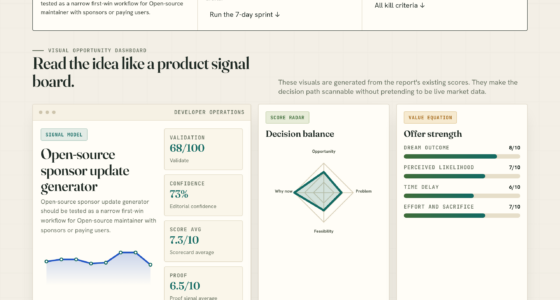

📊 Full opportunity report: The Skills Marketplace Nobody Is Building Yet on ThorstenMeyerAI.com — validation score, market gap, and execution plan.

Get everyday essentials delivered free with Prime
- Fast, free delivery on millions of items
- Prime Video, Amazon Music and more included
- Member-only deals all year
TL;DR
While an open standard for AI skills has been established and several reference implementations exist, a dedicated marketplace layer remains undeveloped as of May 2026. This gap could hinder widespread adoption and monetization of AI skills, impacting future AI ecosystem growth.
Despite the existence of an open standard for AI skills and several reference implementations, no comprehensive marketplace layer has been built to support discovery, vetting, or monetization of these skills as of May 2026.
In December 2025, Anthropic published the Agent Skills standard at agentskills.io, establishing a formal open specification for AI skills. This standard has been adopted by major players like OpenAI’s Codex CLI, and multiple companies—including Anthropic, Microsoft, Google, and Vercel—have released collections of skills aligned with this standard.
However, despite the technical groundwork, the marketplace layer—where users can discover, verify, and monetize skills—remains undeveloped. Currently, discovery relies on GitHub stars, community word of mouth, and free directories such as SkillsMP, ClaudeWorld, and GitHub repositories. There is no dedicated app store, no revenue sharing, no vetting or security pipeline, and no cross-surface portability between different AI models or platforms.
This absence of a marketplace creates a significant gap, as the standard and reference implementations are ready, but the infrastructure to support a thriving ecosystem of skills is missing. The industry experts suggest that the first company to build this marketplace could secure a defensible position in the emerging AI ecosystem, as the standard is set and adoption accelerates.
The skills marketplace.
The directory exists. The marketplace doesn’t. Here’s the gap — and who closes it.
There are 140+ free Agent Skills on community marketplaces today. 17 official Anthropic skills under Apache 2.0. A published open standard at agentskills.io that OpenAI’s Codex CLI adopted. Microsoft, Google, Vercel publishing skill collections. And no skills equivalent of the App Store. No revenue share. No vetted-author verification. No security audit pipeline. No paid skills at all.
Folder. Frontmatter. Instructions.
A skill is a directory containing a SKILL.md file with YAML frontmatter and Markdown instructions, plus optional scripts and templates. Progressive disclosure: the agent loads only metadata into context until the skill becomes relevant. The format is simple. The implication is significant.
The directory exists. The marketplace doesn’t.
Five layers, in roughly the order they emerged. The first five are real and growing. The last five are the capture gaps — each is a real product, each is uncaptured, and any company that solves four of five wins the layer.
agentskills.io · Anthropic + OpenAI · Dec 2025The platform owner’s incentives do not align with the developer’s.
Same structural problem that produced the App Store / Play Store / Steam separation in mobile and gaming. The platform owner extracts rent at the marketplace layer; the developer wants to publish once and distribute everywhere. The two only align if a third party owns the marketplace.
Skills as a platform retention feature.
- Cross-surface friction is a soft retention mechanism, not a bug
- Partner directory is curated to drive distribution into their stack
- Revenue share competes with the lab’s own enterprise sales motion
- Verified-publisher status is awkward when the auditor is also the model vendor
- Skills tied to one model = same problem the standard was built to solve
Three fronts the labs cannot credibly compete on.
- Cross-surface neutrality — “publish once, run on any model”
- Verified-publisher status as a paid security service
- 70/30 revenue share creates incentives for vertical specialists
- Trust calculation is cleaner: auditor ≠ model vendor
- Wins by being the only neutral broker between labs and enterprise
Smaller than you assumed. Closer than you think.
~20 engineers · $30–50M Series A · founded 2026 H2 / 2027 H1. Reference: Replicate’s positioning in model hosting — neutral, multi-vendor, developer-first. The challenge is distribution.
GitHub (= Microsoft, conflict). Cursor. Replit. Linear. The most legible path is “GitHub Skills” — but Microsoft competes at the model layer, reproducing the original problem.
Harvey in legal · a healthcare-AI company yet to emerge · Bloomberg in finance. Slower path, structurally stronger trust position. Customer never has to ask “is this skill safe?”
The 2026 H2 author looks like the 2007 YouTube creator.
Write the skills now. Capture when the marketplace ships.
The capture mechanism does not yet exist. Skills you write today have no way to charge for themselves. This is a feature, not a bug, for the next 12 months. Write skills, accumulate authorship reputation, build a portfolio that becomes legible the moment a marketplace with revenue share goes live.
The directory exists. The marketplace doesn’t. Whoever builds it captures the most defensible position in the post-model AI stack.
Four assignments. By role.
Start writing skills now.
The marketplace doesn’t exist yet but the reputation system runs on what you publish in 2026. The early-mover advantage when the marketplace ships is real. GitHub stars compound into discoverable authorship.
The window is open. Funding is favorable through Q3.
The standard is set, the demand is forming, the labs won’t build it themselves, and the second-mover penalty in marketplaces is severe. The “App Store of agents” thesis is investable today.
Demand a skill governance roadmap.
If your AI vendor’s answer is “we trust Anthropic to vet skills,” the answer is incomplete. Demand SIEM integration, audit logging, enterprise approval workflows. Current admin controls are a starting line.
The position is winnable in 2026 H2.
Natural fits: GitHub, Cursor, Replit. If you build developer tooling but aren’t one of those, you have 12 months to figure out whether your product becomes a skills publishing channel — or watches the value flow past it.
Implications for AI Ecosystem Development
The lack of a dedicated skills marketplace could slow down the broader adoption and monetization of AI skills, limiting innovation and entry for smaller developers. Without a centralized platform, discovery remains fragmented, and the potential for scalable, secure, and verified skill sharing is hampered. This gap represents an opportunity for a company to establish a dominant position in AI infrastructure, potentially shaping the future of AI service ecosystems and value capture.
As an affiliate, we earn on qualifying purchases.
Evolution of AI Skills and Infrastructure Gaps
Since late 2025, the AI industry has seen rapid development of open standards and reference implementations for skills, with the Agent Skills standard providing a common format. Major AI providers have adopted this standard for their tools, and community directories have emerged to host free, open-source skills. Despite these advances, the marketplace layer—analogous to the App Store for AI skills—remains absent, with discovery and monetization still relying on community-driven channels.
This situation echoes past technology cycles where standards outpaced the infrastructure to realize their full potential, creating a window of opportunity for early movers to dominate the ecosystem.
“Without a dedicated marketplace, we’re relying on community channels that aren’t scalable or secure. The industry needs a centralized platform to foster trust and innovation.”
— AI industry executive (anonymous)
As an affiliate, we earn on qualifying purchases.
Unresolved Challenges in Building a Skills Marketplace
It remains unclear which organization or platform will successfully develop and scale the first comprehensive AI skills marketplace. Questions also persist about how to implement vetting, security, monetization, and cross-surface compatibility at scale, and whether industry standards alone will suffice to attract widespread adoption.
AI developer skill verification tools
As an affiliate, we earn on qualifying purchases.
As an affiliate, we earn on qualifying purchases.
Next Steps for Ecosystem Builders and Industry Leaders
Industry players and startups are likely to begin prototyping marketplace platforms within the next 9 to 18 months, focusing on discovery, security, and monetization features. The first scalable, trusted marketplace could emerge from smaller firms or consortiums that leverage the existing open standards, potentially establishing a new dominant layer in AI infrastructure. Monitoring these developments will be key for understanding how the AI ecosystem will evolve post-standardization.
As an affiliate, we earn on qualifying purchases.
Key Questions
Why is there no AI skills marketplace yet?
While the open standard for AI skills exists and several reference implementations are available, a dedicated, scalable marketplace layer has not been built due to technical, security, and business model challenges.
Who stands to benefit most from building this marketplace?
Companies that develop and scale the first trusted, discoverable, and monetizable AI skills marketplace could secure a dominant position in future AI ecosystems, capturing significant value as the industry matures.
What are the main barriers to creating a skills marketplace?
Key barriers include establishing trust and security, implementing vetting and verification processes, enabling cross-surface compatibility, and creating sustainable monetization models.
When might we see a functional AI skills marketplace?
Industry sources suggest that within the next 9 to 18 months, a scalable and trusted marketplace could emerge, depending on industry momentum and platform development efforts.
Source: ThorstenMeyerAI.com
Halloween Picks
halloween
As an affiliate, we earn on qualifying purchases.