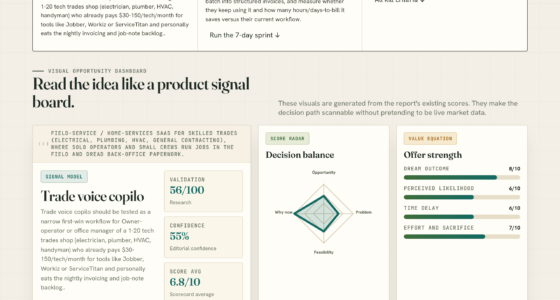

📊 Full opportunity report: The $60 Billion Bargain: Why Cursor Could Be a Steal for SpaceX on ThorstenMeyerAI.com — validation score, market gap, and execution plan.
TL;DR
SpaceX announced it is acquiring Cursor, an AI coding company, for $60 billion in stock. The deal is notable for its size, timing, and strategic implications, with the market reacting positively. Key details about the acquisition’s impact and future plans are still emerging.
SpaceX has announced it will acquire Cursor, an AI coding startup, for $60 billion in all-stock deal. The acquisition, announced just days after SpaceX’s IPO valuation exceeded $2 trillion, is a strategic move to gain a foothold in profitable AI development and control a key distribution layer in enterprise AI workflows. The market responded positively, with SpaceX’s stock rising approximately 16%, briefly making it the fourth-most-valuable U.S. company.
The $60 billion purchase was entirely in SpaceX stock, representing about 3.4% dilution at the IPO valuation, and is less than 3% of SpaceX’s current market cap, which briefly surpassed $2.9 trillion. Despite the headline number, the deal’s valuation is shrinking rapidly based on Cursor’s revenue growth, which doubled from $2 billion in February to $4 billion in June, with projections reaching $6 billion by 2026. This implies a forward multiple of approximately 10x, well within industry norms for rapidly growing AI firms.
Cursor is a leader in AI coding tools, with over 1 million paying users, 50,000 enterprise clients—including half of the Fortune 500—and a profitable enterprise subscription segment. Its own AI model, Composer, built on open weights, is used extensively, and the company has rebuffed major competitors like OpenAI and Microsoft, positioning itself as a strategic asset for SpaceX. The deal also addresses Cursor’s previous reliance on third-party models, which increased costs and limited margins, by integrating its AI stack with SpaceX’s own supercomputers and models, promising higher margins and control.
The $60B bargain: why Cursor could be a steal
$60 billion for a code editor sounds like a bubble. Look past the headline and the price isn’t the scandal — it’s the discount. Here’s the case that SpaceX got Cursor cheap.
A melting multiple, paid in appreciating paper that cost almost nothing, for the profitable leader of the only AI category reliably making money — plus the missing app layer and an escape from the margin trap. If the growth holds and integration doesn’t break the product, $60B will read like a down payment. The risk isn’t overpaying for what Cursor is — it’s breaking what made it worth buying.
Strategic Impact of the Cursor Acquisition
This acquisition is significant because it provides SpaceX with a profitable AI business, a critical distribution platform, and a proven team capable of advancing its own AI models. By owning Cursor, SpaceX gains a foothold in the lucrative enterprise AI market, which is increasingly central to digital workflows and automation. The move also blocks competitors like OpenAI and Microsoft from acquiring Cursor, consolidating SpaceX’s position in AI development and distribution, and potentially enabling vertical integration that could lower costs and improve margins on AI-powered products.

Agentic Coding with Claude Code: The everyday developer's guide to agentic coding with Claude Code
As an affiliate, we earn on qualifying purchases.
As an affiliate, we earn on qualifying purchases.
Background on SpaceX and AI Strategy
SpaceX, primarily known for its rockets and satellite services, has recently expanded into AI through its xAI division, aiming to develop frontier models and integrate AI into space and terrestrial applications. The company’s IPO was the largest in history, valuing it at over $2 trillion, and its stock has appreciated significantly since. Cursor, founded as a developer-focused AI coding tool, rapidly grew its revenue and user base, becoming a leader in enterprise AI tools and models. Prior to the acquisition, Cursor was seen as a strategic target due to its proven product, profitable enterprise segment, and its own AI models, which could complement SpaceX’s ambitions in AI and automation.
“This acquisition accelerates our AI capabilities and secures a leading position in enterprise automation and development tools.”
— SpaceX spokesperson

Generative AI for Software Development: Building Software Faster and More Effectively
As an affiliate, we earn on qualifying purchases.
As an affiliate, we earn on qualifying purchases.
Unanswered Questions About Deal Integration
Details about how SpaceX plans to integrate Cursor’s AI models and products into its existing operations remain unclear. It is also uncertain how the deal will impact Cursor’s existing customer relationships and revenue streams, and whether SpaceX will develop proprietary AI models in-house or continue licensing third-party models. Additionally, the long-term financial impact on SpaceX’s margins and profitability is still to be seen, given the current rapid revenue growth and potential integration costs.
As an affiliate, we earn on qualifying purchases.
Next Steps in AI and SpaceX Strategy
SpaceX is expected to begin integrating Cursor’s technology into its AI initiatives, possibly launching new products or services leveraging the acquired assets. The company may also focus on expanding Cursor’s enterprise customer base and developing its own AI models for broader applications. Monitoring how the company manages the integration process and whether it announces further acquisitions or partnerships will be key in assessing the deal’s long-term impact.
As an affiliate, we earn on qualifying purchases.
Key Questions
Why did SpaceX pay so much for Cursor?
SpaceX paid a high headline price but in stock, which is effectively ‘free’ given its high valuation. The deal provides strategic value through Cursor’s profitable AI tools, customer base, and potential for integration with SpaceX’s own AI models and infrastructure.
What does this mean for competitors like OpenAI and Microsoft?
By acquiring Cursor and blocking major competitors from doing so, SpaceX consolidates its position in enterprise AI, potentially limiting rivals’ distribution channels and access to key developer tools.
Will SpaceX develop its own AI models now?
It is likely, given Cursor’s own AI model and in-house team. The acquisition provides a foundation for SpaceX to accelerate its AI development and reduce reliance on third-party models, which are costly and subject to external control.
How does this affect SpaceX’s financial outlook?
While the deal’s immediate cost is high, the rapid revenue growth of Cursor and potential margin improvements from vertical integration could enhance SpaceX’s profitability in AI-related segments over time.
What are the risks involved in this deal?
Potential risks include integration challenges, overestimation of Cursor’s long-term profitability, and the possibility that the AI market evolves differently than anticipated, affecting the value of the acquired assets.
Source: ThorstenMeyerAI.com