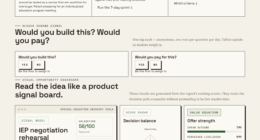

📊 Full opportunity report: AI Catalysts: Transforming SaaS Competition Strategies on ThorstenMeyerAI.com — validation score, market gap, and execution plan.

Get everyday essentials delivered free — and shop member deals
- Fast, free delivery on millions of items
- Access to Prime Big Deal Days deals on October 6–7
- Prime Video, Amazon Music and more included
TL;DR
AI is fundamentally changing SaaS competition by reducing traditional switching costs and altering market valuation. Companies leveraging AI-native solutions are gaining a significant advantage, while legacy SaaS faces declining multiples.
Artificial Intelligence is rapidly transforming SaaS competition strategies, shifting the focus from traditional lock-in tactics to agility, scalability, and AI-native capabilities. This change is impacting market valuations and the competitive landscape, with AI-native SaaS companies commanding higher multiples.
According to Thorsten Meyer, the market’s valuation reset reflects a move away from old SaaS moats based on high switching costs and data gravity. Instead, the new frontier emphasizes model capability, scalability, and rapid iteration. Companies like Sierra and Legora exemplify this shift, achieving rapid growth through AI-driven workflows.
Market data shows a 55% decline in median SaaS multiples since 2021, with AI-native SaaS trading at significantly higher valuations—up to 15–40x forward revenue—compared to legacy SaaS at 2–4x. This bifurcation underscores the market’s recognition of the new competitive edges.
Thorsten Meyer highlights that the old moat of migration pain is dissolving as AI agents make switching easier, but real switching costs—such as compliance and workflow integration—still persist and are now more critical for retention.
SaaS’s competitive frontier — the things that actually decide winners — relocated. Companies struggling now are defending the old line while the fight moved elsewhere.
- Own the system of record
- Make switching painful
- Migration as the moat
- Compound at 85% margins
- Lock-in = durability
- Fluency with the jagged edge
- Outcome pricing, not per-seat
- Cost & clean zero-to-infinity scaling
- Proprietary workflow data
- Value of staying, not cost of leaving
Implications of AI-Driven Market Valuation Shifts
This shift means SaaS companies must now prioritize AI model capabilities, scalability, and workflow integration over traditional lock-in strategies. Investors are now valuing AI-native solutions more highly, making it essential for SaaS providers to adapt or risk declining market multiples and diminished competitive relevance.
AI SaaS workflow automation software
As an affiliate, we earn on qualifying purchases.
As an affiliate, we earn on qualifying purchases.
Evolution of SaaS Competitive Frontiers
For two decades, SaaS success depended on high switching costs, data gravity, and lock-in. The rise of AI is disrupting this model, enabling easier migration and reducing the value of traditional moats. Companies like Oracle and SQL Server faced similar shifts when migration became easier, but AI accelerates this process dramatically, shifting the focus to model performance and workflow efficiency.
Market data from 2021 to 2023 confirms a sharp decline in SaaS multiples, with AI-native firms commanding premium valuations. Analyst estimates project that by 2030, a third of point-product SaaS tools will be replaced by AI agents, signaling profound disruption.
"The market is no longer paying for the SaaS label itself but for which side of the line you're on—legacy or AI-native."
— Thorsten Meyer
As an affiliate, we earn on qualifying purchases.
Unclear Aspects of AI's Long-Term Impact on SaaS
It remains uncertain how quickly legacy SaaS companies can adapt to the new frontier and whether new AI-driven moats will develop to replace traditional ones. The pace of technological advancement and integration into core workflows will influence future market dynamics.
business AI model development tools
As an affiliate, we earn on qualifying purchases.
As an affiliate, we earn on qualifying purchases.
Next Steps for SaaS Companies and Investors
SaaS providers should evaluate their AI capabilities and consider how to incorporate AI-driven workflows into their offerings. Investors will likely scrutinize retention strategies, distinguishing between inertia-based and genuine switching costs. Monitoring AI model advancements and their impact on market valuation will be critical in the coming years.
enterprise AI integration software
As an affiliate, we earn on qualifying purchases.
As an affiliate, we earn on qualifying purchases.
Key Questions
How does AI reduce traditional switching costs in SaaS?
AI enables easier migration by automating translation and integration tasks, making switching less costly and less risky for users, thus eroding the old moat based on migration pain.
Why are SaaS multiples declining since 2021?
The market is reassessing SaaS value based on actual differentiation, favoring AI-native solutions with higher scalability and model capabilities, leading to a significant multiple contraction for legacy providers.
What are the new criteria for SaaS success in the AI era?
Success now depends on AI model performance, scalability, rapid iteration, and the ability to peel off workflow layers without heavy migration costs.
Will legacy SaaS companies survive the AI disruption?
Some will, especially those with high switching costs rooted in compliance and deep workflow integration, but many will face pressure to innovate or decline in valuation.
Source: ThorstenMeyerAI.com
Fall Picks
fall essentials
As an affiliate, we earn on qualifying purchases.