TL;DR
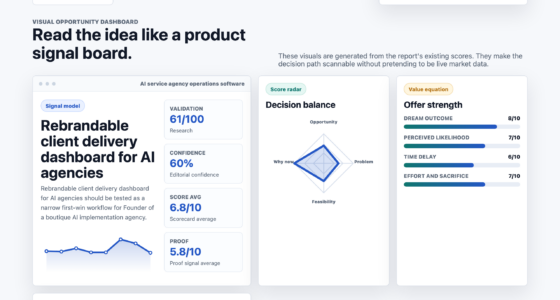
Thorsten Meyer AI says two blind reviews by its IdeaClyst idea council recommended changing a proposed AI agent cost tracker into a narrower ledger for agencies and software makers that resell agent work. The proposed product would match task and client costs from model traces against provider invoices; whether customers will pay for it remains untested.
Thorsten Meyer AI says two blind reviews by its IdeaClyst idea council recommended pivoting its proposed AI agent cost tracker toward a more specific problem: matching costs to provider invoices for agencies and software makers that resell agent work. The proposed ledger is still an idea; the team says it has not established whether businesses will pay for it.

Get everyday essentials delivered free with Prime
- Fast, free delivery on millions of items
- Prime Video, Amazon Music and more included
- Member-only deals all year
The broader concept addressed a visibility gap for businesses that sell agent services to multiple clients. A model provider’s bill may show usage by API key, workspace or model, while a reseller needs to know which tasks and clients generated those costs. If a business charges several clients a flat fee, a combined provider total can make it difficult to assess the margin on each account.
The proposed narrower product would read traces that a team already collects, assign prices to model calls, total costs by task and client, and compare those figures with the provider’s own cost report each day. The review process and idea are described in The Next 90 Businesses #001. The post says IdeaClyst conducted two blind reviews and both recommended a pivot, but it does not publish reviewer identities or individual comments in the summary.
The team proposes a 30-day validation test: interview ten businesses that resell agent work and manually produce one cost report using their exports. It says it would stop pursuing the concept if three of the ten interviewees report that their existing tools already provide the same function. No interviews, paid pilots or product launch are reported as completed.
A broad tracker gets a narrower focus
Two blind reviews recommended focusing on invoice matching for agencies and software makers that resell agent work. The idea is still untested, and willingness to pay is unknown.
The reseller margin problem
A provider’s combined bill may not show which tasks or clients drove costs.
Trace calls to accounts
Assign model call costs to tasks and clients to help resellers assess margins.
Compare with provider bills
The proposed ledger would reconcile its totals with the provider’s cost report.
Usage tools already exist
Gateways, tracing tools and billing platforms cover parts of the workflow.
From traces to a daily ledger
The proposed workflow uses records a team already collects.
Use the team’s records of model calls.
Price calls and group totals by task and client.
Check ledger totals against the provider’s cost report each day.
A proposed 30-day validation
The team has not reported interviews, paid pilots or a product launch.
The Margin Question for Resellers
The idea targets a business accounting problem rather than cost visibility in general. For an agency or software maker charging clients for agent work, knowing total model spend may not show whether a particular task or client is profitable. A ledger that reliably assigns costs could help those businesses price services and identify where spending accumulates, if it can reconcile its records with provider bills.
The distinction matters because several existing products already offer parts of the proposed workflow. Gateways such as LiteLLM and Portkey can set budgets or block requests at a limit. Langfuse offers cost tracking by model, user and tag. The post also points to Paid’s billing features for agents and Stripe’s documentation on token billing with Metronome. The proposed opening is the invoice match across those records, rather than another dashboard showing usage alone.
That potential value is not yet evidence of demand for a standalone product. The post cites the FinOps Foundation’s 2026 survey, which says 98% of respondents manage AI spending, compared with 31% two years earlier. That figure indicates broad attention to AI costs among survey respondents; it does not show how many need client-level reconciliation or would purchase this specific ledger.
Products Worth Considering

Apple MacBook Air 13-inch Laptop with M5 Chip, 32GB Memory, 1TB SSD, Silver

Logitech MX Master 4 Ergonomic Wireless Mouse with Haptic Feedback, Graphite

Kindle Paperwhite Signature Edition, 32 GB (12th Generation, 2024), Metallic Black
As an affiliate, we earn on qualifying purchases.
Why Agent Bills Get Complicated
A simple chatbot exchange may involve a single model call, but an agent can plan a task, call tools, review results and try again. Each step may generate more model usage, so a task’s cost can be spread across multiple calls. The post cites Anthropic’s Claude Code documentation, which says agent teams use roughly seven times as many tokens as a standard session when teammates run in plan mode. That is a statement about the documented setup, not a measure of every agent system.
The FinOps Foundation’s guidance describes challenges in tracing model use to a feature or agent and says there is not yet an accepted method for handling many agents working together. Meanwhile, gateways, tracing tools and billing platforms have developed overlapping cost and usage features. The business proposal emerged from that crowded landscape: focus on the gap between records of individual calls and the provider’s final cost report.
“Agent teams use roughly seven times more tokens than a standard session when teammates run in plan mode.”
— Anthropic documentation, as cited by Thorsten Meyer AI
Demand and Invoice Accuracy
Willingness to pay is unknown. Thorsten Meyer AI says its reviewers disagreed about whether customers would buy the ledger as a standalone product, and says paid pilots are needed to answer that question. The published plan begins with interviews and a manually prepared report, not a completed pilot.
The post also does not establish whether the proposed reconciliation can account for differences among provider billing formats, trace data and pricing changes. Nor does it name interviewees, report customer responses, or show a working product. Those details would determine whether the invoice-matching gap is both technically addressable and valuable enough for resellers to pay for.
Ten Interviews to Test the Idea
The next stated step is to speak with ten agent resellers and build one report by hand from their existing exports. The team’s proposed stopping rule is to abandon the idea if three interviewees say their current tools already do the job. The post does not give a calendar start date for the 30-day test.
Evidence from those interviews could clarify which records businesses use, how often their totals fail to match provider bills, and whether they would fund a paid pilot. Until the interviews or pilots are reported, the ledger remains a proposed response to a documented cost-tracking problem.
Source: Thorsten Meyer AI
Key Questions
What is the proposed AI agent cost tracker?
It is a proposed ledger that would assign model-call costs to tasks and clients, then compare those totals with the provider’s cost report.
Who is the proposed product for?
The suggested customers are agencies and software makers that resell AI agent work and need to understand costs by client.
Why did the idea council recommend a pivot?
Thorsten Meyer AI says both of its two blind IdeaClyst reviews recommended narrowing the broad tracker idea. The summary does not provide reviewer names or detailed individual assessments.
Does the product exist or have paying customers?
The post describes a business idea and a proposed validation test. It does not report a launched product, completed paid pilots or confirmed customer demand.
What happens during the proposed 30-day test?
The team plans to interview ten agent resellers and manually prepare a report from their exports. It says it would stop if three respondents already have tools that provide the same function.
Source: Thorsten Meyer AI