
🔍 Read the full analysis: 15 AI Automation Tools For Small Business Owners To Compare on ThorstenMeyerAI.com

Get everyday essentials delivered free with Prime
- Fast, free delivery on millions of items
- Prime Video, Amazon Music and more included
- Member-only deals all year
TL;DR
ThorstenMeyerAI.com has published a comparison of 15 books about AI automation for small businesses, ranking them as learning resources rather than working software. The roundup favors practical workflow coverage while noting that the title descriptions alone cannot verify specific instructions, integrations or results.
ThorstenMeyerAI.com has published a comparison of 15 books aimed at small-business owners exploring AI automation, naming AI Automation for Small Businesses: A Practical Guide to Automating Marketing, Sales, Customer Service, Operations, and Everyday Work its best overall pick. The roundup compares learning resources, not automation software, and says its assessments rely on titles, stated audiences and promised formats rather than verified details about each book’s contents.
The comparison groups the books by the kind of learning path their titles suggest, complementing other small-business AI automation coverage. Its recommended broad guide names marketing, sales, customer service and operations in its title. For readers seeking a more directed entry point, the source highlights AI Automation Made Simple for Small Business for its stated no-code focus and ChatGPT for Business: The 10X Playbook for workflow ideas described as ready to adapt.
The publisher says it weighed practical workflow coverage, accessibility for nontechnical owners and relevance to common business functions, criteria also relevant when comparing AI automation tools for business. Titles suggesting a set-up-yourself approach or a 30-day plan are presented as possible fits for owners who want a defined starting structure. The article also distinguishes business-growth framing from practical process guidance; those are different priorities, not evidence that one book produces better results.
Its ranking is explicitly limited by the available information. The source says it used each title’s stated audience, promised format and named topics, and did not establish specific tool integrations, detailed instructional quality or business outcomes. Readers are advised to check publisher descriptions or sample pages and verify compatibility with their own software before applying a workflow.
The 15 picks
- 1
 Smart AI for Small Business: 50 Simple Hacks to Grow Revenue, Cut Costs, and…View on Amazon →
- 2
 The Small Business Owner’s AI Handbook: How to Use Artificial Intelligence to…View on Amazon →
- 3
 AI Tools for Small Business: A Practical Guide to Automation, Saving Time, an…View on Amazon →
- 4
 AI-Powered Automation and Workflows for Small Business OwnersView on Amazon →
- 5
 ChatGPT for Business: The 10X Playbook — 100 AI Workflows to Save Time, Grow…View on Amazon →
- 6
 AI Automation for Small Businesses: Build Smarter Workflows, Save Time, Reduc…View on Amazon →
- 7
 Claude AI Made Practical: A Beginner’s Guide to Everyday Work, Small-Business…View on Amazon →
- 8
 AI Automation for Small Businesses: A Practical Guide to Save Time, Work Smar…View on Amazon →
- 9
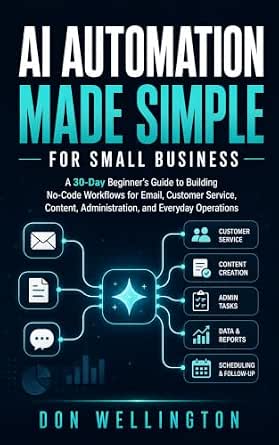 AI Automation Made Simple for Small Business: A 30-Day Beginner’s Guide to No…View on Amazon →
- 10
 AI Automation for Small Business: Simple AI Workflows for Everyday TasksView on Amazon →
- 11
 AI Automation for Small Business: A Practical Guide to Automating Marketing,…View on Amazon →
- 12
 AI for Small Business, Volume I: Getting Started — Set It Up Yourself, No Tec…View on Amazon →
- 13
 AI for Small Business: From Marketing and Sales to HR and OperationsView on Amazon →
- 14
 AI Automation for Small Businesses: Build Semi-Passive Income Systems Without…View on Amazon →
- 15
 AI for Entrepreneurs and Small Business Owners: How to Compete with Larger Bu…View on Amazon →
1. AI Automation for Small Businesses: A Practical Guide
The roundup’s best overall pick has a title spanning marketing, sales, customer service, operations and everyday work. That breadth may appeal to owners comparing several processes, but the source does not verify how the book treats each one.
Products Worth Considering

Samsung 27-Inch Odyssey G5 QHD Gaming Monitor (G51F)

Sony WH-1000XM6 Wireless Noise-Canceling Headphones, Black

Apple MacBook Air 15-inch Laptop with M5 Chip, 16GB Memory, 512GB SSD, Liquid Retina Display, and 12MP Center Stage Camera (Midnight)
As an affiliate, we earn on qualifying purchases.
2. AI Automation Made Simple for Small Business
This title signals a no-code learning path, which could suit owners who want to explore workflows without starting with programming. The title alone cannot confirm how much setup instruction or technical detail it provides.
3. ChatGPT for Business: The 10X Playbook
The source points to this book for workflow ideas intended for adaptation. Its named focus is ChatGPT, making it a potentially narrower choice than an overview spanning multiple business functions.
4. AI Automation for Small Business: Start With a Process
Owners should look for learning resources that connect automation to a specific repetitive task. The supplied material does not provide this title as a verified book entry; it recommends the process-first approach as a selection criterion.
5. A Guide Focused on Everyday Work
Everyday-work coverage may be relevant to recurring administration and routine tasks. The source identifies this as a scope signaled by some titles, but does not provide enough bibliographic detail to confirm a separate book matching this description.
6. A Marketing Automation Guide
A marketing-focused resource may better match an owner seeking help with campaign tasks than a broad introduction. The source lists marketing among common functions, but does not name a distinct marketing-only title in the material provided.
7. A Sales Workflow Guide
For sales work, readers can look for coverage of repeatable processes such as inquiry handling or follow-up. These are examples of tasks to assess, not confirmed contents of a specific book in the supplied list.
8. A Customer Service Automation Guide
Customer-facing automation needs review rules because errors can affect customers. The source recommends weighing oversight needs, but does not identify a separate customer-service title or establish its recommendations.
9. An Operations Automation Guide
Operations-focused material may fit owners who want to examine internal processes. The roundup names operations as one of the functions covered by its broad pick, but supplies no confirmed details for a standalone operations book.
10. A Beginner’s AI Automation Guide
A beginner-oriented title can indicate a more accessible starting point. Readers should check sample pages for plain-language explanations and step-by-step examples, rather than relying on a title’s promise alone.
11. A 30-Day Automation Plan
The source identifies titles promising a 30-day plan as potentially useful to people seeking structure. It does not name or verify a specific title in this category, so the format and quality remain unconfirmed.
12. A Set-Up-Yourself Automation Guide
A do-it-yourself framing may appeal to owners who want to build workflows themselves. Before buying, check whether the book shows actual setup steps and whether those steps match the business’s software.
13. A Business Growth and AI Guide
Entrepreneur-focused books may frame AI around competition and growth, while practical guides may emphasize repeatable processes. The source treats these as different aims, not proof of measurable growth from reading a book.
14. A Practical Workflow Collection
A workflow collection may suit experienced readers who want ideas to adapt rather than a beginner course. The source says broad workflow coverage can be useful, but does not confirm the contents of an additional named title.
15. A General AI Business Overview
A general overview can help owners learn the subject before choosing a project. The supplied source does not identify a fifteenth book by name, so it cannot substantiate a complete, title-by-title list of 15 distinct picks.
Choosing a Guide Before a Platform
The comparison addresses a practical distinction for owners: a book can explain a workflow, but it does not run one. Businesses still need to select and configure the software that carries out automation, and confirm that it works with their existing email, calendar, customer records and other systems. That distinction matters when estimating cost and implementation effort; buying a guide is not the same as putting an automated process in place.
The source also advises starting with a task that consumes meaningful staff time and defining its steps before automating it. For customer-facing work, businesses should set human review requirements before messages or recommendations are sent. The time needed to check outputs belongs in any assessment of whether a workflow is useful.
How the Roundup Set Its Criteria
The publisher says it compared the 15 titles as business learning resources, not as live AI products. Its stated criteria include practical application, entry points for nontechnical owners and coverage of common functions. It ranks broad guides above more specialized options when they appear to address a wider range of everyday business needs.
The source warns that title wording is only an indication of scope. It recommends checking publisher descriptions and sample pages for examples, screenshots and setup detail, then confirming integration claims with the software provider. The material supplied for this article does not include publication dates, prices, editions or full descriptions for all 15 titles.
“These are learning resources, not automation platforms.”
— ThorstenMeyerAI.com
What the Book Details Do Not Establish
The source material does not name or describe all 15 books individually. It identifies three titles and refers to other formats and topics, but does not provide enough bibliographic information to verify 15 distinct picks or support full individual summaries for the remaining entries. The additional sections above describe selection categories, not confirmed book titles.
It is also unclear which software, integrations or setup steps each book covers, how current its instructions are, or whether any workflow will produce measurable savings. No test results, customer outcomes, pricing comparisons or independent evaluations are provided. Those details require checking the books and their publishers directly.
What Readers Should Check Next
Before choosing a title, owners can write down a recurring task, estimate how often it occurs and identify who handles it. They should then compare that need with a book’s description and sample pages, and check whether its examples fit the business’s existing tools. For any planned automation, define which outputs require human approval and account for the time needed to review them.
No follow-up publication, product test or update schedule is given in the source material. Readers seeking a verified 15-book shortlist should consult the original roundup’s full entries and confirm each title’s edition, contents and availability with its publisher or bookseller.
Key Questions
Is this a list of 15 automation software tools?
No. The source compares books about AI automation; it says they are learning resources rather than software platforms that carry out workflows.
Which book does the roundup rate highest?
ThorstenMeyerAI.com names AI Automation for Small Businesses: A Practical Guide to Automating Marketing, Sales, Customer Service, Operations, and Everyday Work as its best overall pick.
Which titles are suggested for a more guided start?
The source highlights AI Automation Made Simple for Small Business for its stated no-code focus and mentions titles that promise a beginner path or a 30-day plan. It cautions that titles do not confirm the depth of instructions.
Does the roundup verify integrations or business results?
No. The supplied material does not establish specific integrations, implementation details or measurable results. Owners should verify software compatibility and review book samples before relying on a workflow.
Source: ThorstenMeyerAI.com