

TL;DR
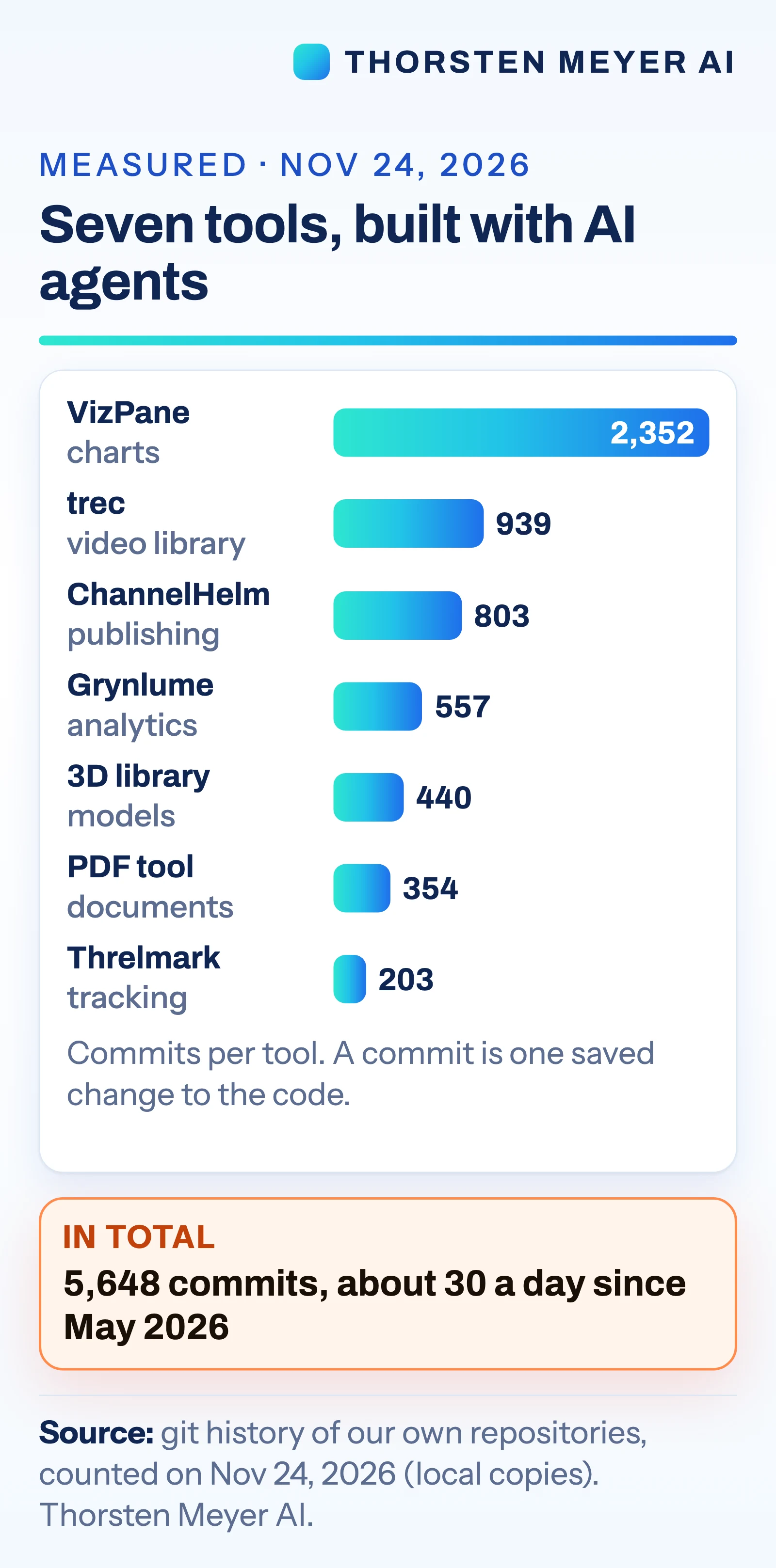
Thorsten Meyer describes using Claude and Codex subscriptions to build and connect software tools for his own work. He reports that seven tools in his repositories had 5,648 commits and 2,128 test files as of Nov. 24, 2026; the figures describe his projects, not a general industry trend. He says the approach shifts costs and responsibilities toward review, security and maintenance.
Meyer’s post describes a workflow in which coding agents read project code, make changes, run tests and report results after he assigns a task. He says he uses Claude and Codex subscriptions to build and adapt applications for his business. He characterizes the agents as capable developers, but says they need written instructions and human review.

Get everyday essentials delivered free with Prime
- Fast, free delivery on millions of items
- Prime Video, Amazon Music and more included
- Member-only deals all year
For the article and an accompanying video, Meyer traced one job through seven tools: a project tracker, tool guides, video transcripts, a PDF tool, a 3D model library, a publishing application and an analytics tool. He says the steps were carried out without a person clicking through each handoff; people still set the goal and check the result. The analytics step was read-only.
Meyer reports that seven tools covered in the article had 5,648 commits and 2,128 test files in his repositories as of Nov. 24, 2026. Those are counts from his own projects; the post gives no comparison baseline or time window for the totals. He also says AI models for generating voices, images and clips are paid for separately, by use.
A Shift in Small Business Software
The account illustrates how coding agents can let an individual build software tailored to a specific workflow. Meyer argues that the scarce skill is increasingly the ability to describe what a tool should do and judge whether it does it. That is his assessment of the change, rather than an independently measured finding.
The arrangement also changes who carries the work. A business may avoid some subscriptions, but the person running custom tools must take responsibility for updates, security, testing and support. Meyer says his own software spending now centers on subscriptions to two AI providers, creating a reliance on Anthropic and OpenAI. The post does not provide a cost comparison with the services he stopped using.
For software companies, Meyer suggests that narrow products may be easier for some customers to recreate themselves. He expects reliability, support, security and compatibility with agents to matter more. That is his view; the article offers no broader market data to show how widespread the shift is.
Products Worth Considering

Apple Watch Series 12 GPS 42mm Smartwatch

Apple Watch SE 3 GPS 40mm Smartwatch

Bose QuietComfort Ultra Earbuds (2nd Gen), Wireless Noise-Cancelling Earbuds, Black
As an affiliate, we earn on qualifying purchases.
From Software Rental to Custom Tools
Meyer frames the change against the common subscription model known as software as a service, or SaaS. He cites the U.S. National Institute of Standards and Technology’s definition: users access a provider’s applications running on cloud infrastructure, while the provider manages the underlying systems and application capabilities.
He compares this arrangement to renting space: it is ready to use and maintained by someone else, but the customer has limited control over how it works. His own case replaces several separate services with tools he controls. The post does not say that every business can or should make the same switch; Meyer says renting remains a reasonable choice for people who do not want to build software.
He also distinguishes ordinary apps, designed for people to operate through screens and buttons, from “agentic” tools intended to be used by other software. In his description, agents need a readable guide explaining a tool and a standard way to interact with it. Meyer references a public proposal by Jeremy Howard about such guides, but the supplied article text ends before giving its full details.
““I no longer pay other vendors for the software I run my work on.””
— Thorsten Meyer
Costs and Risks Remain Unmeasured
The post gives no itemized comparison between Meyer’s current AI subscriptions and the software services he says he no longer pays for. It also does not quantify the time required to build or maintain the tools, or report on security incidents, defects or outages.
The repository totals are self-reported counts with no stated comparison period or benchmark. They show the scale of activity in those projects, but do not establish how well the tools work or how much labor they save. The article also does not establish whether the seven-step workflow can be reproduced by other users or applied safely to higher-risk tasks.
Meyer says his workflow depends heavily on Anthropic and OpenAI. The post does not discuss what would happen if either provider changed its pricing, access or services. Further details about the agent-readable guides referenced in the source excerpt are also unavailable there.
Review and Maintenance Shape the Work
Meyer’s account points to an ongoing cycle of writing down project rules, giving agents defined tasks, reviewing their changes and maintaining the resulting applications. He presents that work as part of using custom tools, not a one-time build.
The accompanying video is described as a deeper look at the same workflow. The article does not announce a product launch, outside evaluation or a scheduled next milestone. Any assessment of the approach beyond Meyer’s own projects will depend on evidence about costs, reliability, security and how much ongoing human review the tools require.
Key Questions
What did Thorsten Meyer report changing?
He said tools for web analytics, project tracking, PDFs and video recording in his work now run on applications he built, rather than software services from other vendors.
Which AI coding agents does Meyer use?
He names Claude Code from Anthropic and Codex from OpenAI. He says the agents read and write project code, run tests and report back.
What does “agentic” mean in this article?
Meyer uses the term for software designed to be understood and operated by other software agents. He says such tools need a readable guide and a standard way for an agent to interact with them.
How large were the projects Meyer described?
He reports 5,648 commits and 2,128 test files across seven tools in his own repositories as of Nov. 24, 2026. The figures have no stated comparison baseline or period.
What responsibilities come with building custom tools?
Meyer says he is responsible for maintenance, security and review. He also says the approach leaves him reliant on subscriptions from Anthropic and OpenAI.
Source: Thorsten Meyer AI