
TL;DR
The International Energy Agency says energy use per AI task has fallen by at least an order of magnitude annually in recent years, while data centre electricity use rose 17% in 2025. The pattern is consistent with Jevons paradox: efficiency can lower the cost of a service and encourage additional use, potentially increasing total consumption. Whether that will continue, and how much electricity AI itself will use, remains uncertain.
The International Energy Agency says energy use per AI task has fallen substantially, while electricity use at the world’s data centres rose 17% in 2025. The agency says efficiency gains are contributing to wider adoption of AI services, a pattern associated with Jevons paradox, and projects that total electricity use from AI will rise in the near term. The figures show falling energy use per task alongside higher data centre demand, but do not establish how much of that increase was caused by AI.

Get everyday essentials delivered free with Prime
- Fast, free delivery on millions of items
- Prime Video, Amazon Music and more included
- Member-only deals all year
The IEA says energy used per AI task has dropped by at least an order of magnitude annually in recent years, a pace it describes as unprecedented in energy history. At the same time, data centres worldwide used 485 terawatt-hours of electricity in 2025. The IEA reports that electricity use rose 17% across data centres and 50% at facilities built for AI. Those figures refer to different groups of facilities; the source does not provide a direct estimate of AI’s share of all data centre electricity use.
Other figures cited in the source point to expanding use. Epoch AI estimates that the cost of a given level of AI performance has fallen about 13 times per year since 2023. Google’s monthly token count increased from 9.7 trillion in May 2024 to more than 3.2 quadrillion in May 2026. Token counts measure processed text units, not electricity directly, and the cited figures do not give a comparison baseline for energy per token.
The IEA projects that data centre electricity demand will reach about 950 TWh in 2030. It names Jevons paradox as one dynamic behind broader AI adoption, saying efficiency gains are “also fuelling broader adoption of AI services.” That is an explanation of a possible demand mechanism, not a precise forecast of how much electricity AI will consume or proof that efficiency alone caused the increase.
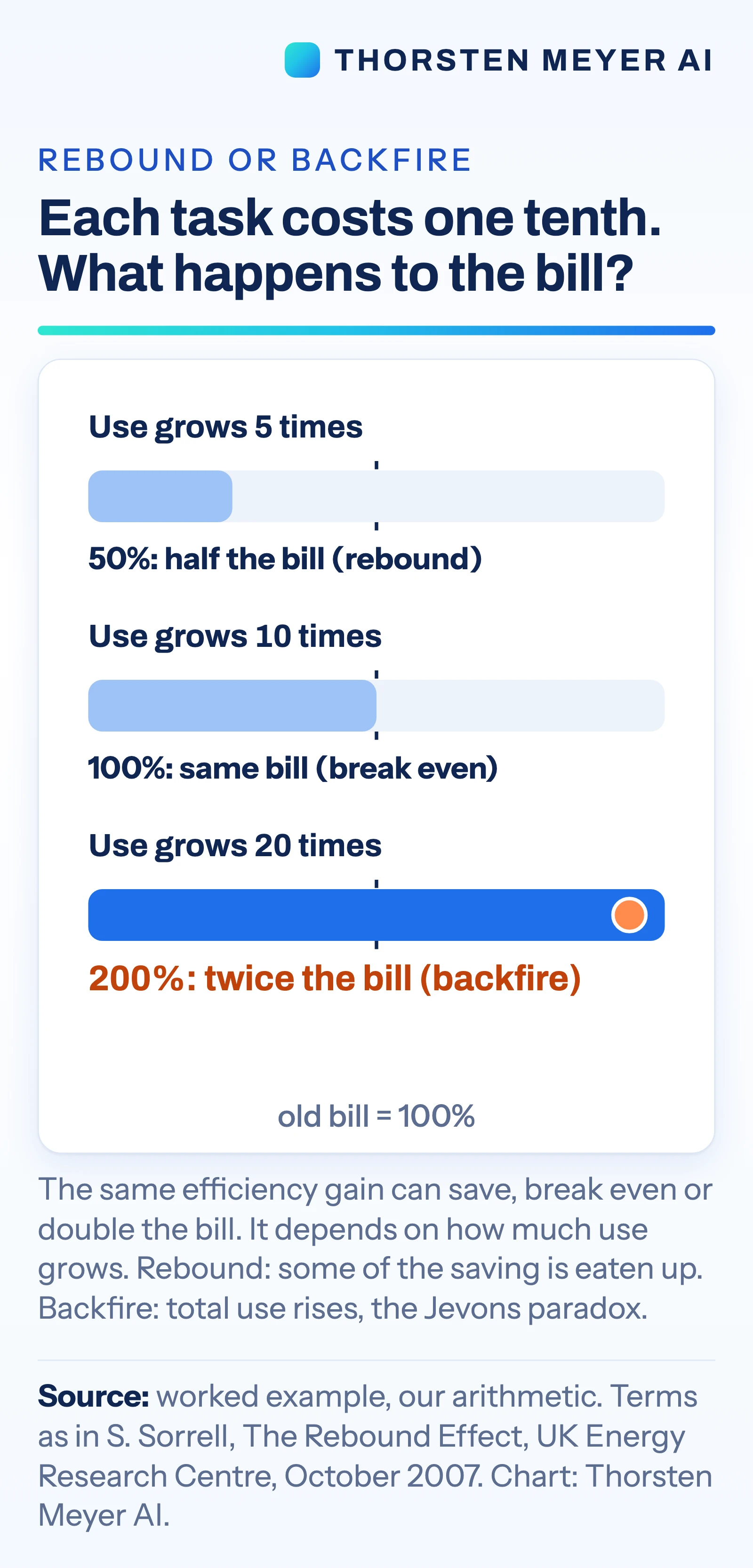
Lower Costs and Total Demand
For companies, the distinction is between the price of an individual task and the total cost of using AI. A model may become cheaper to run for a given task, while a business adds more tasks, users or automated steps. The overall bill can then rise even as the unit price falls. The source recommends tracking budgets per finished task and paying attention to uses that consume many tokens, including reasoning and agent-based workflows.
The same distinction matters for electricity planning. A simple text prompt may require little power by itself, but demand from many users and more resource-intensive services can add up. The cited figures do not quantify the electricity required by particular prompts or services. They illustrate why efficiency alone does not guarantee lower total consumption if use expands.
For readers, the relevant question is whether lower costs lead people and businesses to use AI enough to offset efficiency savings. That balance affects data centre investment and power demand and depends on adoption, hardware, model design and the kinds of tasks people choose to run.
Products Worth Considering

Bose QuietComfort Headphones (2nd Gen), Wireless Noise-Cancelling Over-Ear Headphones, Black

Sony WH-1000XM6 Wireless Noise-Canceling Headphones, Black

Bose SoundLink Max Portable Bluetooth Speaker, IP67 Waterproof, Black
As an affiliate, we earn on qualifying purchases.
Jevons’s Coal-Era Argument
English economist William Stanley Jevons described the idea in his 1865 book, The Coal Question. He was considering whether more efficient steam engines would conserve Britain’s coal. His argument was that efficiency could make coal-powered work more profitable and useful, lowering costs and encouraging industrial growth. Increased use could then outweigh the reduced coal required for each unit of work.
Jevons used ironmaking as an example: if a blast furnace needed less coal per ton of iron, production could become more profitable, prices could fall and demand could grow. He reported that Scottish coal use for ironmaking rose tenfold after the coal needed per ton was cut to less than one-third of its former amount. That historical example concerned coal and industrial production; it is not direct evidence about modern computing.
The broader term rebound effect describes cases where efficiency savings are partly offset because use increases. “Backfire” refers to the more specific case in which increased use outweighs the efficiency gain and total resource consumption rises. A 2007 review for the UK Energy Research Centre found that efficiency gains usually still save energy overall, although savings can be smaller than engineers expect. The source therefore presents backfire as a possibility, not a rule.
““It is wholly a confusion of ideas to suppose that the economical use of fuel is equivalent to a diminished consumption. The very contrary is the truth.””
— William Stanley Jevons, The Coal Question (1865)
How Much Power AI Uses
The figures do not settle how much of 2025’s data centre electricity use came from AI, or how much of the increase resulted specifically from efficiency gains. The 50% rise applies to data centres built for AI, while the 17% figure covers data centres worldwide. Neither figure, as presented in the source, breaks out electricity use by model, task or customer.
The token count and cost estimates also do not translate directly into power consumption. More tokens can indicate more AI use, but the source gives no common measurement that connects Google’s monthly token count to the electricity used for those tasks. Forecasts to 2030 depend on future adoption and computing efficiency, so the size and pace of future demand remain uncertain.
Demand Through 2030
The next comparison will be whether falling costs continue alongside growing use and rising data centre electricity demand. The IEA projects about 950 TWh of data centre electricity use in 2030, compared with 485 TWh in 2025. That projection covers data centres, not AI alone. Future reporting will need clearer estimates of AI’s share and of how much efficiency reduces energy per task.
Businesses can track spending and resource use by completed task as they expand AI deployments. For power planners, the central measure is total electricity demand, alongside the efficiency of the systems supplying each service. Those measures can show whether additional use is offsetting efficiency savings in practice.
Key Questions
What is Jevons paradox?
It is the possibility that greater efficiency lowers costs and encourages enough additional use to raise total consumption of a resource.
Does the IEA say AI efficiency is causing data centre electricity use to rise?
The IEA links efficiency gains to broader AI adoption and says AI electricity use is set to rise in the near term. The figures cited do not isolate how much of the data centre increase was caused by AI efficiency.
How much electricity did data centres use in 2025?
The IEA figure cited is 485 TWh worldwide in 2025. The source also reports a 17% rise across data centres that year and a 50% rise at facilities built for AI.
Does more efficient AI always use more electricity overall?
No. Jevons paradox describes a possible outcome. A 2007 UK Energy Research Centre review found efficiency gains usually still reduce energy use overall, though by less than expected.
Source: Thorsten Meyer AI