TL;DR
Diffusion image generators learn to predict noise added to training images, then use that skill in reverse, starting with random noise and refining it into a picture. Prompts steer the process, but the method can struggle with lettering and precise object relationships; research has also extracted near-copies of some training images.
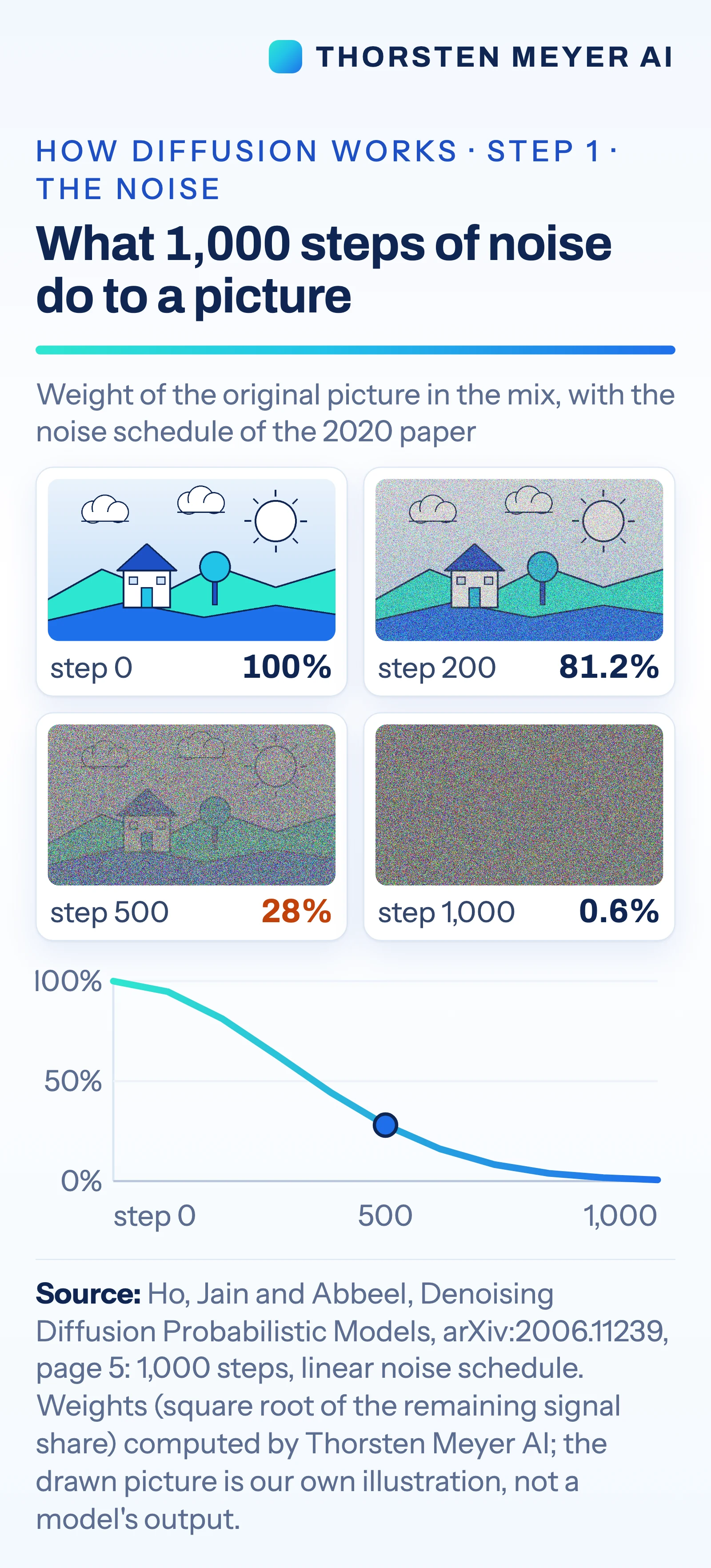
During training, a model is shown images that have been altered with increasing amounts of noise. It learns to estimate the noise in each altered image. In the 2020 paper Denoising Diffusion Probabilistic Models, Jonathan Ho, Ajay Jain and Pieter Abbeel used a process of 1,000 steps, gradually adding noise until the original image signal was effectively destroyed.

Get everyday essentials delivered free with Prime
- Fast, free delivery on millions of items
- Prime Video, Amazon Music and more included
- Member-only deals all year
Generation runs the learned process in reverse. The system begins with random noise and makes repeated estimates, removing some noise at each step. The explainer says rough shapes tend to form before finer details. A commonly used open-source pipeline has a 50-step default, though the number of steps and results depend on the model and settings.
A text encoder converts a prompt into numerical representations that can guide the image model during generation. The explainer also describes a guidance technique that increases alignment with the prompt, while noting that stronger guidance can come at a cost to image quality. In latent diffusion systems such as Stable Diffusion v1, image work takes place in a compressed representation: the source says a 512-by-512 image is represented using 48 times fewer numbers.
Why Noise Shapes the Result
The process helps explain both the strengths and limits of image generators. Since the model develops a picture through many rounds of estimation, its output is not a literal drawing made stroke by stroke or a photo retrieved in response to a search. It is a generated result shaped by learned patterns and by the prompt’s influence at each step.
That design does not guarantee precise control. The explainer identifies garbled lettering, inaccurate counting and incorrect spatial relationships—such as one object appearing beside another instead of on top—as recurring difficulties. These limitations matter for people using generated images where exact text, object counts or layouts are important.
Training data also raises questions about similarity and copying. Researchers have extracted images resembling training examples from models, according to the source. That observation does not establish that every generated image is copied, but it highlights why model behavior and the use of training material remain matters of research and legal debate.
Products Worth Considering

Kindle Paperwhite Signature Edition (2024), 32 GB, Metallic Black

Bose QuietComfort True Wireless Noise-Cancelling Earbuds, Black

Bose TV Speaker Compact Soundbar with Bluetooth and HDMI-ARC, Black
As an affiliate, we earn on qualifying purchases.
From Early Theory to Latent Models
The underlying idea predates today’s popular image generators. In 2015, Jascha Sohl-Dickstein and colleagues described gradually destroying structure in data and learning a reverse process to restore it. The 2020 paper by Ho, Jain and Abbeel made a diffusion approach practical for image generation, using a forward process that adds noise and a learned reverse process that removes it.
Later systems reduced the computational burden by operating in a compressed latent space rather than directly processing every pixel at full resolution. Text conditioning added a way for a prompt to influence the generation. These components are described in research and technical documentation; the explainer points readers to the 2020 paper and Hugging Face diffusers documentation for the process and implementation details.
The legal picture is not settled. The source reports that a UK court ruled in 2025 that Stable Diffusion itself was not an “infringing copy.” That finding addresses the specific question described in the source; it does not resolve every copyright issue involving training data or generated images.
““systematically and slowly destroy structure in a data distribution through an iterative forward diffusion process.””
— Jascha Sohl-Dickstein and colleagues, 2015 paper, as quoted by Thorsten Meyer AI
Limits and Legal Questions Remain
The explainer does not establish a single rate at which models produce text errors, miscount objects or place them incorrectly; performance varies by model, prompt and settings. It also does not quantify how often generated images resemble training examples. Researchers have extracted near-copies, but the scope and frequency of that behavior are not specified here.
The reported 2025 UK ruling concerns whether Stable Diffusion itself is an “infringing copy.” The source does not set out the full legal reasoning or settle other questions about training data, individual outputs or other jurisdictions. The legal status of those issues remains unresolved in the material provided.
More Research and Legal Decisions
Readers seeking the technical details can consult the 2020 diffusion paper and the Hugging Face diffusers documentation cited by the explainer. Further research may clarify how model design and settings affect image quality, prompt adherence and the chance of reproducing training material.
Legal developments will depend on later proceedings and decisions addressing specific copyright questions. The source does not identify a scheduled next court date or a forthcoming technical milestone, so no particular timeline is confirmed.
Key Questions
How does an AI image generator turn noise into a picture?
It starts with random noise and repeatedly predicts and removes some of it. Over successive steps, image structure emerges, with finer details developing later.
How does the model learn to remove noise?
During training, noise is added to real images in stages. The neural network learns to estimate the added noise; generation uses that learned ability in reverse.
What does a prompt do during generation?
A text encoder turns the prompt into numerical information that guides the image process. Guidance settings can change how closely the result follows the text, with possible effects on image quality.
Why can image models get words or object positions wrong?
The generation process does not guarantee accurate lettering, counting or spatial relationships. The explainer lists these as known difficulties, and results vary by system and settings.
Has a court settled whether AI image models violate copyright?
No broad resolution is reported here. The source says a UK court found in 2025 that Stable Diffusion itself was not an “infringing copy,” while other copyright questions remain open.
Source: Thorsten Meyer AI