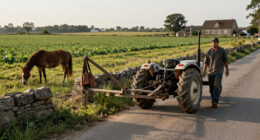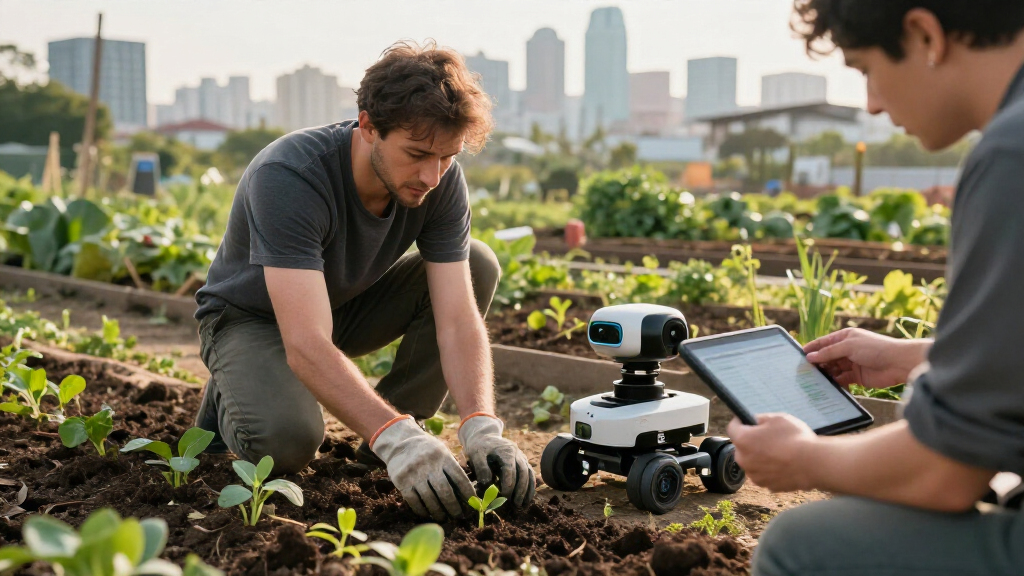

🔍 Read the full analysis: A Brief History Of Work, From Farming To AI on ThorstenMeyerAI.com

Get everyday essentials delivered free with Prime
- Fast, free delivery on millions of items
- Prime Video, Amazon Music and more included
- Member-only deals all year
TL;DR
A November 3, 2026, article from ThorstenMeyerAI.com traces the long decline in farming’s share of work, from about 74% of U.S. workers around 1800 to about 1.5% today. It argues that agricultural automation offers a useful comparison for AI, while stressing that farm labor changed over centuries and that the future scale and speed of AI’s impact remain uncertain.
ThorstenMeyerAI.com published a report on November 3 tracing how farming went from employing most workers in many societies to a small share of the workforce in some wealthy countries. The article uses that shift as a historical comparison for AI’s possible effects on jobs, but its prediction that automation could affect as much as 90% of a sector is presented as the author’s thesis, not an established forecast.
The report estimates that 73.7% of the U.S. labor force worked in agriculture in 1800, drawing on economic historian Stanley Lebergott’s figures published by the U.S. Census Bureau. The underlying series counts about 1.4 million agricultural workers out of a labor force of 1.9 million people aged 10 and older. It includes about 530,000 enslaved people. The figures before 1840 are estimates rather than census counts, so the article describes the share as roughly three out of four.
The change came through a series of developments rather than one invention. The report points to improved farm tools, including John Deere’s steel plough in 1837; industrial production of ammonia fertilizer following Fritz Haber’s 1908 patent; and higher-yield crop varieties associated with the Green Revolution. It says India’s wheat harvest rose from 12.3 million tonnes in 1964–65 to 26.4 million tonnes in 1971–72, citing official statistics.
Farm work has not disappeared worldwide. The International Labour Organization estimated that 928 million people worked in agriculture in 2025, about one in four workers globally, according to the article. It reports agriculture’s workforce share at about 43% in India, compared with roughly 1.5% in the United States and 1% in Germany. Those differences show that the shift away from farm work is uneven and remains incomplete.
Farm Productivity and Job Change
The history matters because it separates the decline in farming’s share of employment from a simple story of workers disappearing. In the United States, the report says, the number of farm workers continued to rise until about 1910, reaching 11.8 million, even as farming’s share of the workforce fell. In Germany, it says, the share dropped from 43% to 25% between 1882 and 1939 while the number of farm workers remained between 8 million and 10 million.
That pattern is relevant to debates about AI and employment: a technology may change productivity and the mix of jobs without immediately reducing the total number of people working in an affected sector. The agricultural example also suggests that change can take decades or longer. It does not establish how quickly AI will spread, which jobs it will alter, or whether new work will replace roles that are reduced.
The report also challenges the idea that fewer farmers must mean less food. It states that global cereal production increased 4.2-fold from 1961, while world population increased 2.7-fold over the same period. It also cites U.S. farm output in 2023 as nearly three times its 1948 level, with only a small rise in total inputs. These comparisons support the article’s account of rising agricultural productivity; they do not, by themselves, describe every cost or consequence of that growth.
Products Worth Considering

Logitech MX Brio Ultra HD 4K Webcam, Graphite

Samsung Galaxy Tab A11+ 11-Inch Tablet, 6GB RAM, 128GB Storage, Expandable, Gray

Amazon Kindle Paperwhite (2024), 16 GB, 7-inch Display, Black
As an affiliate, we earn on qualifying purchases.
How Farm Work Became More Productive
Before mechanization and modern inputs, farming depended heavily on human and animal labor. The article describes households relying on hand tools, draft animals and weather, with land productivity limiting how much food a farm could produce. In that setting, a large share of the population had to work in agriculture to supply food and other essentials.
The report assembles estimates from several countries to show that the U.S. experience was not unique, while noting that the figures are not all directly comparable. It cites an estimate of about 85% in Japan in 1872 working in the primary sector, which includes farming, forestry and fishing; 83.5% in China in 1952; and 69.7% of workers in India in 1951. Germany’s first official occupational census, in 1882, put agriculture and forestry at 43.4% of the workforce, though the report says it undercounted women working on family farms.
Technology and farming practices developed in stages. Deere’s account dates the steel plough to 1837, while the report describes mechanical reapers, threshers and tractors as later advances. Haber filed a patent on ammonia synthesis in 1908, and the first ammonia factory followed in 1913, according to the source. In the 1960s, short-straw wheat varieties associated with Norman Borlaug’s work could support more grain without falling over, particularly when used with fertilizer and irrigation.
“My thesis, not a fact: automation could become a sector of up to 90% within a decade or a few decades.”
— Thorsten Meyer, ThorstenMeyerAI.com
Limits of the AI Comparison
The report offers historical comparison, not a forecast of AI’s effects. Its suggestion that automation could reach up to 90% of a sector is Meyer’s thesis; the source does not define the sector, explain the method behind the estimate or identify a specific time horizon beyond “a decade or a few decades.” It should not be read as a verified prediction about the share of jobs that AI will eliminate.
The agricultural figures also have limits. Some early workforce shares are historical reconstructions, not direct census counts, and the source notes that definitions differ between countries and periods. The excerpted report does not provide a full account of where displaced farm workers went, how working conditions changed, or how the productivity gains were distributed. Those questions matter when comparing agricultural change with AI.
The Series Turns to Factories
The article identifies itself as Episode 2 of “Work After Work,” an ongoing series about how the economy is built. It says the next episode will examine mechanical reapers, threshers and tractors as part of farming’s technological history. That installment could add detail on how machinery affected farm work beyond the tools, fertilizer and crop varieties covered here.
For the broader AI comparison, the source does not give a timetable for testing its thesis or name specific measures to track. Readers should treat the agricultural history as evidence that major labor shifts can unfold over long periods, while waiting for further reporting to establish how AI adoption affects particular occupations and industries.
Key Questions
What is the news in this article?
ThorstenMeyerAI.com published a report on November 3, 2026 about the history of farm labor, using agricultural productivity and workforce change as a comparison for debates about AI and jobs.
How many U.S. workers farmed around 1800?
The report cites an estimate that 73.7% of the U.S. labor force worked in agriculture in 1800. The figure is based on a historical reconstruction, not a census count, and includes enslaved people.
Does the article say AI will automate 90% of jobs?
No. Meyer describes automation affecting up to 90% of a sector as his thesis, not a fact. The article does not establish that AI will automate 90% of jobs or provide a verified forecast.
How many people still work in agriculture worldwide?
The article cites an ILO estimate of 928 million agricultural workers in 2025, about one in four workers globally. It reports that the share varies widely by country.
What happens in the next episode?
The series says its next episode will cover mechanical reapers, threshers and tractors and their role in the history of farm work.
Source: ThorstenMeyerAI.com