

🔍 Read the full analysis: Which Of These 14 AI Workflow Automation Software Tools Fits Your Needs? on ThorstenMeyerAI.com

Get everyday essentials delivered free with Prime
- Fast, free delivery on millions of items
- Prime Video, Amazon Music and more included
- Member-only deals all year
TL;DR
ThorstenMeyerAI.com presents 14 resources for choosing and using AI workflow automation, grouped around business users, developers and enterprise teams. The guide favors no-code guidance for users seeking a quick start and code-first approaches for teams needing greater control, but the supplied material includes no independent performance data or full item-by-item evidence.
ThorstenMeyerAI.com has published a guide to 14 AI workflow automation resources, sorting them by user needs such as no-code business automation, developer control and enterprise integration. The publisher’s comparison says the choice largely comes down to technical skill and operational goals, rather than a single tool serving every team.
In its comparison, ThorstenMeyerAI.com recommends The No-Code AI Automation Playbook as its overall pick for business users who want to build workflows without programming. The guide says the resource connects concepts associated with Zapier, Make and n8n. For developers seeking more control over custom agents, the publisher points to n8n AI Automation and its Python integration. These are the guide’s assessments; the supplied material does not include independent testing results or detailed comparative measurements. Readers can also explore lessons from other AI automation software guides.
The source groups its 14 options into materials for business owners, engineers and organizations operating complex cloud environments. It also names Agentic Coding with Claude Code and Agentic AI for DevOps as resources focused on autonomous decision-making, and says Microsoft Power Automate may suit organizations already working in Microsoft’s ecosystem. The publisher frames AI-Powered Automation for Small Business around starting with simpler, high-impact tasks. For more options, see AI workflow automation tools to know about in 2027.
According to the guide, selection criteria include practical instructions, technical accessibility and fit with a user’s profile. It advises readers to examine integrations, API support, pricing at higher volumes, data handling and error management. The supplied source material does not list all 14 titles or provide enough detail to independently assess every selection.
The 14 picks
- 1
 Agentic AI for DevOps Engineers: Building Autonomous CI/CD, Infrastructure, a…View on Amazon →
- 2
 Workflow Automation with Microsoft Power AutomateView on Amazon →
- 3
 Claude AI for Smart Automation: No-Code Strategies to Build Intelligent Workf…View on Amazon →
- 4
 The No-BS Guide to AI Agents & Automation: Build AI Workflows, Automate Your…View on Amazon →
- 5
 AI Agents: From Theory to Operations — A Practical Guide to Business Automati…View on Amazon →
- 6
 50 AI Workflows for Engineers: From Debugging to System Design, Code Review &…View on Amazon →
- 7
 AI-Powered Automation and Workflows for Small Business OwnersView on Amazon →
- 8
 Practical Autonomous Workflow Automation: Build AI Agents and Automate Real-W…View on Amazon →
- 9
 Hands-On AI Workflow Automation: A Beginner-Friendly Roadmap to Eliminating R…View on Amazon →
- 10
 The No-Code AI Automation Playbook: Build Practical AI Workflows with Zapier,…View on Amazon →
- 11
 AI for Everyday Automation: 7 AI Workflows to Save Hours at Work Every WeekView on Amazon →
- 12
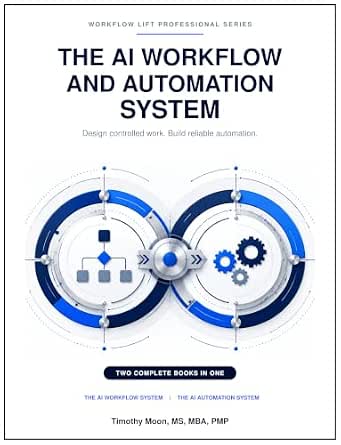 AI Workflow and Automation System – Workflow Lift Professional SeriesView on Amazon →
- 13
 n8n AI Automation: Build Smarter Workflows, Agents, and Intelligent Systems w…View on Amazon →
- 14
 Agentic Coding with Claude Code (5-in-1): A Practical Developer’s Handbook fo…View on Amazon →
The Trade-Off Between Speed and Control
The comparison addresses a practical buying problem: automation software can save effort only when teams can build and maintain useful workflows. ThorstenMeyerAI.com’s guide suggests no-code products may help nontechnical users get started, while code-first frameworks can give engineers more control over complex logic. A mismatch can leave a tool unused or produce workflows that are difficult to change.
The guide also warns that these choices can affect spending and risk. It notes that task-based pricing may rise with usage and that workflows can move sensitive information between services. Readers should treat the publisher’s recommendations as a starting point, then verify actual connector availability, costs, security terms and maintenance requirements against their own systems.
Products Worth Considering

Jackery HomePower 3600 Plus Portable Power Station, 3584 Wh, 3600 W

Anker SOLIX C300 DC Portable Power Station, 288Wh, 300W

Jackery Solar Generator 1000 V2 with 200W Solar Panel, 1,070Wh, 1,500W, Dune White
As an affiliate, we earn on qualifying purchases.
How the Guide Sorts Its Picks
ThorstenMeyerAI.com distinguishes among no-code playbooks, developer-focused frameworks and enterprise guidance, rather than treating AI automation as one uniform category. The guide argues that a manager without programming support may struggle with a Python-oriented framework, while engineers may find simple visual tools restrictive when workflows need branching logic or custom behavior.
As described in the supplied material, the guide prioritizes resources that translate concepts into actionable steps and address operational bottlenecks. It also emphasizes checking whether required applications have supported APIs and whether connectors are actively maintained. The publisher offers selection advice, but the material provided here does not include a full methodology, scoring table or documented test results.
What the Comparison Does Not Show
The supplied source excerpt does not name all 14 resources, provide their individual prices or explain how each was tested. It is also unclear whether the recommendations reflect hands-on product trials, the quality of written guides, or both. “Overall choice” is ThorstenMeyerAI.com’s judgment, not a result supported here by performance data.
The source flags security, integration and scaling concerns but does not report a specific breach, outage or measured cost comparison. It also does not establish that any one platform is suitable for every organization in a given sector. Buyers need to check current product documentation and compliance commitments directly, since features and pricing can change.
Checks to Make Before Choosing
The guide advises readers to match a candidate to a real workflow: identify the applications involved, the data being moved and the decisions the automation must make. Teams can then test a small process and check failure handling, connector reliability and the time needed for upkeep before expanding it.
Before committing, compare total costs at expected usage and review data-processing terms, access controls and audit features. ThorstenMeyerAI.com announces no follow-up or product launch in the supplied material; the comparison remains guidance, and teams must validate whether its recommendations fit their own technical and regulatory requirements.
Key Questions
What is the guide’s overall recommendation?
ThorstenMeyerAI.com names The No-Code AI Automation Playbook as its overall choice for business users seeking to start without coding. That is the publisher’s recommendation, not an independently verified ranking in the supplied source.
Which option does the guide suggest for developers?
ThorstenMeyerAI.com points developers seeking more control over custom agents toward n8n AI Automation, citing Python integration. Teams should confirm the current technical requirements and integrations before choosing it.
Does the source document all 14 picks?
No. The supplied material says the guide covers 14 options, but it does not provide all 14 names or a complete item-by-item comparison.
What should a team check before buying automation software?
The guide advises checking whether the platform supports required applications and APIs, how its pricing scales, how it handles sensitive data, and what tools it offers for monitoring and fixing errors. The team’s coding skills and maintenance capacity also matter.
Source: ThorstenMeyerAI.com