
TL;DR

Get everyday essentials delivered free with Prime
- Fast, free delivery on millions of items
- Prime Video, Amazon Music and more included
- Member-only deals all year
Google DeepMind presented Genie 4 on October 27, describing it as a real-time world model that generates scenes users can explore and change with text or controls. The company has not published benchmark figures, and it says objects can drift and interaction lasts only a few minutes. Access remains limited to trusted testers, with broader availability promised but undated.
Google DeepMind presented Genie 4 on October 27, describing it as a real-time AI world model that generates scenes people can move through and alter with text prompts. The announcement points to possible uses in game prototyping, film previsualization and robotics research, but the system is available only to trusted testers, and DeepMind says its generated worlds can drift over time.
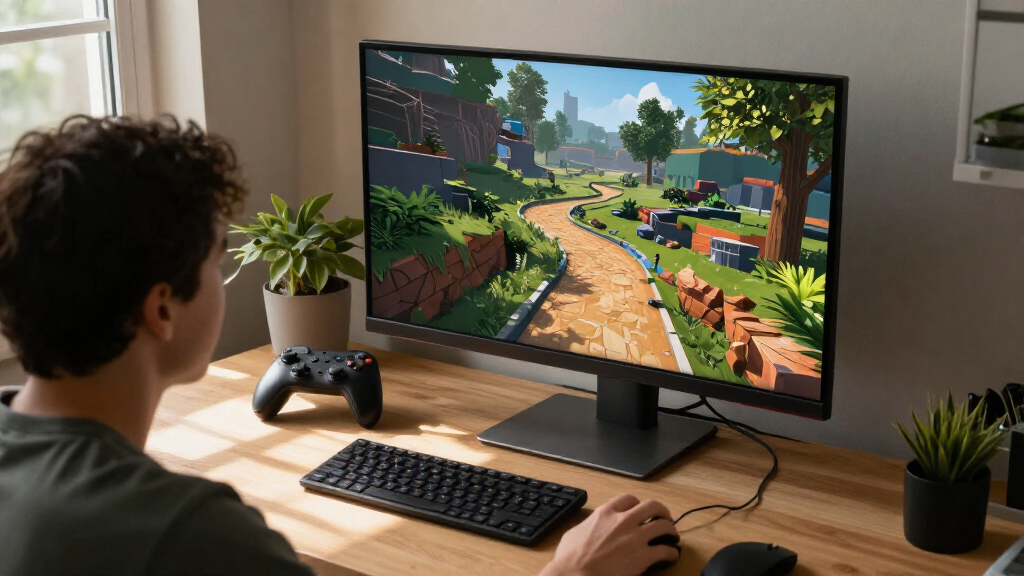
Unlike a conventional video generator that renders a clip from a prompt, Genie 4 produces the next part of a scene as a user interacts with it. DeepMind says users can steer scenes with keyboard and mouse controls, then issue instructions such as changing the weather or adding an object. The company also says the model generates audio alongside images, including environmental sounds, music and dialogue.
DeepMind says Genie 4 can simulate events including collisions and aerodynamics and can produce more natural-looking people than earlier versions. Its announcement describes Gemini models as working alongside the world model: Gemini 3.8 Flash can break a goal into steps and monitor generated frames, while DeepMind says Gemini Omni helps anchor simulations in real-world appearance and behavior. These are company descriptions; DeepMind did not publish benchmark results in the source material.
The system is not publicly available. DeepMind says it is being tested by a limited group and is expected to come to Google AI Ultra subscribers through Project Genie and early Gemini API partners. The source reports no launch date or API price. It also says DeepMind promises invisible SynthID watermarks in Genie 4 video and audio outputs.
What Interactive Worlds Could Enable
Genie 4’s significance is its combination of on-the-fly scene generation and user control. If the system can reliably maintain a scene while responding to movement and instructions, it could give creative teams a faster way to test environments and concepts than building each one manually. DeepMind has reported tester feedback pointing to film previsualization and game prototypes, but that feedback is not independent evidence of commercial performance.
The research also touches robotics, where simulated environments can help researchers test tasks before using physical machines. The source describes a demonstration involving a simulated Apptronik Apollo humanoid playing checkers; no real robot took part. The distinction matters: a demonstration of a generated scenario does not establish that Genie 4 can train robots reliably or improve their real-world performance.
For the public, sound-enabled synthetic scenes raise questions about how people identify generated media. DeepMind says outputs will carry SynthID, but the source does not provide details about how the watermark can be detected or how it performs after editing or sharing. The potential uses are therefore paired with open questions about consistency, verification and practical access.
Products Worth Considering

Logitech MX Mechanical Wireless Illuminated Keyboard, Tactile Quiet, Graphite

Logitech MX Keys S Wireless Keyboard, Graphite

Bose QuietComfort Wireless Bluetooth Headphones with Active Noise Cancellation, Mic, USB‑C Charging, Deep Bass, 24‑Hour Battery – White Smok
As an affiliate, we earn on qualifying purchases.
From Genie 3 to Real-Time Scenes
Genie 4 follows earlier versions that DeepMind described as increasingly interactive. The source says the original Genie, introduced in February 2024, generated simple 2D worlds. Genie 2, announced in December 2024, generated 3D worlds from a single image and maintained them for up to a minute, though its real-time version ran at lower quality. Genie 3, in August 2025, was described as a real-time model running at 720p and 24 frames per second for a few minutes.
A world model differs from a traditional game engine, which draws scenes from a stored map of objects and spaces. As described in the source, Genie 4 instead predicts what comes next from earlier frames and user input. That approach can produce flexible scenes without a conventional stored 3D map, but it also helps explain why objects and details may shift as a session continues.
The available evidence has limits. DeepMind’s selected demonstration clips show what the company chose to present, not a full independent evaluation of performance across prompts or extended sessions. The source also reports that TechCrunch and Bloomberg, cited by heise, described scenes lasting about two minutes; that figure is not in DeepMind’s own wording.
“Details and objects “can shift or drift over time.””
— Google DeepMind
Limits, Testing and Access
Several central details remain unconfirmed or undisclosed. DeepMind has not provided benchmark numbers in the source material, and the article’s account says the public has not yet been given access to test Genie 4 directly. The length of reliable interaction is also unclear: DeepMind says “a few minutes,” while other outlets cited in the source report sessions of about two minutes.
It is not clear how consistently Genie 4 maintains the same objects and layout across different prompts, how its audio performs in longer interactions, or what computing resources are required. The source also provides no date for access through Project Genie or the Gemini API, and no API pricing. Claims about uses in creative work are based on tester feedback reported by DeepMind, while the robotics example is a simulation rather than a physical robot trial.
Broader Testing Has No Date
DeepMind has said Genie 4 is being tested by trusted users and is expected to reach Google AI Ultra subscribers through Project Genie and early Gemini API partners. The company has not announced a timetable, API price or detailed access conditions. The next meaningful evidence will come from wider testing and clearer information on performance, session limits and availability.
Until then, Genie 4 should be understood as a research and product demonstration with potential uses, not as a broadly available tool with independently established capabilities. Further evaluations would help show whether generated worlds remain coherent beyond short demonstrations and whether the system’s audio and interactive controls work reliably across varied tasks.
Key Questions
What is Genie 4?
Genie 4 is a world model that DeepMind says generates interactive scenes in real time. Users can move through them and issue instructions that change what happens.
Can the public use Genie 4 now?
No. The source says Genie 4 is limited to trusted testers. DeepMind has indicated future access through Project Genie for Google AI Ultra subscribers and to early Gemini API partners, but has not given a date.
How long can a Genie 4 world last?
DeepMind describes “a few minutes of continuous interaction” and warns that objects and details can drift. Other outlets cited in the source report scenes of about two minutes, but that precise figure is not in DeepMind’s own statement.
Does Genie 4 generate sound?
DeepMind says it generates audio together with the scene, including ambient sounds, music and dialogue. The source provides no independent benchmark of audio quality or consistency.
Has Genie 4 been shown training a real robot?
The source describes a robotics research demonstration in which a humanoid was simulated playing checkers. It says no physical robot was involved, so the demonstration does not establish real-world training results.
Source: Thorsten Meyer AI