TL;DR

Get everyday essentials delivered free — and shop member deals
- Fast, free delivery on millions of items
- Access to Prime Big Deal Days deals on October 6–7
- Prime Video, Amazon Music and more included
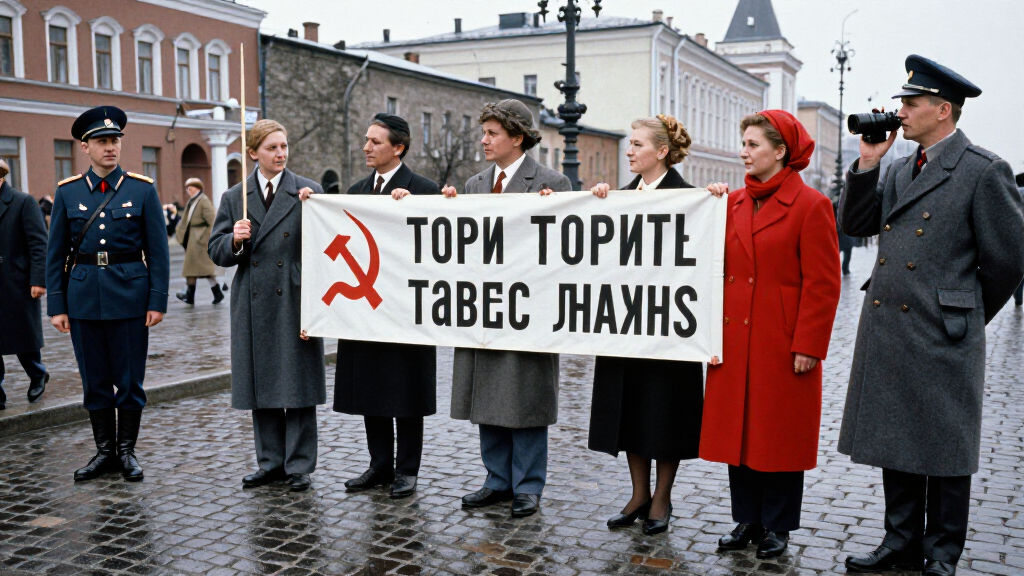
On Dec. 5, 1965, several dozen people gathered at Moscow’s Pushkin Square to demand an open trial for writers Andrei Sinyavsky and Yuli Daniel. The brief protest, organized by Alexander Volpin, called on Soviet authorities to follow their own laws and is widely regarded as a starting point for the Soviet dissident movement.
On Dec. 5, 1965, several dozen people gathered at Pushkin Square in Moscow to demand an open trial for writers Andrei Sinyavsky and Yuli Daniel, challenging Soviet authorities to obey the country’s own laws. The rally, organized by mathematician and poet Alexander Volpin, lasted only a few minutes before officials dispersed it, but it helped launch a dissident movement built around public scrutiny of state repression.
The demonstrators did not call for a change of government or a broad political reform program. Their demand was narrower: that the state respect citizens’ legal right to an open trial. The rally turned a legal principle into a public challenge at a time when authorities controlled political demonstrations and restricted independent reporting.
Volpin’s action was prompted by the prosecution of Sinyavsky and Daniel, writers whose work could not be published legally in the Soviet Union. They had sent writing abroad under pseudonyms, and their case became the first major public trial of writers in the post-Stalin period. A public appeal for an open hearing challenged the state’s ability to handle such a case behind closed doors.
Meduza’s retrospective says the protest received almost no coverage in Soviet newspapers, yet its significance extended beyond the square. The action established a model for dissent that appealed to the government’s stated laws and rights, rather than demanding immediate political power or relying on a mass demonstration.
A Legal Demand Becomes Dissent
The protest mattered because it made a limited, recognizable demand in a system where open opposition was dangerous: apply the law publicly. That approach let participants expose the gap between constitutional promises and state practice without presenting the rally as an attempt to overthrow the government.
Its influence was less about the size of the crowd than the form of protest. A brief gathering, largely ignored by official newspapers, became an example for people seeking to document repression and hold authorities to their own stated rules. Meduza describes the rally as helping launch the Soviet dissident movement; that characterization refers to its historical role, not to an immediate political victory. The writers’ case and the state’s restrictions continued.
As an affiliate, we earn on qualifying purchases.
From the Thaw to Pushkin Square
The demonstration took place after years in which independent political rallies had been suppressed. The Soviet authorities had used force against earlier protests, including a peaceful 1918 march in support of the Constituent Assembly, while unauthorized political demonstrations had largely disappeared by the end of the 1920s. The post-Stalin Thaw loosened some cultural restrictions, but it did not create a right to protest.
In 1962, Soviet forces fired on workers protesting prices and wage cuts in Novocherkassk. The authorities kept information about the killings and subsequent trials secret. That episode made clear that the easing of cultural controls had firm limits. By 1965, young poets associated with the group SMOG were holding readings and circulating samizdat, while the Sinyavsky–Daniel case brought renewed pressure on writers. Volpin’s rally emerged from that tension between limited public life and continued state control.
“The protest was organized to remind the authorities publicly of citizens’ right to an open trial.”
— Alexander Volpin, as described in Meduza’s retrospective
As an affiliate, we earn on qualifying purchases.
Limits of the Historical Record
The account supplied for this article does not detail the exact number of people at the rally beyond saying several dozen, nor does it identify all participants or provide a complete account of arrests or other consequences for them. It also does not establish that the demonstration alone caused the dissident movement to form; Meduza presents it as a key early event that helped launch that movement.
The available material gives only part of the Sinyavsky–Daniel case and does not set out the full trial timeline, verdicts, or every response to Volpin’s appeal. Those details should not be inferred from the protest’s stated demand or its later historical reputation.
Cold War protest history documentaries
As an affiliate, we earn on qualifying purchases.
As an affiliate, we earn on qualifying purchases.
What the Anniversary Revisits
Meduza’s Oct. 7, 2026, report revisits the rally as a 60-year-old turning point, placing it within the history of Soviet protest and the prosecution of writers. The material provided does not announce a new legal or political development tied to the anniversary. The next step for readers seeking a fuller record is to consult the complete historical account and documentation of the trial and participants, rather than treating the anniversary retrospective as evidence of a new event.
As an affiliate, we earn on qualifying purchases.
Key Questions
What did the protesters demand?
They called for an open trial for writers Andrei Sinyavsky and Yuli Daniel and urged Soviet authorities to follow their own laws.
Who organized the 1965 protest?
The rally was organized by Alexander Volpin, a mathematician and poet, according to Meduza’s retrospective.
Where and when did it take place?
Several dozen people gathered at Pushkin Square in Moscow on Dec. 5, 1965. The rally lasted a few minutes before authorities dispersed it.
Were protesters calling for the Soviet government to be overthrown?
No. Meduza says they were not seeking a change of government or political reforms. Their stated demand concerned the right to an open trial.
Why is the protest remembered?
It is remembered as an early public challenge to Soviet secrecy that relied on the state’s own legal promises. Meduza says it helped launch the Soviet dissident movement, though the rally did not itself end state repression.
Source: rss
Halloween Picks
halloween
As an affiliate, we earn on qualifying purchases.