
📊 Full opportunity report: Community volunteer action tracker for local boards on IdeaNavigator AI — validation score, market gap, and execution plan.

Get everyday essentials delivered free with Prime
- Fast, free delivery on millions of items
- Prime Video, Amazon Music and more included
- Member-only deals all year
TL;DR
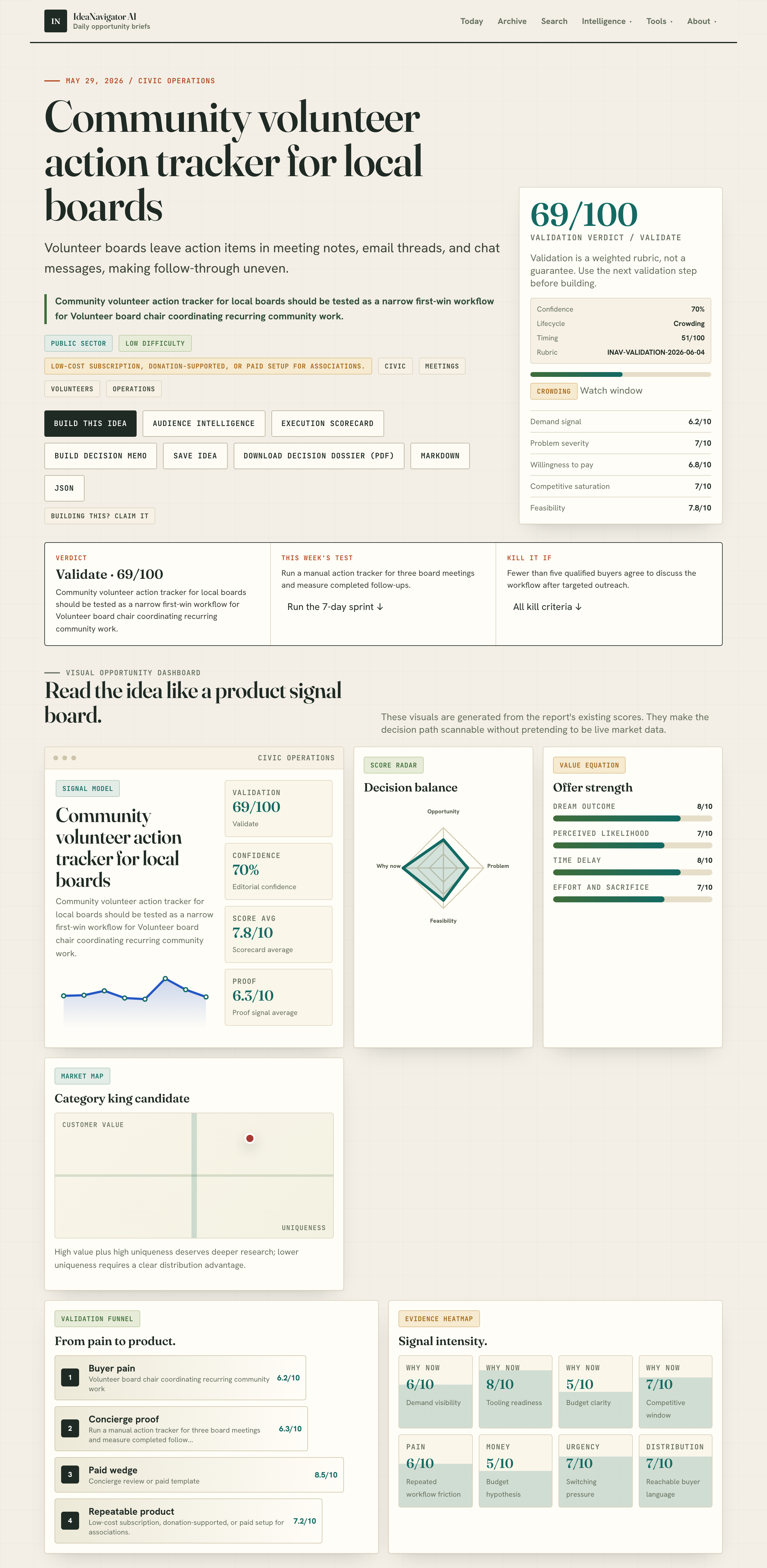
A community volunteer action tracker is being tested for local boards to improve follow-up on community projects. The initial test involves tracking actions from three meetings. This development aims to address follow-through issues in civic groups relying on volunteers.
A new volunteer action tracker for local community boards is being tested as a tool to improve follow-up on meeting decisions and community projects. The initiative aims to address the common problem of volunteer groups leaving action items in informal notes and messages, which hampers follow-through. The testing is intended to serve as a proof of concept before broader adoption.
The proposed tool is a meeting-action tracker that automatically extracts decisions made during meetings, assigns responsibility to specific volunteers or members, tracks due dates, and sends weekly reminders to ensure follow-through. This approach is intended for volunteer board chairs who coordinate recurring community work and currently rely on informal communication channels.
The initial validation involves running the tracker manually for three consecutive board meetings and measuring how many follow-up actions are completed. The tracker is envisioned as a low-cost subscription service, supported by donations or paid setup fees for associations. The target market includes civic organizations and local government advisory groups seeking more efficient coordination.
Potential Impact on Civic Group Coordination Efficiency
This development could significantly improve how volunteer-led community groups manage ongoing projects. By providing a structured, automated system for tracking actions, it may reduce missed follow-ups and improve community engagement. The tool’s low-cost model makes it accessible for small civic groups with limited budgets, potentially increasing participation and project completion rates.
Products Worth Considering

Logitech MX Keys S Combo Wireless Keyboard and Mouse, Graphite

Apple Watch SE 3 GPS 40mm Smartwatch

LG UltraGear 25G590B-B 25-Inch Full HD 1000Hz Gaming Monitor
As an affiliate, we earn on qualifying purchases.
Addressing Follow-Up Challenges in Volunteer Boards
Volunteer boards and civic groups often leave action items in meeting notes, emails, and chat messages, leading to inconsistent follow-up and project delays. While some organizations use manual tracking or informal reminders, these methods are often unreliable. The idea of a dedicated action tracker has been discussed as a way to formalize follow-up processes, but practical testing has been limited.
The current initiative is a first step toward validating whether a simple, automated meeting-action tracker can serve as an effective solution, with plans to refine the tool based on real-world use.
“Implementing a structured action tracker could transform volunteer coordination by ensuring accountability and timely follow-up.”
— an anonymous researcher
Uncertainties About Tracker Effectiveness and Adoption
It is not yet clear how effectively the tracker will improve follow-up in diverse civic groups or whether volunteers will adopt the tool consistently. The success of the initial test depends on user engagement and accurate tracking, which remain to be confirmed.
Next Steps in Validation and Potential Broader Rollout
The project team plans to run the manual tracker for three upcoming board meetings, then evaluate the completion rate of follow-up actions. If successful, they may develop a digital version and explore broader deployment to other civic organizations. Further feedback from users will guide improvements and potential commercialization.
Key Questions
How will the tracker be implemented in volunteer groups?
The tracker will initially be used manually, with volunteers inputting decisions and assigned tasks, before possibly developing an automated digital version.
What are the costs associated with using the tracker?
The tracker is planned to be a low-cost subscription service, with options for donation support or paid setup for organizations.
Will the tracker be available for all types of civic groups?
The initial focus is on local boards and civic organizations that coordinate recurring community work, with potential expansion based on success.
What challenges might affect the tracker’s adoption?
Volunteer engagement, consistent use, and integration with existing communication channels are potential hurdles that will be assessed during testing.
Source: IdeaNavigator AI