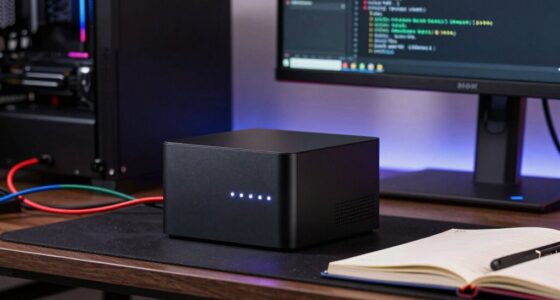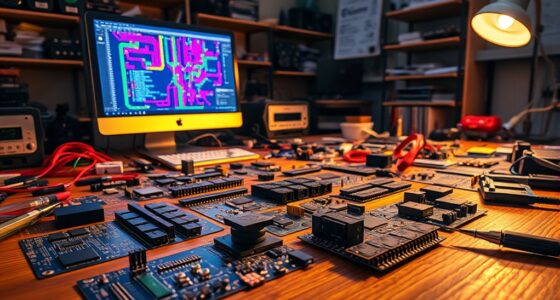

AI is sparking renewed interest in specialty hardware because traditional processors like CPUs and GPUs struggle with complex models, pushing the need for tailored solutions. Emerging technologies like quantum computing and edge acceleration offer unprecedented speed and efficiency, enabling smarter, faster AI applications. Designing hardware specifically for AI tasks now becomes as important as developing algorithms. If you keep exploring, you’ll discover how these innovations are shaping the future of AI technology.

Get everyday essentials delivered free with Prime
- Fast, free delivery on millions of items
- Prime Video, Amazon Music and more included
- Member-only deals all year
Key Takeaways
- Growing AI complexity drives demand for specialized hardware to improve performance and efficiency beyond traditional CPUs and GPUs.
- Quantum computing offers revolutionary processing capabilities that could accelerate AI training and problem-solving.
- Development of AI-specific hardware accelerators enhances resource efficiency and enables deployment in edge devices.
- Edge hardware accelerators facilitate real-time processing, reducing latency and bandwidth for applications like autonomous vehicles.
- The synergy of quantum and edge hardware innovations is making specialized solutions essential for future AI advancements.
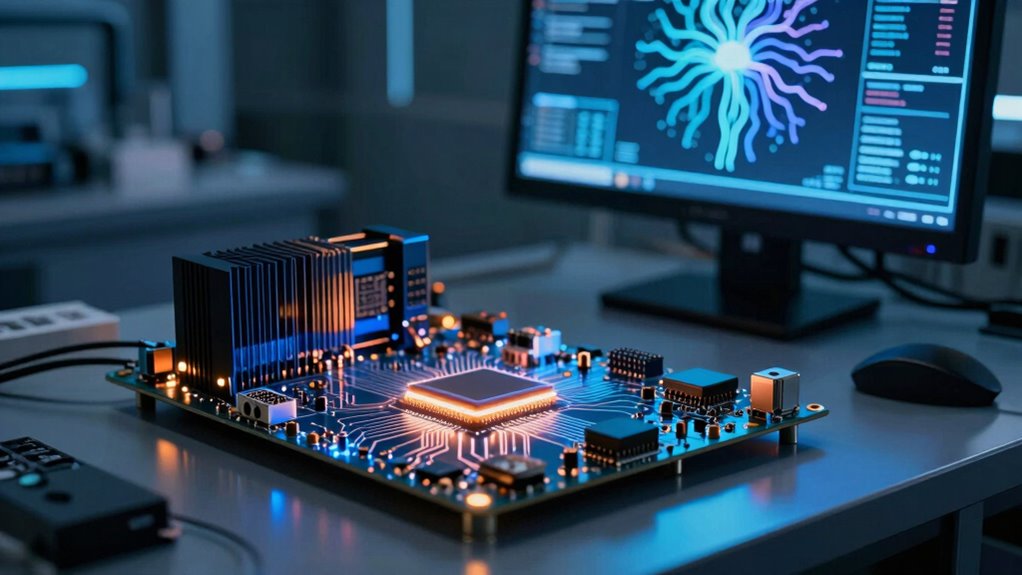
As artificial intelligence continues to advance, it’s sparking renewed interest in specialty hardware designed to optimize its performance. You’re likely aware that traditional CPUs and GPUs have served well, but as AI models grow more complex, these general-purpose processors are hitting their limits. That’s where specialized hardware comes into play, offering tailored solutions that push the boundaries of speed and efficiency. Quantum computing, for instance, is emerging as a game-changer, promising revolutionary leaps in processing power that could accelerate AI training and inference beyond current capabilities. Although still in nascent stages, quantum processors hold potential for solving problems that classical computers struggle with, such as optimizing large neural networks or simulating complex systems. Their ability to perform many calculations simultaneously could dramatically shorten AI development cycles, making breakthroughs happen faster. Additionally, specialized hardware architectures are being developed to better leverage these advanced computing paradigms, further enhancing AI capabilities. Meanwhile, edge acceleration is gaining traction as AI applications move closer to the data source. Instead of relying solely on centralized data centers, you’re seeing a surge in hardware designed for edge devices—smartphones, IoT sensors, autonomous vehicles—that need real-time processing. Specialized chips optimized for edge acceleration enable these devices to analyze data locally, reducing latency and bandwidth demands. This means faster decision-making, enhanced privacy, and improved user experiences. For example, in autonomous vehicles, edge-optimized AI hardware can process sensor data instantly to make split-second driving decisions, all without needing to send data to the cloud. This level of performance relies heavily on custom hardware architectures that are more efficient than traditional components. Additionally, the development of AI-specific hardware accelerators is crucial for maximizing efficiency and performance in real-world AI deployments. What’s compelling about these developments is how they complement each other. Quantum computing could revolutionize AI’s foundational algorithms, enabling smarter, more capable models, while edge acceleration ensures these models can run efficiently in real-world, resource-constrained environments. As you look at the landscape, it’s clear that specialty hardware isn’t just a niche—it’s becoming central to AI’s future. These innovations are not only about improving performance but also about accessing new applications that were previously impossible due to hardware limitations. You’re witnessing a shift where hardware design is becoming as critical as the algorithms themselves. This synergy between advanced computing paradigms like quantum tech and practical solutions like edge acceleration will shape AI’s trajectory for years to come, fueling faster, smarter, and more accessible AI systems worldwide.
AI hardware accelerators for edge devices
As an affiliate, we earn on qualifying purchases.
As an affiliate, we earn on qualifying purchases.
Frequently Asked Questions
How Does AI Influence the Design of Specialty Hardware?
AI influences your specialty hardware design by optimizing user interfaces, making devices more intuitive and responsive. It also drives material innovation, helping you select advanced materials that enhance performance and durability. Through simulations and data analysis, AI guides your design process, enabling rapid prototyping and customization. As a result, your hardware becomes more efficient, user-friendly, and innovative, giving you a competitive edge in the evolving market.
What Are the Cost Implications of Ai-Driven Hardware Development?
AI-driven hardware development can boost cost efficiency by optimizing designs and reducing prototyping costs. However, you should also consider investment risks, as integrating advanced AI technologies demands substantial upfront expenses and specialized expertise. While initial costs may be high, in the long run, AI can streamline production and improve performance, potentially offsetting risks. Ultimately, balancing these factors helps you make informed decisions about adopting AI-driven specialty hardware.
How Secure Is Ai-Optimized Specialty Hardware Against Cyber Threats?
Is your AI-optimized specialty hardware truly secure against cyber threats? It’s a valid concern, as cybersecurity vulnerabilities and encryption challenges can expose these systems to attacks. While advancements boost performance, they also create new attack surfaces. You should prioritize robust security measures, like layered defenses and continuous updates, to mitigate risks. Ultimately, no system is invulnerable, but proactive strategies help safeguard your valuable AI hardware investments.
Can AI Replace Traditional Manufacturing Methods for Hardware?
AI can profoundly enhance manufacturing, but it won’t fully replace traditional methods. You’ll see assembly automation become smarter, speeding up production and reducing errors. Material innovation driven by AI helps develop stronger, more efficient components. However, human oversight remains essential for complex tasks and quality control. So, AI acts as a powerful supplement, transforming how you build hardware, rather than completely replacing the traditional manufacturing process.
What Industries Benefit Most From Ai-Enhanced Specialty Hardware?
Think of industries as ships steering through complex waters; AI-enhanced specialty hardware acts as your lighthouse. Quantum computing firms, renewable energy sectors, and healthcare benefit most, leveraging breakthroughs in sustainable materials and processing speed. You’ll find that these innovations accelerate research, reduce costs, and improve precision. By adopting AI-driven hardware, you empower your industry to stay competitive, innovative, and eco-friendly—guiding you safely through the technological storm toward a brighter, more efficient future.
quantum computing development kits
As an affiliate, we earn on qualifying purchases.
As an affiliate, we earn on qualifying purchases.
Conclusion
As you see, AI’s push for specialized hardware is transforming the tech landscape. With over 50% of data centers expected to adopt AI-specific chips by 2025, it’s clear this shift isn’t slowing down. You can expect faster processing, more efficient power use, and new opportunities in fields like healthcare and autonomous vehicles. Embrace these innovations, because they’re shaping the future of technology—and your role within it.
As an affiliate, we earn on qualifying purchases.
As an affiliate, we earn on qualifying purchases.
Halloween Picks
halloween
As an affiliate, we earn on qualifying purchases.