
📊 Full opportunity report: Making Parental Consent Easier To Manage For Kid-Facing Vendors on IdeaNavigator AI — validation score, market gap, and execution plan.

Get everyday essentials delivered free with Prime
- Fast, free delivery on millions of items
- Prime Video, Amazon Music and more included
- Member-only deals all year
TL;DR
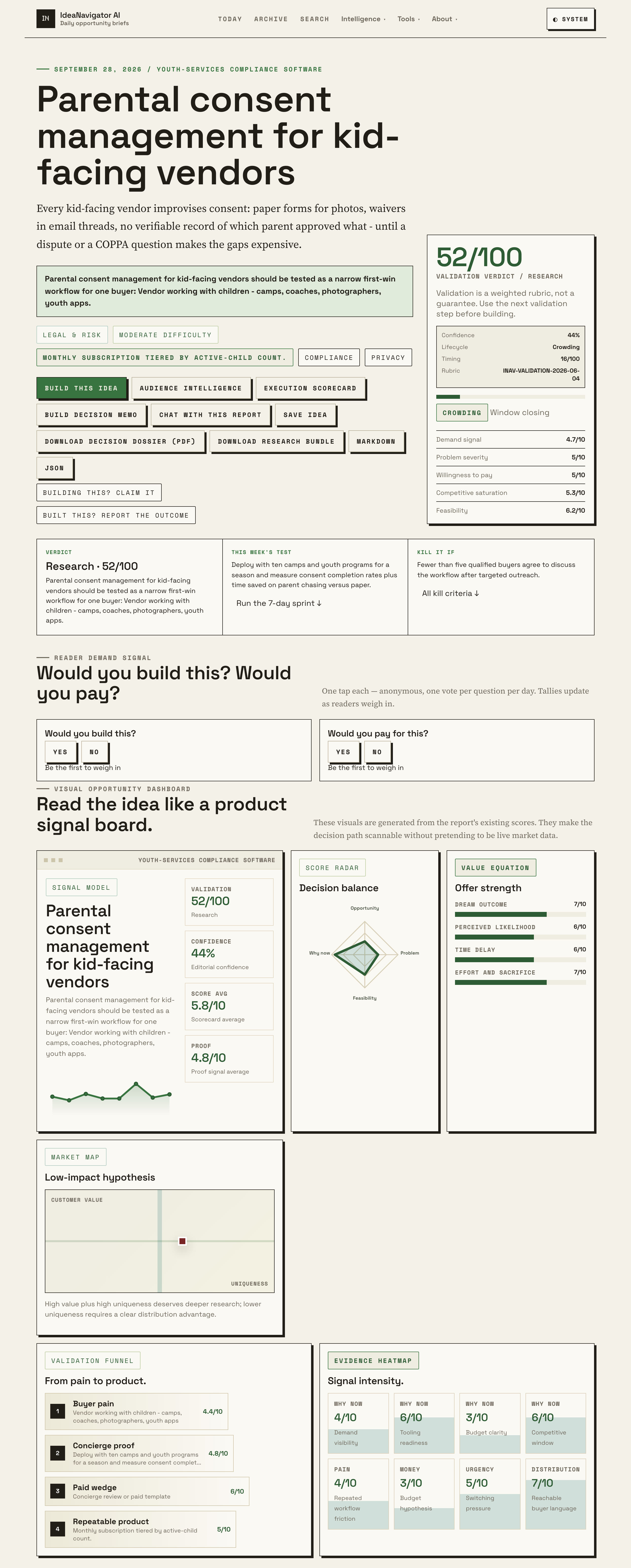
A proposal describes a consent-management service for camps, coaches, photographers and youth apps, with mobile forms, per-child records and audit exports. It recommends testing the workflow with ten programs for a season; no launch, pilot results or customer commitments are reported.
IdeaNavigator AI has outlined a proposed consent-management service for camps, coaches, photographers and youth apps, aiming to give parents a phone-based way to approve how vendors use children’s photos, data and other information. The proposal calls for testing the workflow with ten camps and youth programs for one season; it does not report that a product has launched or that a pilot is underway.
The proposed service would let vendors create branded consent flows that parents complete on their phones. Suggested consent categories include photo use, data collection, medical information and liability waivers. The proposal also lists identity checks matched to the risk of each request, a separate record for each child, expiry tracking and an exportable audit record.
The problem it seeks to address is fragmented recordkeeping. The proposal says vendors may currently rely on paper forms, email threads and improvised processes, leaving them without a clear record of which parent approved which use. It argues that gaps may become costly when a dispute arises or a vendor faces a question about children’s privacy obligations.
The proposed business model is a monthly subscription priced by the number of active children. To assess whether the service solves a practical problem, IdeaNavigator AI suggests a seasonal trial with ten camps or youth programs, measuring consent completion rates and time spent following up with parents compared with paper-based processes.
A Clearer Record of Parent Approvals
For organizations that collect permissions from many families, one system could make it easier to see which child has approval for which activity and whether that permission has expired. A retrievable record could also help a vendor respond when a parent asks how a photograph or piece of information was used. These are intended benefits in the proposal, not outcomes demonstrated by a deployed service.
The idea targets smaller youth-service providers as well as apps. A subscription based on active-child counts could connect the price to the number of records a program manages, though the proposal gives no rates or evidence about what vendors would pay. Whether it saves enough staff time to justify a recurring fee is one of the questions a pilot would need to answer.
The proposal points to changing privacy expectations and regulation as reasons to examine the problem now, including updates to the U.S. Children’s Online Privacy Protection Rule and state laws. It does not identify particular legal requirements or explain how a product would meet them. A consent record may support administration, but the proposal does not establish that using the service would itself satisfy a vendor’s legal duties.
From Paper Forms to Phone-Based Consent
The concept is framed as a narrow first product for vendors working with children, rather than a general-purpose consent platform. Its suggested customers span in-person services such as camps and coaching, photography businesses and youth-focused apps. Those settings can involve different types of information and different levels of risk, which is why the proposal includes identity verification tailored to the request.
The proposed workflow would combine several tasks that may otherwise be handled separately: asking for permission, keeping the approval linked to a child, recording an expiry date and retrieving the record later. The proposal does not describe the technical design, how parent identity would be checked, how consent could be changed or withdrawn, or how the service would handle data retention and security.
IdeaNavigator AI’s recommendation is to validate demand through a season-long test rather than assume that a product is ready for broad adoption. The suggested measures—completion rates and time spent chasing parents—focus on usability and staff workload. No participating programs, test dates or baseline figures are provided.
Pilot Results and Legal Scope
No product launch or pilot is confirmed, and the proposal provides no evidence that vendors have agreed to participate. It also gives no completion rates, time-savings data, pricing, customer interviews or estimate of the size of the potential market.
It remains unclear what identity checks would be used for different consent requests, how parents could update or revoke permission, and how records would be protected, retained or shared. The proposal mentions privacy regulation and disputes as motivating concerns, but does not specify which legal obligations apply to each type of vendor or claim that a digital ledger would meet them.
A Seasonal Test Would Measure Demand
The next step proposed is to recruit ten camps or youth programs for a season-long test. Organizers would compare consent completion and staff time spent following up with parents against paper-based processes. Those measures could indicate whether the workflow is usable and whether it reduces administrative work.
Before a test could establish wider value, its scope, participating programs, timing and comparison method would need to be set. The proposal does not say who would build or run the service, when a pilot might begin, or whether results would be published. Until those details emerge, the concept remains a product opportunity under consideration.
Key Questions
Has a parental consent product launched?
No launch is reported. IdeaNavigator AI has outlined a proposed service and a way to test it.
Who is the proposed service for?
The suggested customers are camps, coaches, photographers and youth apps that need parent permissions related to children.
What would parents be asked to do?
The proposal describes branded forms completed on a phone, covering areas such as photo use, data collection, medical information and liability.
Would using the service guarantee compliance with privacy laws?
That is not established. The proposal presents recordkeeping as a response to privacy concerns but does not explain how the service would meet specific legal requirements.
How would the idea be tested?
IdeaNavigator AI proposes a seasonal trial with ten camps and youth programs, tracking consent completion rates and time spent following up with parents. No trial or results are confirmed.
Source: IdeaNavigator AI
Halloween Picks
halloween
As an affiliate, we earn on qualifying purchases.