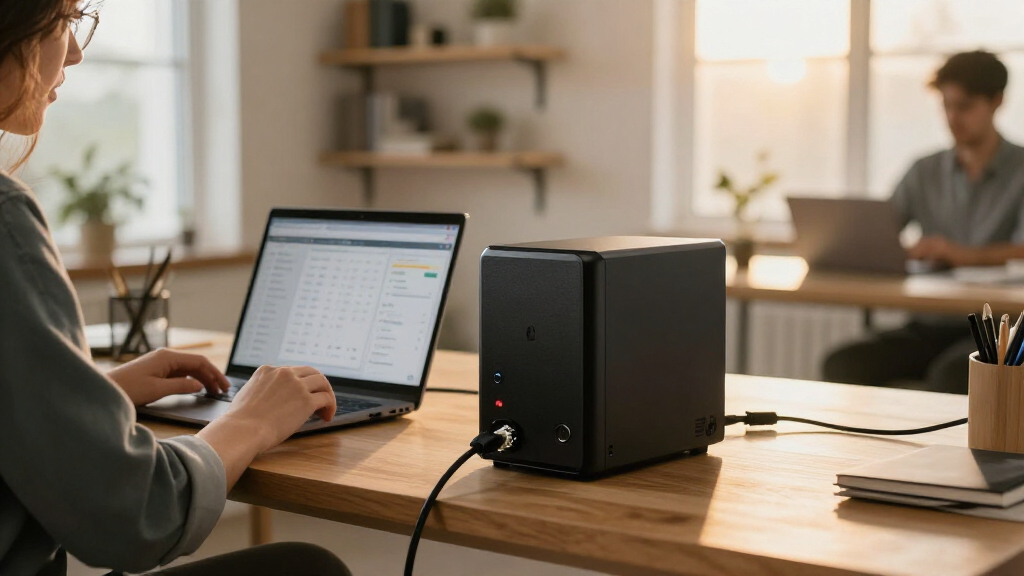

🔍 Read the full analysis: 10 Network Attached Storage Devices For Home Setups And Businesses In 2027 on ThorstenMeyerAI.com

Get everyday essentials delivered free with Prime
- Fast, free delivery on millions of items
- Prime Video, Amazon Music and more included
- Member-only deals all year
TL;DR
ThorstenMeyerAI.com’s 2027 guide compares 10 network-attached storage devices for home and business use, ranking the Synology DS225+ as its best overall balance. The picks range from single-bay units for basic file sharing to rackmount systems for larger storage plans; drive bundles, pricing and detailed specifications are not provided in the source material.
ThorstenMeyerAI.com has published a 2027 guide ranking 10 network-attached storage (NAS) devices for home and business use. The guide ranks the Synology DS225+ first, citing its two-bay format and suitability for a range of home storage needs. The lineup includes single-drive products, personal-storage systems and rackmount hardware with different capacity, redundancy and maintenance considerations.
The guide ranks the Synology DS225+ first, describing it as a balance of shared storage, capacity choices and manageable home setup. It also identifies the UGREEN NASync DXP2800 for personal storage and the QNAP TS-864eU-8G-US for rack-based deployments requiring more bays. These are the guide’s editorial assessments; the supplied material does not report independent testing results.
The 10 named devices are the Synology DS225+, UGREEN NASync DXP2800, QNAP TS-864eU-8G-US, BUFFALO TeraStation 5420RN, BUFFALO LinkStation 210, Synology DS124, Synology DS223j, UGREEN DH2300, and two configurations or listings of the BUFFALO LinkStation 210. The source names the LinkStation line but does not distinguish the two entries with model suffixes or separate specifications, so the information provided does not identify 10 distinct model names.
The recommendations address different intended uses. One-bay systems are described as options for basic file sharing, while multi-bay products offer more capacity-planning options and the potential for drive redundancy. The guide also distinguishes diskless systems, which require a separate drive purchase, from products sold with drives. It does not provide a complete price list, capacity configuration or detailed specification sheet for every entry.
The 10 picks
- 1
 QNAP TS-864eU-8G-US 8-Bay Short-Depth Rackmount NAS, DisklessView on Amazon →
- 2
 UGREEN NAS DXP4800 Pro 4-Bay Desktop NAS with Intel Core i3-1315U, 8GB DDR5,…View on Amazon →
- 3
 UGREEN NAS DXP2800 2-Bay for Advanced Home Users, Remote Workers & CreatorsView on Amazon →
- 4
 Synology DS225+ 2-Bay Diskless NASView on Amazon →
- 5
 UGREEN NAS DH2300 2-Bay Desktop NASync, Support Capacity 64TB (Diskless), Rem…View on Amazon →
- 6
 BUFFALO TeraStation 5420RN 4-Bay Rackmount NAS, 32 TB with Four 8 TB DrivesView on Amazon →
- 7
 Synology DiskStation DS223j 2-Bay NAS Enclosure (Diskless)View on Amazon →
- 8
 BUFFALO LinkStation 210 4TB 1-Bay Network Attached StorageView on Amazon →
- 9
 Synology DS124 1-Bay Diskless NAS for Backup, File Sharing, and Home Surveill…View on Amazon →
- 10BUFFALO LinkStation 210 2TB 1-Bay NAS Network Attached StorageView on Amazon →
How Bay Count Changes the Tradeoffs
The guide notes that a NAS enclosure is not, by itself, a complete backup plan. A single-bay system has no internal drive redundancy, so a drive failure can make its files unavailable. Two bays may allow mirroring, which can preserve access after one drive fails, but reduces usable capacity and does not protect against accidental deletion, malware, theft or damage to the whole device.
For businesses, desktop and rackmount equipment differ in installation requirements and potential upkeep. The guide identifies the BUFFALO TeraStation 5420RN and QNAP TS-864eU-8G-US for rack environments and larger storage plans. Buyers should also plan a separate copy of important files and verify that they can restore it.
Products Worth Considering

Samsung Galaxy Tab A11+ Kids Edition, 128GB, Royal Blue

Bose Smart Dolby Atmos Soundbar with Alexa, A.I. Dialogue Mode, and Bluetooth, Black

Anker SOLIX C1000 Gen 2 Portable Power Station with 200W Solar Panel
As an affiliate, we earn on qualifying purchases.
What the Guide Uses to Rank NAS
ThorstenMeyerAI.com says it ranked the devices by how well their hardware, bay count and intended setting match shared files, computer and phone backups, media libraries and business storage. It says it considered practical flexibility, capacity choices and whether a product’s complexity suits its likely user, rather than treating bay count alone as a measure of quality.
The source describes the DS225+ as a middle-ground option for households and says the Synology models emphasize a familiar NAS software ecosystem. It presents the DXP2800 and DH2300 as UGREEN personal-storage options with different capability and complexity levels. These are the publisher’s assessments; the supplied material does not include test methods, measured results or direct product comparisons.
Drive configuration is another distinction. Diskless products require buyers to select and install drives, while bundled-drive systems may be ready sooner but may not match a buyer’s preferred capacity. The guide advises checking drive compatibility and comparing the full system cost, not just the enclosure price.
“The DS225+ is the strongest all-rounder in this lineup.”
— ThorstenMeyerAI.com, in its buying guide
Details Buyers Still Need to Check
The supplied source does not state the guide’s publication date, current prices, availability, tested performance or the drive configurations used for each product. It also does not explain whether the two LinkStation 210 entries refer to different bundles, capacities or listings. As a result, readers cannot use this material alone to compare total costs or confirm the exact configuration behind each pick.
Product compatibility, software features and support can vary by model and configuration. The guide’s descriptions of intended use and relative fit are editorial recommendations, not evidence that a device meets a particular organization’s requirements. Buyers should verify current manufacturer specifications, drive compatibility and warranty terms before purchasing.
Verify Models Before Buying
The source offers buying considerations rather than a reported upcoming product launch or scheduled follow-up. Readers comparing these devices can estimate current storage needs and likely growth, then assess bay count and redundancy options. They can also compare diskless and bundled-drive prices, check compatible drives and confirm the network and software requirements for their intended use.
Before storing important files, buyers should set up an independent backup and test a restore. A more complete comparison would require checking current product listings and manufacturer documentation, particularly for the two LinkStation 210 entries, whose differences are not identified in the supplied guide.
Key Questions
Which NAS does the guide rank best overall?
ThorstenMeyerAI.com ranks the Synology DS225+ first, citing its two-bay format and flexibility for home use. This is the guide’s editorial ranking, not a claim of independently verified superiority.
Which picks are aimed at rack-based storage?
The guide identifies the BUFFALO TeraStation 5420RN and QNAP TS-864eU-8G-US for rack environments and larger storage plans.
Does a two-bay NAS provide a full backup?
No. Two bays can allow mirroring, which may help keep data available after one drive fails, but it does not protect against deletion, malware, theft or damage to the NAS. Keep a separate backup and test file restoration.
Should buyers choose a diskless or drive-included NAS?
A diskless NAS lets buyers choose compatible drives but adds purchase and installation work. A bundled-drive model may be quicker to set up. Compare the total cost, included capacity and compatibility rather than the enclosure price alone.
Are all 10 entries clearly identified as different models?
No. The supplied material names the BUFFALO LinkStation 210 twice but does not provide suffixes or separate specifications. Readers should check the full guide or product listings to determine whether those entries refer to different configurations.
Source: ThorstenMeyerAI.com