
TL;DR

Get everyday essentials delivered free with Prime
- Fast, free delivery on millions of items
- Prime Video, Amazon Music and more included
- Member-only deals all year
A Nov. 3 report uses farming to show how technology can reduce the share of workers needed in a sector over a long period. Its figures trace changes in farm employment and food production, while its suggestion that AI could automate up to 90% of a sector within decades is presented as a thesis, not a forecast established by the evidence.
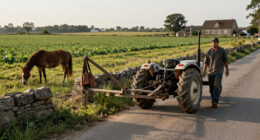
A Nov. 3 episode from Thorsten Meyer AI examines how tools, agricultural chemistry and improved seeds helped reduce the share of American workers in farming from an estimated 73.7% in 1800 to about 1.5% today, while farm output rose. The report presents agriculture as a case study for its broader question about how automation, including AI, may change work.
The episode draws on economic historian Stanley Lebergott’s estimates, published by the U.S. Census Bureau, for the early American figures. His series counts about 1.4 million agricultural workers among a labor force of 1.9 million in 1800. The report cautions that figures before 1840 are estimates rather than census counts; the same series puts the agricultural share even higher in 1810. It also says the 1800 labor force included about 530,000 enslaved people, whose work was coerced.
The shift unfolded through successive changes rather than one sudden invention. The report points to John Deere’s 1837 steel plough, which shed sticky Midwestern soil more readily than earlier designs, and to later farm machinery. It also describes the introduction of short-straw wheat varieties in India and Pakistan in the mid-1960s. According to the Nobel Foundation, plant breeders around Norman Borlaug helped bring dwarf wheat to the region. India’s official figures show wheat production rising from 12.3 million tonnes in 1964–65 to 26.4 million tonnes in 1971–72.
The report says the U.S. number of farm workers continued to rise even as farming’s share of the workforce fell, reaching about 11.8 million around 1910. It also cites Germany, where agriculture’s share dropped from 43% to 25% between 1882 and 1939 while the number of farm workers stayed between eight and 10 million. These examples distinguish a shrinking share of workers from an immediate fall in the number employed.
How AI Is Changing The Way We Work Lessons from farming
Agriculture shows how tools and new methods can reshape work over generations. Its history offers context for AI, but does not establish how quickly or widely AI will change jobs.
A long shift in farm work
The workforce share fell over generations as farming methods changed.
Share and headcount tell different stories
A smaller share of workers in farming did not always mean fewer farm workers right away.
- U.S. farming’s share fell from an estimated 73.7% in 1800 to about 1.5% today.
- Germany’s share fell from 43% in 1882 to 25% in 1939.
- U.S. farm workers continued to rise, reaching about 11.8 million around 1910.
- Germany’s farm worker count stayed between eight and 10 million.
Output rose as farming changed
The episode reports rising food production alongside long-term changes in farm work.
More cereal harvested
The world cereal harvest grew 4.2-fold from 1961, while population grew 2.7-fold.
Higher farm output
U.S. farm output in 2023 was nearly three times its 1948 level, with only a small rise in total inputs.
What the comparison can—and cannot—show
Historical farm figures describe agriculture; they do not prove what AI will do across other sectors.
- The 1800 U.S. workforce share is an estimate, not a census count.
- National figures use different definitions and periods, so they are not a directly comparable ranking.
- The 90% automation scenario is the author’s thesis, not an established forecast.
What Farm Automation Shows
The history matters because it offers a long-running example of technology changing the amount and type of labor an industry requires. The episode argues that fewer workers farming did not mean less food: it reports that the world’s cereal harvest grew 4.2-fold from 1961, while the population grew 2.7-fold. It also cites U.S. farm output in 2023 as nearly three times its 1948 level, with only a small rise in total inputs.
Those figures speak to agricultural output over specific periods; they do not establish what will happen to jobs in other sectors as AI spreads. The report’s suggestion that automation could reach as much as 90% of a sector within a decade or a few decades is explicitly its author’s thesis. The farming comparison also spans roughly 200 years in the United States, a timescale that cautions against treating past changes as a precise timetable for AI.
Agriculture remains a major source of work globally even after its long decline in richer economies. The episode cites a 2025 International Labour Organization estimate of 928 million people working in agriculture, about one in four workers worldwide. It gives national shares of about 43% in India, 1.5% in the United States and 1% in Germany. The global figure makes clear that the change is uneven and far from complete.
Products Worth Considering

Apple MacBook Air 13-inch with M5 chip, 16GB memory, 512GB SSD, and 12MP Center Stage camera

EcoFlow Delta 3 Portable Power Station – 1024 Wh, 1800 W

Logitech MX Brio Ultra HD 4K Webcam, Graphite
As an affiliate, we earn on qualifying purchases.
From Fields to Other Work
The episode is the second installment of a series called “Work After Work.” The previous installment divided the economy into field, factory and office; this one focuses on farming as the oldest of those sectors. A later episode is expected to address machinery such as reapers, threshers and tractors, according to the source.
Historical comparisons require care because the figures come from different kinds of records. The U.S. estimate for 1800 is reconstructed, while Germany’s 1882 figure comes from an official occupational census. The source notes that the German count undercounted women who helped on family farms. Japan’s 1872 estimate covers the broader primary sector—farming, forestry and fishing—not farming alone. China’s 1952 series also covers the primary sector, while India’s 1951 figure counts cultivators and agricultural laborers.
The episode attributes the earliest American estimate to Lebergott’s historical statistics and identifies economic historians’ reconstructions for Japan and Germany. These measures provide evidence of a broad shift, but their differing definitions mean they should not be treated as a perfectly comparable international ranking.
“The share fell long before the headcount.”
— Thorsten Meyer AI episode
Limits of the Historical Comparison
The episode’s historical figures describe changes in farming; they do not show how quickly AI will affect employment across the wider economy. Its 90% scenario is not supported in the supplied material by a defined measure of automation, a specific sector, or a cited forecast. The source also does not specify which jobs might be created or lost as workers leave agriculture, or how those outcomes differed across countries and groups.
Some statistics are estimates, and the national figures use different definitions and time periods. The source provides no single, directly comparable measure for all countries. Its cited global agricultural employment total is an ILO estimate for 2025; the supplied material does not describe the estimate’s method.
The Series Turns to Machinery
The report points readers to the next episode, which is expected to cover reapers, threshers and tractors. That installment may add detail on the machinery that changed farm work after the steel plough. The source does not provide a release date for it.
For now, the episode’s central evidence remains historical: agriculture’s workforce share fell over generations as tools and farming methods changed, while reported output increased. Whether AI will produce changes on a similar scale, and on what timetable, remains an open question.
Key Questions
What is the main development covered in the report?
The Nov. 3 episode traces the long decline in farm employment and uses agriculture as a case study for discussion of automation and work.
How much of the U.S. workforce farmed in 1800?
Stanley Lebergott’s estimate puts the share at 73.7%. The figure is a historical estimate, not a census count, and the labor force included enslaved people.
Does the report say AI will automate 90% of jobs?
No. The author presents automation reaching up to 90% of a sector within a decade or a few decades as a thesis. The source does not establish it as a measured outcome or settled forecast.
How many people still work in agriculture worldwide?
The episode cites a 2025 International Labour Organization estimate of 928 million people, or about one in four workers worldwide.
Source: Thorsten Meyer AI