

TL;DR
President Donald Trump said on Nov. 20 that US companies building data centres abroad could face a “tremendous tax” and penalties, but he gave no details. As of the following morning, no order or rule implementing the threat had been published; existing chip export controls remain in force.
President Donald Trump said Nov. 20 that the United States would not allow American companies to build data centres abroad and that firms doing so could face a “tremendous tax.” As of the next morning, no executive order, regulation or other published action put that threat into effect, leaving companies without a new rule to follow.

Get everyday essentials delivered free with Prime
- Fast, free delivery on millions of items
- Prime Video, Amazon Music and more included
- Member-only deals all year
Trump made the remarks at a White House news conference after a trip to Asia. In a transcript published by The Verge, he said, “We’re not going to allow our companies to build data centers outside of our country.” He then qualified the statement: “If they do that, they can, but we’re going to put a tremendous tax on them.” He also said he had not yet told his staff about the idea.
The comments did not specify a tax rate, start date, legal authority or affected companies. Trump referred to China and Finland, but did not name a list of countries or explain whether the policy would apply to projects already underway. Newsweek reported that it was unclear whether his remarks about Finland referred to a specific planned investment he had criticized days earlier.
A review of the official record cited in the source material found no presidential action or Federal Register rule on overseas data centres as of Nov. 21. The White House referred Newsweek to Trump’s remarks when asked for details. The statement therefore signals a possible policy direction; it does not, on its own, establish a new obligation for companies.
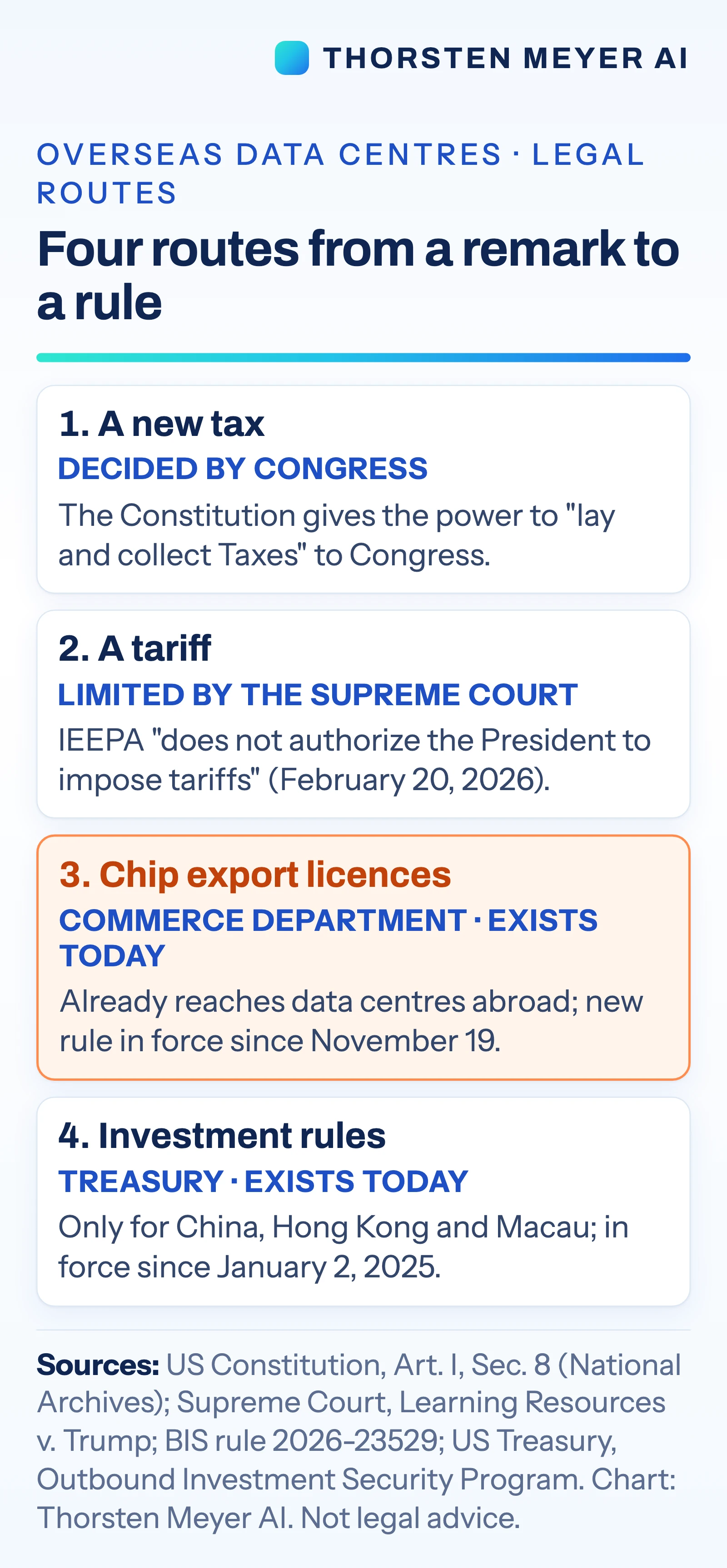
How a Tax Could Reach Data Centres
A tax on overseas construction could affect where US technology companies place computing capacity for AI services, and could alter plans involving foreign sites. But its effect depends on what is covered and how the policy is enacted. The remarks do not answer whether they concern owned facilities only, or also leased space and cloud capacity.
The legal route matters to companies making long-term investments. The Constitution assigns Congress the power to lay and collect taxes. The source material also notes that the Supreme Court ruled on Feb. 20, 2026, that the emergency law known as IEEPA does not authorize the president to impose tariffs. That decision limits one possible route for imposing charges, though it does not resolve what other measures might be pursued.
Products Worth Considering

Apple AirPods Pro (1st Generation) with MagSafe Charging Case

Samsung Galaxy Tab A11+ Tablet (6GB RAM, 128GB Storage, Gray)

Logitech MX Mechanical Mini for Mac Wireless Keyboard, Space Gray
As an affiliate, we earn on qualifying purchases.
Existing Rules on AI Chip Exports
Some restrictions affecting foreign AI infrastructure are already in force, but they concern advanced chip exports, not a general prohibition on building data centres abroad. A Commerce Department rule effective Nov. 19 requires licences for advanced AI chips in five countries and covers data centres serving China-headquartered companies at scale. The source says it also creates a reporting lane for US-headquartered companies.
A July 2025 executive order, meanwhile, set a policy of supporting the global deployment of US-origin AI technologies, including data centres. Those existing measures provide the immediate policy context, but neither is the new overseas-building tax Trump described. The source material does not identify the five countries covered by the November rule.
It remains unclear which companies or countries Trump’s proposal would cover, whether existing projects would be affected, and whether the remarks refer to ownership, construction, leases or purchased cloud capacity. No tax rate, implementation date or exemptions were given.
The source material does not establish what legal instrument the administration might pursue. A new tax would require congressional action under the constitutional allocation of taxing power described in the source; other policy tools could raise different legal questions. There is also no published detail showing whether the administration plans to turn the remarks into a proposal.
Watch for a Written Proposal
The next concrete indication would be a published executive action, proposed rule, legislation or agency guidance describing the measure and its authority. Until such material appears, the Nov. 20 remarks remain a threat without an implementation mechanism, while the chip licensing and reporting requirements effective Nov. 19 remain the rules identified in the source.
Any formal proposal would need to clarify which projects and companies it covers, how it treats existing commitments, and when compliance would begin. The source material provides no announced timetable for those details.
Key Questions
Has Trump imposed a tax on US companies building data centres abroad?
No tax implementing the remarks was listed in the official record as of Nov. 21, 2026. Trump threatened a “tremendous tax,” but did not provide a rate or start date.
What did Trump say about overseas data centres?
At a Nov. 20 White House news conference, he said the United States would not allow US companies to build data centres abroad, then said they could do so but would face a “tremendous tax.” He also referred to penalties.
Do existing rules restrict AI data centres abroad?
The source identifies a Commerce Department rule effective Nov. 19 requiring licences for advanced AI chips in five countries and covering certain large-scale data centres serving China-headquartered companies. It does not describe a general ban on US firms building facilities abroad.
Could the administration impose the proposed tax under emergency powers?
The source says the Supreme Court ruled on Feb. 20, 2026, that IEEPA does not authorize the president to impose tariffs. A tax would require congressional action under the constitutional rule cited in the source; the administration has not published a proposed legal route for Trump’s remarks.
Source: Thorsten Meyer AI