
TL;DR

Get everyday essentials delivered free with Prime
- Fast, free delivery on millions of items
- Prime Video, Amazon Music and more included
- Member-only deals all year
Mistral is focusing on sovereignty, open weights, and efficiency rather than frontier performance. Its strategy appeals to regulated industries and Europe’s digital autonomy goals, but questions remain about its long-term competitiveness in AI capabilities.
Imagine a startup that says, ‘We’re not trying to beat OpenAI at their own game.’ That’s Mistral in a nutshell. Instead of building the biggest, most complex models, it’s betting on a different set of rules: sovereignty, control, and efficiency.
At a recent summit in Paris, Mistral made it clear — it’s not just about making models. It’s about owning the entire AI stack, from compute to model deployment, especially for Europe’s regulated industries. But is focusing on sovereignty enough to stay relevant in the fast-moving world of AI? That’s the question everyone is asking.
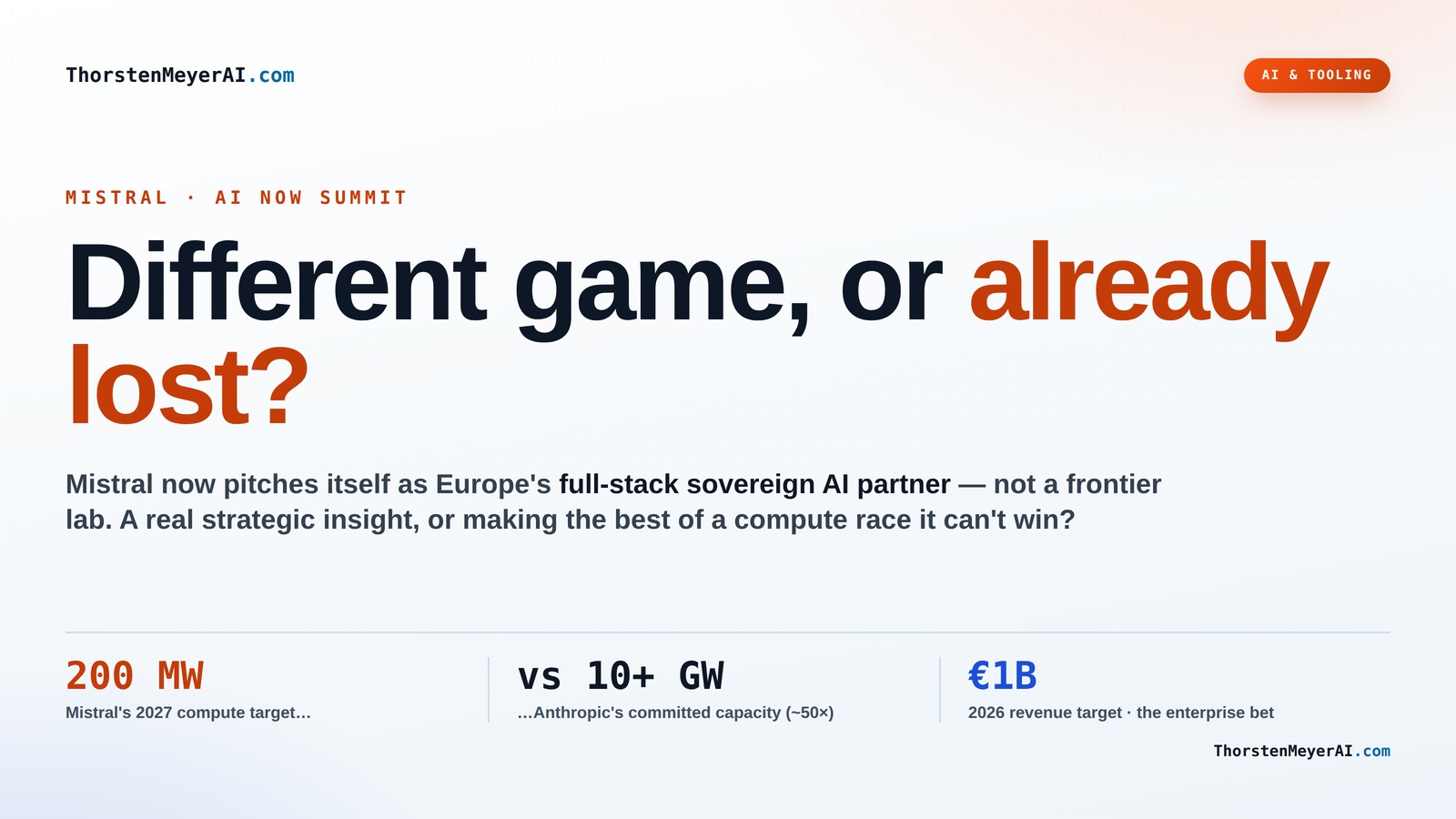
Different game, or already lost?
Mistral now pitches itself as Europe’s full-stack AI provider — compute, models, platform, consultancy — not a frontier-model lab. Is that a real strategic insight, or making the best of a race it can’t win? Both readings fit the same facts.
From model lab to full-stack provider
The clearest signal from the summit wasn’t a model — it was a posture. Heavy on enterprise logos and partnerships (ASML, BNP Paribas, Alexa+), light on new-model announcements. That absence is exactly what skeptics seized on.
Compute
40MW Paris DC + Sweden build · 200MW target by 2027
Models
Open & custom · efficient · you own and run them
Platform
Forge for custom models · Vibe for Work agent
Consultancy
Sales teams, integrators, EU provenance & support
Small & focused, or large & general?
Mistral bets on specialized small models. The claim isn’t that they win a reasoning leaderboard — they don’t. It’s that on the metrics that matter in production agent systems, a purpose-built small model wins. Flip the metric to see the case reverse.
Small specialized vs large general — by what you measure
In token-heavy agentic apps making hundreds of calls, speed/energy/cost compound. Toggle the metric.
Narrow models doing real work
Each is one model doing one thing efficiently — the tangible version of the strategy. Strong on their own terms; the open question is whether the bundle beats a free Chinese open-weight download.
On-prem KYC compliance
Mistral models run inside the bank’s walls for know-your-customer checks. Sensitive financial data never leaves. (BNP was Mistral’s first customer, 2023.)
Voxtral multilingual voice
A focused voice model powering Alexa+ across Europe — speed and efficiency over raw size.
Robostral industrial robotics
Plus a “physics AI” push (via the Emmi acquisition) into aerospace, automotive & semiconductor design and simulation.
Document AI / OCR at scale
Large-scale text extraction — the unglamorous, high-volume enterprise work small models excel at.
The strategy is downstream of the compute gap
Once you see the raw numbers, “why is Mistral behind?” answers itself — and the specialized-small-model strategy starts looking partly like a smart adaptation to a binding constraint, not a pure philosophical choice.
Compute & capital · Mistral vs a frontier leader, this same week
Not a knock — it’s the constraint that forces the efficiency-first, sovereignty-wedge strategy. Adapting intelligently to your position is what good strategy is.
“I want them to win, but I’m worried”
That ambivalence is the most accurate read of where Mistral sits. The enterprise pivot gets read two opposite ways — and both deserve airing.
On-prem, real sales teams, the Koyeb deployment acquisition, EU provenance — exactly what regulated enterprises want, and stickier than consumer mindshare. Targeting €1B revenue in 2026 with 1,000 staff, up from 15 people and one customer in 2023. US closed-API labs structurally can’t match the sovereignty axis.
“Software consultancy with a data center,” not a foundation-model moat. Enterprise B2B is where European startups go when they can’t win consumer or world-scale SaaS. Why pay Mistral on-prem when you could run Qwen free? One paying Le Chat Pro user said the quality gap with frontier labs is now hard to ignore.
Key Takeaways
- Mistral’s focus on sovereignty and open weights targets European regulated industries, giving it a unique market niche.
- Sparse mixture-of-experts architecture boosts efficiency, making small models competitive for enterprise use cases.
- The company’s rapid revenue growth signals regional demand, but skepticism exists about its ability to match giants on reasoning and medium context tasks.
- Open weights and on-prem deployment are critical for enterprises with strict data residency requirements, setting Mistral apart from API-centric models.
- Long-term success depends on whether sovereignty can compensate for potential gaps in large-scale reasoning performance.
As an affiliate, we earn on qualifying purchases.
Why Mistral’s Sovereignty Play Is a Game-Changer in Europe
Mistral’s strategy hinges on something many big AI players ignore: control. For European banks, governments, and defense agencies, keeping data on-site isn’t just a preference — it’s a legal requirement. Mistral’s on-prem solutions and open weights give them a way to comply while still leveraging AI.
Take BNP Paribas. They run Mistral’s models in their own data centers in Belgium, ensuring sensitive financial data stays inside the bank’s walls. That’s a level of control US-based API giants can’t match without complex reengineering.
For these organizations, sovereignty isn’t just about politics — it’s about operational independence. Mistral has tapped into this need, making itself a critical part of Europe’s AI fabric. But is that enough to build a lasting moat? That’s where the debate heats up.
As an affiliate, we earn on qualifying purchases.
Open Weights: Why Mistral’s Approach Matters for Customization
Open weights are a big deal. Unlike OpenAI’s closed API, Mistral releases models under licenses like Apache 2.0. Learn more about open weights and customization. That means developers can tweak, fine-tune, and run models locally — giving control back to the enterprise.
Imagine a European healthcare provider customizing a model for patient data privacy, then deploying it in their own clinics. That’s only possible with open weights, and Mistral’s early releases like Mistral 7B and Mixtral 8x7B are prime examples.
However, critics argue that open weights aren’t enough. If a free open model outperforms Mistral’s in reasoning or medium-context tasks, why pay for the privilege? The real question is whether Mistral’s support, compliance, and regional focus justify the cost.
Ultimately, open weights allow enterprises to tailor models to their specific needs, such as compliance with GDPR or industry-specific regulations. This flexibility can lead to better integration into existing workflows, but it also requires technical expertise and resources. The tradeoff is between control and complexity—while open weights empower customization, they also demand more from the user in terms of maintenance and tuning.

As an affiliate, we earn on qualifying purchases.
Efficiency and Architecture: How Mistral Wins Small but Critical Battles
Mistral’s secret sauce is efficiency — and it’s not just talk. Discover how Mistral wins small but critical battles. Using sparse mixture-of-experts models, it packs 45 billion parameters into a system that only uses about 13 billion per inference. That makes it faster and cheaper to run.
Picture a factory that produces a thousand parts an hour, while others produce only 200. That’s what Mistral’s architecture does for AI models — it’s a leaner, faster way to get results, especially for tasks that don’t require massive reasoning or contextual understanding.
They’ve demonstrated this with smaller, purpose-built models for OCR, voice, and industrial robotics. These models excel in their niches, delivering results with less energy and lower costs — crucial factors for enterprise adoption where operational efficiency can significantly impact profitability and scalability. This approach also reduces infrastructure demands, enabling more organizations to deploy AI solutions without huge capital investments. The tradeoff, however, is that these models may not excel in tasks requiring deep reasoning or extensive context, limiting their scope in certain applications.

European regulated industry AI solutions
As an affiliate, we earn on qualifying purchases.
As an affiliate, we earn on qualifying purchases.
Is Mistral Falling Behind or Just Playing a Different Game?
Here’s the big question: does Mistral’s focus on sovereignty and efficiency mean it’s falling behind in reasoning and large-context tasks? Read more about Mistral’s strategic positioning. Recent chatter on Hacker News suggests yes. Critics say the company trails behind in medium-sized models, especially in reasoning benchmarks.
But Mistral’s defenders argue that they’re not trying to beat the giants at their own game. They’re building for a different market — one where control, customization, and compliance outweigh raw performance.
Consider the recent revenue jump from $20 million to over $400 million in just a year. That’s not just hype — it shows real regional demand. Still, the tech race is fierce, and the question remains: can Mistral keep pace, or is it already out of the main contest? This strategic divergence highlights a fundamental tradeoff: by prioritizing sovereignty and efficiency, Mistral might sacrifice some performance benchmarks, but it gains a foothold in markets where control and compliance are paramount. The critical question is whether this tradeoff limits their growth in core AI capabilities or if it positions them as a resilient player in a niche that larger competitors might overlook.

What the Numbers Say About Mistral’s Future
Mistral’s growth is impressive. Revenue surged from roughly $20 million in early 2025 to over $400 million by early 2026, with plans to hit €1 billion by year’s end according to recent reports.
Most of that — about 60% — comes from Europe, reinforcing its regional, sovereignty-driven appeal. The company, founded in Paris in April 2023, is quickly becoming a regional heavyweight.
But recent discussions highlight a concern: can a company that’s not leading on reasoning and medium-context tasks sustain its growth? The regional success might be a double-edged sword if global AI giants beat it on core capabilities. While regional focus provides a strong customer base and strategic advantage, it may also limit the company's ability to compete globally in the most demanding AI benchmarks. The critical factor will be whether Mistral can leverage its regional momentum to innovate in areas that matter for long-term competitiveness, such as reasoning and scale, or if it remains confined to niche markets.

The Real Question: Is Sovereignty Enough to Win?
Sovereignty isn’t just a buzzword for Mistral. It’s the core of their strategy — offering control, customizability, and compliance for European enterprises. But does that translate into long-term dominance? Or is it a niche that will be overshadowed by larger, more capable models?
For now, the answer depends on your perspective. If Europe’s digital autonomy remains a priority, Mistral’s approach could carve out a lasting space. If not, they might struggle to stay competitive as giants push ahead in reasoning and scale.
The key is whether regional, sovereignty-focused AI can evolve fast enough to keep up with global benchmarks — or if it’s a different, less ambitious game. This strategic choice reflects a fundamental tradeoff: investing heavily in sovereignty and control might limit rapid scaling and performance improvements, but it secures a niche where regulation and local control are paramount. The long-term outcome hinges on whether this niche can expand or if global giants will eclipse it by pushing the boundaries of reasoning, scale, and performance.
Frequently Asked Questions
What does “sovereign” mean in Mistral’s context?
In Mistral’s world, sovereignty means giving European enterprises and governments the ability to run AI models locally, keep data inside their borders, and avoid dependence on US or Chinese cloud providers. It’s about control, compliance, and regional independence.Is Mistral actually open source, or just open-weight?
Mistral releases its models under licenses like Apache 2.0, making them open-weight. This allows self-hosting, customization, and fine-tuning, but the models aren’t fully open-source in the traditional sense. It’s a strategic choice to balance openness with control.How is Mistral different from OpenAI, Anthropic, and Google?
Unlike those giants, Mistral prioritizes regional sovereignty, open weights, and efficiency. It’s not chasing the largest models or the highest benchmarks but focusing on control, compliance, and niche enterprise needs, especially for Europe’s regulated industries.Why do governments and regulated industries care so much about sovereignty?
Regulated sectors like banking, defense, and healthcare face strict data residency laws and security standards. Sovereign AI lets them keep sensitive data on-prem, customize models to their needs, and avoid reliance on foreign cloud infrastructure, reducing risk and ensuring compliance.Can open models and self-hosting really compete with closed, giant models?
They can, in specific contexts. For enterprises prioritizing control, customization, and compliance, open weights and local deployment are perfect. But for large-scale reasoning and reasoning benchmarks, big closed models still hold an edge — at least for now.Conclusion
Mistral is playing a different game, one rooted in control, customization, and regional autonomy. Whether that’s enough to challenge the giants remains uncertain. But one thing’s clear: in the race for AI dominance, sovereignty is becoming a serious contender — if it can stay ahead on the essentials.
European enterprises and regulators are watching closely. The choice isn’t just about performance; it’s about control. That’s the new frontier — and Mistral is betting it’s the right one.

Fall Picks
fall essentials
As an affiliate, we earn on qualifying purchases.