TL;DR
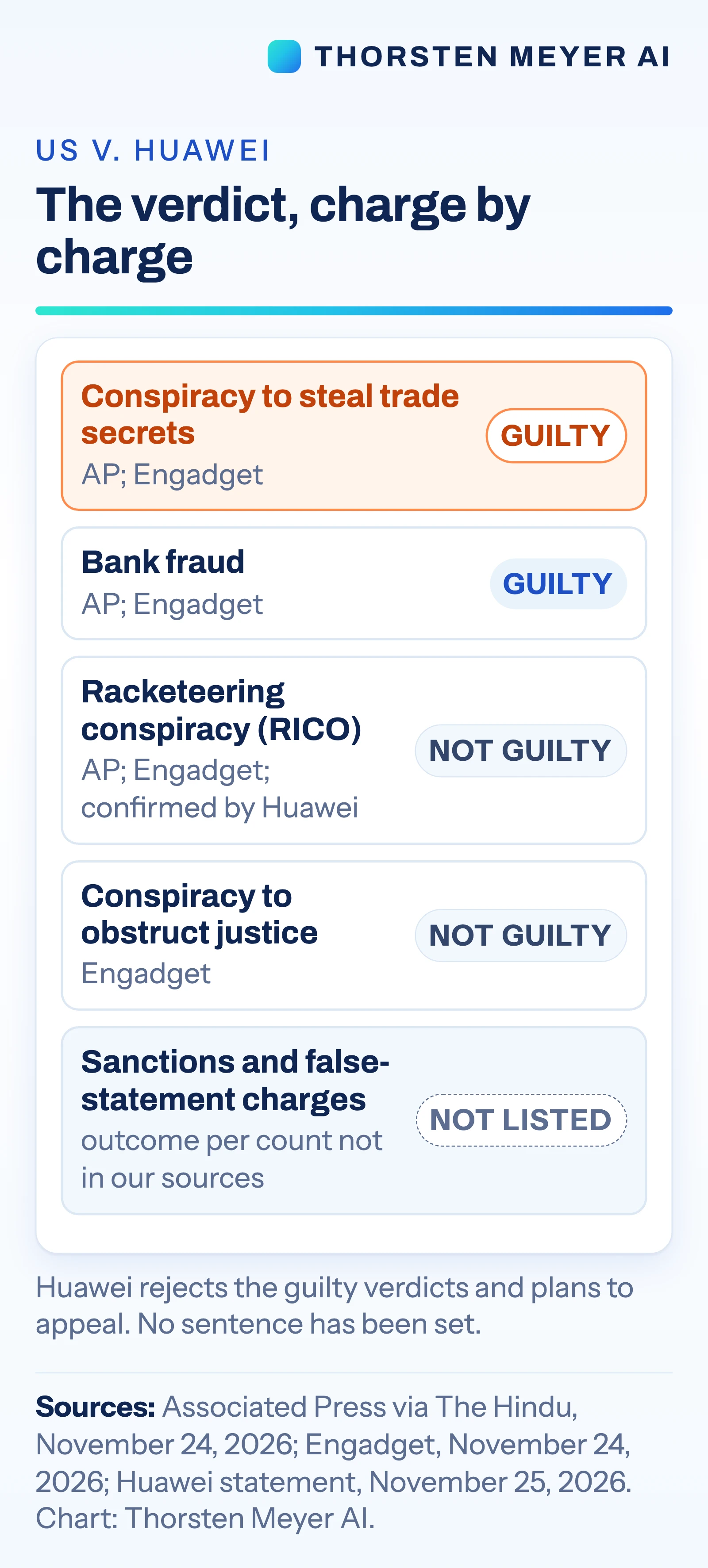
A federal jury in Brooklyn found Huawei guilty of conspiring to steal trade secrets and of bank fraud, while acquitting the company of racketeering conspiracy. Huawei rejected the remaining charges and its lawyer said it plans to appeal; the sources reviewed do not identify a sentencing date.
A federal jury in Brooklyn found Huawei guilty of conspiring to steal trade secrets and of bank fraud on November 24, while acquitting the Chinese technology company of racketeering conspiracy, the most serious charge it faced. Huawei said it rejects the remaining charges, and its lawyer told the Associated Press that the company plans to appeal.

Get everyday essentials delivered free with Prime
- Fast, free delivery on millions of items
- Prime Video, Amazon Music and more included
- Member-only deals all year
The verdict followed an 11-week trial in federal court in Brooklyn, according to Arab News. The Associated Press reported that jurors convicted Huawei of conspiracy to steal trade secrets and bank fraud. They found the company not guilty of racketeering conspiracy. Huawei confirmed the acquittal in a statement issued November 25 and said it “welcomes this decision.”
Huawei said the charges on which it was convicted are “without legal or factual merit,” according to its statement. The company denied wrongdoing during the case, and the verdict does not resolve its stated intention to challenge the convictions. Its lawyer told the AP that Huawei plans to appeal.
The sources reviewed do not give a sentencing date or penalty. The case includes allegations involving trade secrets, dealings with sanctioned countries, and statements to banks and US officials. The verdict reported here establishes the jury’s findings on the charges; the underlying allegations should not be treated as findings beyond those verdicts.
Huawei’s Convictions and US Business
The verdict gives a criminal jury’s answer to allegations that Huawei conspired to obtain confidential technical information, while drawing a boundary around the racketeering charge: jurors convicted the company on other counts but did not find it guilty of that charge. The split verdict matters to companies that protect source code, designs and other commercially valuable information because it shows the distinct charges prosecutors brought and the different outcomes the jury reached.
The case also touches the AI chip competition. The AP describes Huawei as a major alternative to Nvidia chips within China. But the verdict itself is not a new trade rule, and the source material does not report an immediate change to Huawei’s chip business as a result. Huawei was already barred from selling its equipment in the United States, according to the source article. It reports no immediate product change for customers outside the US.
Products Worth Considering

DJI Mic 2 Wireless Microphone System (2 Transmitters, 1 Receiver, Charging Case)

Anker SOLIX S2000 Portable Power Station, 2,010Wh, 1,500W

Bose Smart Dolby Atmos Soundbar with Alexa, Voice Control, and Bluetooth
As an affiliate, we earn on qualifying purchases.
How the Brooklyn Case Reached Trial
The US announced criminal charges against Huawei in early 2019 and later expanded them, the AP reported. Prosecutors presented the case as involving alleged efforts to obtain trade secrets from US companies, as well as dealings with countries under US sanctions and alleged false statements to banks and officials. The companies identified as alleged victims in court records cited by the AP included Cisco Systems, Motorola Solutions, T-Mobile, Quintel USA and Fujitsu.
Examples described in the indictment, according to the AP, included source code allegedly copied into routers sold by Huawei, secret photographs of circuits taken at a competitor’s trade show booth in Chicago, and a robotic arm allegedly removed from a rival’s laboratory to be photographed and measured. These are prosecutors’ allegations reported in connection with the case; the jury’s verdicts determine which charges resulted in convictions.
Trade secrets are commercially valuable information kept confidential, such as software code, circuit designs or technical processes. The conspiracy charge concerned an alleged agreement and steps toward obtaining protected information. Prosecutors argued that repeated alleged conduct supported a racketeering conspiracy charge as well. Engadget described racketeering as a charge traditionally associated with organized criminal acts. The jury acquitted Huawei of that charge.
““Huawei welcomes this decision.””
— Huawei, in a statement issued November 25, 2026
Sentencing and Appeal Remain Open
The reviewed sources do not state when Huawei will be sentenced, what penalty prosecutors may seek or what sentence the court could impose. They also do not provide a filing date or detailed grounds for the planned appeal. The company’s stated intention to appeal is not itself an appeal ruling, and the convictions remain the jury’s verdict unless changed through later court proceedings.
The sources report the jury’s findings and summarize the prosecution’s allegations, but they do not provide a full account of the court’s instructions, deliberations or the evidence jurors accepted for each conviction. The exact effect of the verdict on Huawei’s operations outside the United States is also not established in the reports.
Court Proceedings and Huawei’s Appeal
The next reported steps are sentencing and Huawei’s planned appeal. No sentencing date appears in the source material available as of November 27, 2026. Further court filings or scheduling decisions may clarify the timing, the penalties under consideration and the basis for Huawei’s challenge. Until those developments are reported, the case’s next milestones remain uncertain.
Key Questions
What did the jury find Huawei guilty of?
The jury convicted Huawei of conspiracy to steal trade secrets and bank fraud, according to the Associated Press.
Was Huawei convicted of racketeering?
No. The jury acquitted Huawei of racketeering conspiracy, the most serious charge in the case, according to the reports.
What did Huawei say about the verdict?
Huawei said it welcomed the racketeering acquittal, rejected the remaining charges as “without legal or factual merit,” and said through its lawyer that it plans to appeal.
When will Huawei be sentenced?
The sources reviewed do not provide a sentencing date or state what penalty the court may impose.
Does the verdict change Huawei products or sales outside the United States?
The source material reports no immediate change for customers outside the US. The verdict is a criminal case, and the reports do not describe it as a new trade restriction.
Source: Thorsten Meyer AI