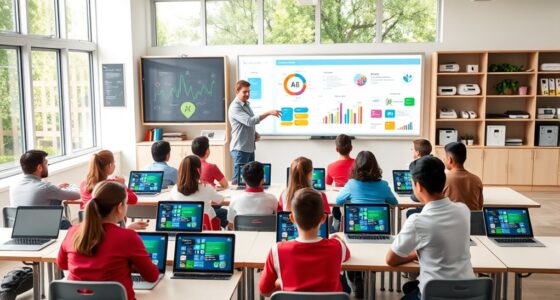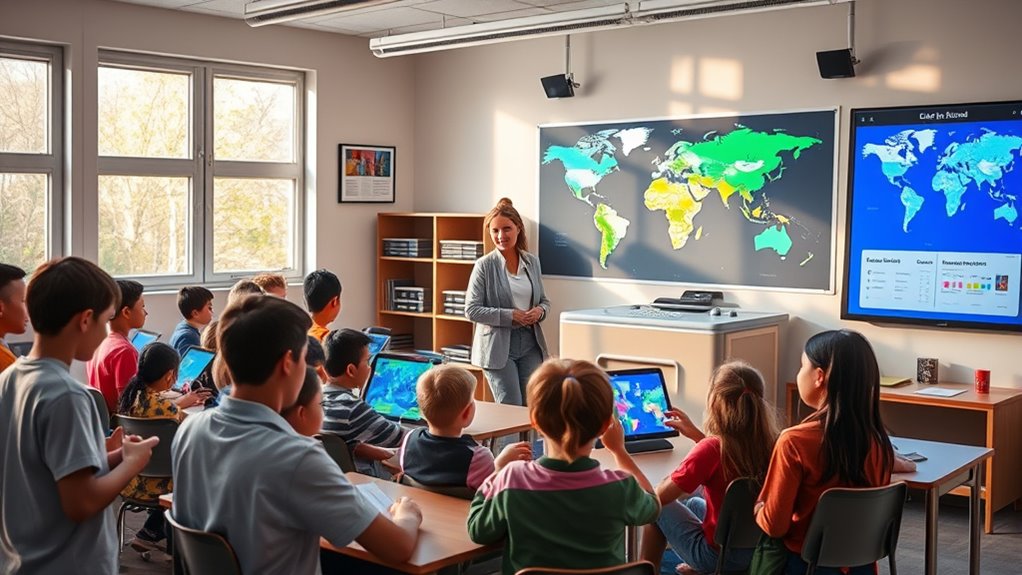

Across the globe, AI-powered personalized learning helps you experience tailored lessons, real-time assessments, and targeted support. Schools in South Korea and Finland use AI to analyze responses, improve test scores, and identify students needing early intervention. In the U.S., adaptive content encourages self-directed learning. These case studies show how AI boosts engagement and inclusivity. By exploring further, you’ll discover how these advancements are shaping education for everyone.
Key Takeaways
- South Korea uses AI platforms to analyze responses, creating tailored practice sets that improve test scores and student confidence.
- Finland employs AI tools to monitor student progress for early intervention, reducing teacher workload and enhancing support.
- U.S. digital curricula adapt content based on student mastery, promoting self-directed learning and personalized engagement.
- AI-driven assessment provides real-time feedback, enabling dynamic instruction and continuous lesson refinement worldwide.
- Technological advancements like high-refresh-rate projectors support real-time AI feedback, boosting accessibility and effectiveness in diverse classrooms.

Personalized learning with AI is transforming education by tailoring lessons to each student’s unique needs and pace. One of the most impactful tools in this transformation is AI-driven assessment, which allows educators to gauge understanding in real-time and adjust instruction accordingly. Unlike traditional testing methods, AI-driven assessment analyzes student responses instantly, identifying strengths and weaknesses with remarkable precision. This immediate feedback helps create a more dynamic learning environment, where lessons are continuously refined based on individual progress. As a result, students receive targeted support that addresses their specific gaps, boosting engagement and comprehension.
Complementing AI-driven assessment is adaptive content, which dynamically adjusts the material presented to learners. When you use adaptive content, the system assesses your current understanding and modifies the difficulty, topics, or format, ensuring that lessons stay challenging yet achievable. For example, if you’re struggling with a math concept, the system might offer additional practice problems or alternative explanations until you grasp the concept. Conversely, if you quickly master a topic, it advances you to more complex material. This personalized approach keeps you motivated and prevents boredom or frustration. Schools around the world are leveraging adaptive content to cater to diverse learning styles and paces, making education more inclusive and effective. Additionally, advancements in high refresh rates and low input lag in projectors demonstrate how technology can optimize real-time feedback and engagement in other learning environments.
In South Korea, for instance, AI-powered platforms analyze students’ responses during exam prep, providing tailored practice sets that focus on their weak spots. This targeted approach has resulted in improved test scores and increased confidence among students. Meanwhile, in Finland, educators use AI-driven assessment tools to monitor student progress continuously, allowing them to intervene early if someone is falling behind. These tools help teachers personalize instruction without adding extra workload, as the AI handles the heavy lifting of data analysis.
Across the United States, some schools incorporate adaptive content into digital curricula, enabling students to explore topics at their own pace. This flexibility fosters deeper understanding and encourages self-directed learning. In developing countries, AI-powered platforms are bridging gaps in access and quality by providing adaptive content that adjusts to available resources and individual learning needs.
Frequently Asked Questions
How Does AI Personalize Learning for Diverse Student Needs?
AI personalizes learning by adapting assessments to each student’s skill level, ensuring they’re challenged without feeling overwhelmed. It analyzes student responses to identify strengths and gaps, then tailors content accordingly. This keeps student engagement high, as lessons feel relevant and achievable. By continuously adjusting based on progress, AI helps meet diverse needs, fostering a more inclusive and effective learning environment tailored specifically for each learner’s unique journey.
What Are the Privacy Concerns With AI in Education?
Did you know that 85% of students are concerned about data privacy? With AI in education, privacy concerns center on data privacy and student tracking, which could expose sensitive information or lead to misuse. You need to guarantee robust security measures, clear policies, and transparency to protect student data, prevent unauthorized access, and maintain trust. Addressing these concerns is essential for ethical AI implementation in educational settings.
How Cost-Effective Is Implementing Ai-Driven Personalized Learning?
Implementing AI-driven personalized learning can be cost-effective if you carefully conduct a cost analysis upfront. While initial setup and implementation challenges might seem high, long-term benefits like improved student engagement and tailored instruction can justify the investment. You’ll need to weigh the costs against potential gains, ensuring that infrastructure and training are manageable within your budget, making AI integration a worthwhile, sustainable educational upgrade.
What Skills Do Teachers Need to Effectively Use AI Tools?
To effectively use AI tools, you need AI training to understand their functions and capabilities. Developing teacher adaptability is vital, allowing you to embrace new technologies and integrate them into your teaching methods seamlessly. You should stay open to continuous learning, experiment with AI applications, and adjust your strategies based on student needs. These skills guarantee you can leverage AI tools to enhance personalized learning experiences for your students.
How Is Ai’s Impact on Student Motivation Measured?
Think of measuring AI’s impact on motivation as capturing a butterfly in a jar—you need keen eyes and the right tools. You’ll use motivation assessment and engagement metrics to track how students’ enthusiasm blossoms or wanes. By analyzing participation levels, time-on-task, and emotional responses, you can gauge the spark AI ignites within learners, revealing whether it fuels their curiosity or leaves them as still as a dormant pond.
Conclusion
As you explore these case studies, you’ll see how AI transforms education—tailoring lessons, boosting engagement, and revealing potential. But the true power lies ahead. What breakthroughs await as technology advances? Will personalized learning redefine education as we understand it? One thing’s certain: the journey has only just begun, and the future holds surprises that could change everything. Stay curious—because the next chapter is about to unfold, and you won’t want to miss it.