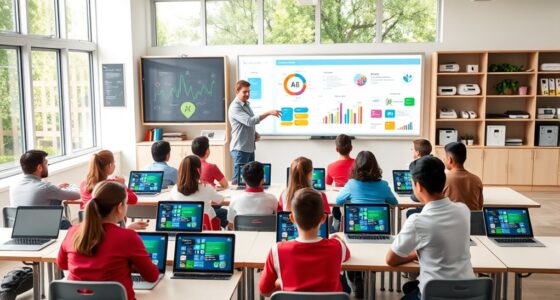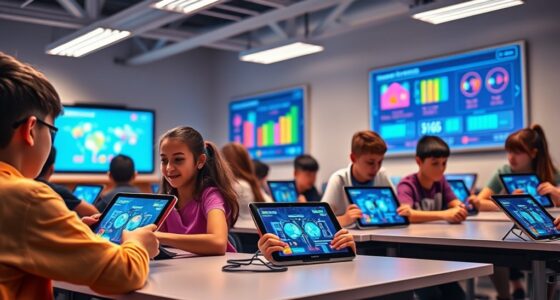

AI is transforming language learning by offering personalized lessons tailored to your pace and style. It analyzes cultural nuances, regional expressions, and social cues for authentic understanding. You can practice pronunciation with instant feedback that replicates native speakers and engage in immersive conversations using virtual assistants. These innovations remove barriers and make learning more accessible and effective. Keep exploring how AI’s new tools can enhance your language skills and cultural knowledge even further.
Key Takeaways
- AI personalizes language lessons by analyzing individual learning styles, progress, and cultural context for more effective teaching.
- Advanced AI models improve translation accuracy by understanding regional nuances, idioms, and social cues.
- Speech recognition technology provides instant feedback on pronunciation, helping learners achieve natural accents.
- Virtual environments and chatbots simulate real-life conversations, enhancing practical language skills and cultural understanding.
- AI-driven analytics track learner progress, identify challenges, and adapt content for continuous, personalized improvement.
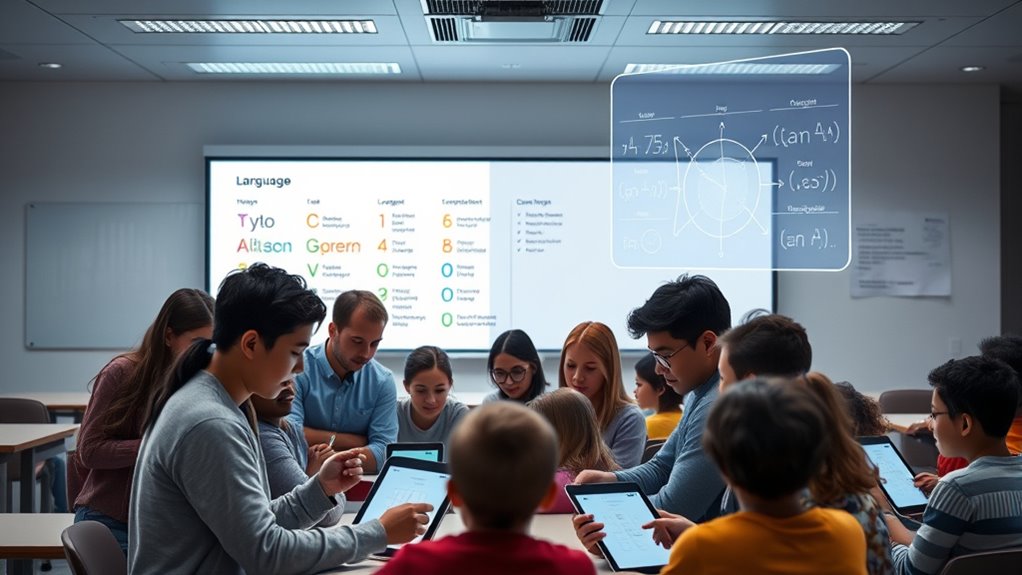
How is artificial intelligence transforming the way you learn new languages? It’s changing everything, from personalized lessons to real-time feedback. With AI-powered tools, you no longer have to rely solely on textbooks or language classes. Instead, you get tailored experiences that adapt to your pace and style, making learning more efficient and engaging. One major way AI enhances your journey is by helping you grasp cultural nuances. Languages aren’t just about vocabulary and grammar; they’re deeply tied to culture, context, and social cues. AI algorithms analyze vast amounts of data to identify subtle cultural differences that might be missed in traditional learning. For example, AI can show you how certain phrases are used in specific regions or guide you on appropriate gestures and expressions, giving you a more authentic understanding of the language.
AI personalizes language learning by analyzing cultural nuances, regional usage, and social cues for a more authentic experience.
Pronunciation practice is another area where AI makes a significant impact. Traditional methods often involve repetition and recordings, but AI tools offer instant, precise feedback on your pronunciation. When you speak into an app or device, it compares your speech to native speakers and highlights areas for improvement. This immediate correction helps you develop a more accurate accent and sound more natural when speaking. AI-driven pronunciation tools also simulate conversations with native speakers, giving you real-world practice without the pressure of a face-to-face interaction. These systems continuously learn from your attempts, adjusting their feedback to target your specific challenges, which accelerates your progress.
Moreover, AI enables you to practice in immersive environments that mimic real-life situations. Virtual assistants and chatbots are designed to hold conversations on various topics, allowing you to practice vocabulary, idioms, and cultural references in context. This kind of interaction not only boosts your confidence but also helps you understand how language functions in different social settings. The technology also enables you to review your progress over time, highlighting improvements and identifying areas needing more focus. Additionally, reliable resources ensure that the data AI uses to improve language understanding remains comprehensive and accurate, further enhancing your learning experience.
All these advancements mean you can customize your learning experience based on your goals, whether it’s mastering pronunciation, understanding cultural subtleties, or becoming fluent in everyday conversations. AI removes many of the barriers that once slowed down language acquisition, making it more accessible and effective. As a learner, you now have powerful tools at your fingertips, capable of guiding you through the complexities of new languages with greater precision and insight. This revolution in language learning isn’t just about faster progress — it’s about creating a more authentic, nuanced, and enjoyable journey to fluency.
Frequently Asked Questions
How Does AI Handle Idiomatic Expressions in Translation?
AI handles idiomatic expressions by analyzing contextual understanding and cultural nuance. It examines surrounding words and phrases to grasp the intended meaning, rather than translating literally. You’ll notice that advanced AI models learn from large datasets, capturing subtle language variations. This way, they provide translations that reflect the idiomatic and cultural essence, making the output more natural and accurate, even for expressions that don’t translate directly.
Can AI Adapt to Regional Dialects and Slang Effectively?
Yes, AI can adapt to regional dialects and slang effectively. You’ll find that AI systems improve as they learn from diverse, region-specific data, allowing them to recognize and accurately interpret unique expressions. By continuously training on local language patterns, slang adaptation becomes more natural. So, you can rely on AI to handle regional dialects better over time, making translations more authentic and contextually appropriate for different communities.
What Ethical Concerns Exist With Ai-Driven Language Teaching?
Imagine teaching a student with a mirror—if the mirror is flawed, your reflection distorts. Similarly, AI-driven language teaching raises privacy concerns, risking personal data leaks. Bias mitigation is vital to prevent unfair stereotypes from skewing lessons. Ethically, you must guarantee AI respects user privacy and actively reduces biases, so learners receive fair, accurate education without unintended harm. This keeps the learning environment trustworthy and inclusive.
How Do AI Translation Tools Compare to Human Translators in Accuracy?
AI translation tools, powered by machine learning, often match human translators in accuracy for straightforward texts. However, they struggle with linguistic nuances, idiomatic expressions, and cultural context, where humans excel. You’ll find AI can quickly generate translations, but for complex or sensitive content, human translators provide better precision and understanding. So, while AI is improving rapidly, it still can’t fully replicate the depth and subtlety of human linguistic insight.
Will AI Replace Human Language Teachers Entirely?
AI won’t replace human language teachers entirely; they’re more like a helpful compass guiding your learning journey. While AI excels at grammar and vocabulary, it can’t replicate human empathy or cultural nuance—the heart of effective teaching. You need a real person’s understanding, patience, and cultural insights to truly connect and thrive. So, AI becomes a tool, but your human teacher remains essential for meaningful, nuanced language mastery.
Conclusion
You can see how AI is revolutionizing language learning, making translation faster and teaching more personalized. For example, over 70% of language learners now use AI tools to practice daily, boosting their fluency. As technology continues to evolve, you’ll find more innovative ways to master new languages, breaking down barriers and connecting cultures. Embrace these advancements—AI isn’t just changing how you learn; it’s transforming your entire language journey.