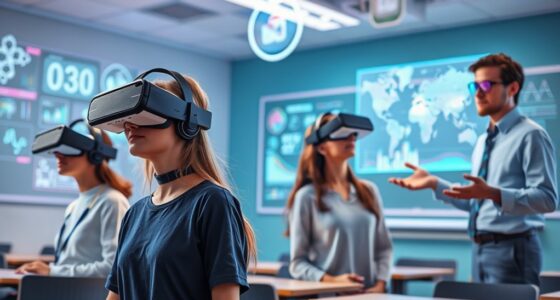

To effectively integrate AI in education, you need targeted professional development that bridges existing training gaps. Teachers often feel unprepared to use AI tools confidently and align them with pedagogy, limiting their benefits. Quality training helps you understand how AI supports differentiated instruction, assessments, and student engagement. Ongoing support and collaboration are key to building confidence and innovation in your teaching. If you want to discover practical strategies, keep exploring how better training can transform your classroom.
Key Takeaways
- Teachers lack sufficient training to effectively integrate AI tools into pedagogical practices.
- Current professional development is often generic, not addressing specific classroom challenges with AI.
- Proper training enables educators to align AI with curriculum goals and personalized student learning.
- Sustained, targeted PD fosters confidence, innovation, and effective use of AI in diverse educational settings.
- Improved teacher training maximizes AI’s potential to enhance student engagement and learning outcomes.

As artificial intelligence becomes more integrated into classrooms, many educators find themselves unprepared to harness its full potential. Despite the rapid growth of AI tools designed to personalize learning, manage administrative tasks, and provide data-driven insights, teachers often lack the necessary training to incorporate these technologies effectively. This gap stems from insufficient professional development focused on AI, leaving many educators unsure how to align new tools with existing teaching strategies. Without proper teacher training, AI remains underutilized, and its benefits are not fully realized in student outcomes.
Many teachers feel unprepared to effectively integrate AI tools into their classrooms due to lack of targeted training.
Effective curriculum integration requires more than just familiarity with AI software; it demands a deep understanding of how these tools can complement and enhance pedagogical approaches. Teachers need targeted professional development programs that move beyond basic technical skills and explore how AI can support differentiated instruction, formative assessment, and student engagement. When training emphasizes curriculum integration, educators learn to seamlessly embed AI into lesson plans, rather than using it as an isolated gimmick. This approach guarantees that AI becomes a meaningful part of the learning experience, promoting personalized pathways for students and enabling teachers to address individual needs more efficiently.
However, current professional development often falls short by providing generic training sessions that fail to address real classroom challenges. Schools must prioritize ongoing, content-specific teacher training that focuses on practical applications of AI within curricula. This means offering workshops, coaching, and collaborative planning sessions where educators can experiment with AI tools in a supportive environment. The goal is to build confidence, foster innovation, and ensure that teachers feel equipped to adapt AI to their unique classroom contexts. Additionally, fostering an understanding of educational technology and its role in enhancing teaching practices can help bridge the training gap. Incorporating insights from software quality assurance can also help educators understand how to evaluate and select reliable AI tools for their classrooms. Moreover, understanding the importance of professional development in sustaining meaningful change can encourage schools to invest in ongoing support rather than one-off training sessions. Furthermore, integrating feedback mechanisms into professional development programs allows educators to continuously improve their AI integration strategies based on classroom experiences.
A deeper understanding of watt-hours, capacity, and selection can assist teachers in choosing the most appropriate AI tools that align with their classroom needs and resources. Additionally, teachers need opportunities to share best practices and learn from peers who are successfully integrating AI into their teaching. Building a community of practice around AI in education encourages continuous learning and helps educators troubleshoot issues as they arise. When professional development is rooted in real-world classroom needs, it becomes more relevant and impactful, leading to increased adoption and effective implementation of AI technologies.
Ultimately, the success of AI in education hinges on thorough, ongoing teacher training that emphasizes curriculum integration. When educators are well-prepared through targeted professional development, they can tap into AI’s full potential to transform learning experiences. This not only benefits students but also empowers teachers to become confident innovators in their classrooms, ensuring that AI becomes a tool for meaningful educational progress rather than an underused novelty.
AI in education professional development courses
As an affiliate, we earn on qualifying purchases.
As an affiliate, we earn on qualifying purchases.
Frequently Asked Questions
How Can Teachers Effectively Integrate AI Tools Into Existing Curricula?
To effectively integrate AI tools into your existing curricula, you should focus on AI implementation that complements your teaching goals. Start by adapting your curriculum to include AI-driven activities, ensuring they align with learning objectives. Experiment with different tools to see what works best, and seek ongoing professional development to stay updated. Engaging with colleagues and resources in AI implementation can boost your confidence and help you create a seamless curriculum adaptation.
What Are the Best Practices for Ongoing AI Professional Development?
Think of it as your own “Quest for the Holy Grail.” To excel in AI, you should pursue ongoing professional development that emphasizes adaptive learning and data privacy. Attend workshops, join communities, and stay updated on emerging tools. Regular training helps you adapt to new AI features, while understanding data privacy guarantees responsible use. This continuous learning keeps you ahead, empowering you to integrate AI effectively and ethically into your teaching practice.
How Does AI Training Address Diverse Educator Tech Skill Levels?
AI training addresses diverse educator tech skill levels through personalized support and skill differentiation. You receive tailored resources that match your current proficiency, whether you’re just starting or advanced. This approach helps you build confidence and competence at your own pace. By focusing on your specific needs, AI training guarantees all educators can effectively integrate technology into their teaching, fostering an inclusive, adaptable learning environment for everyone.
What Are the Potential Ethical Concerns in AI Education Training?
Did you know that 76% of educators worry about bias in AI tools? Ethical concerns in AI education training include bias mitigation and data privacy. You need to guarantee AI systems don’t reinforce stereotypes and that student data remains confidential. Addressing these issues helps build trust and fairness, making AI a valuable tool for all learners. Ignoring these concerns risks perpetuating inequality and damaging your reputation as an educator.
How Can Institutions Measure the Success of AI Professional Development Programs?
You can measure the success of AI professional development programs by using assessment metrics that evaluate how well educators apply new skills in practice. Skill benchmarking helps you compare progress against established standards or prior performance. Regularly collecting feedback, analyzing classroom integration, and tracking student engagement and outcomes provide concrete data to determine if the training effectively enhances teaching with AI tools.
teacher training for AI classroom tools
As an affiliate, we earn on qualifying purchases.
As an affiliate, we earn on qualifying purchases.
Conclusion
Without proper professional development, AI in education risks becoming just another tool gathering dust, unused and misunderstood. Yet, with targeted training, you can realize its true potential, transforming classrooms into dynamic spaces for personalized learning. The contrast is clear: one path leads to missed opportunities, the other to empowered educators and engaged students. Investing in your growth guarantees AI becomes a bridge, not a barrier, guiding your teaching into the future.
AI integration workshops for teachers
As an affiliate, we earn on qualifying purchases.
As an affiliate, we earn on qualifying purchases.
educational AI software training programs
As an affiliate, we earn on qualifying purchases.
As an affiliate, we earn on qualifying purchases.