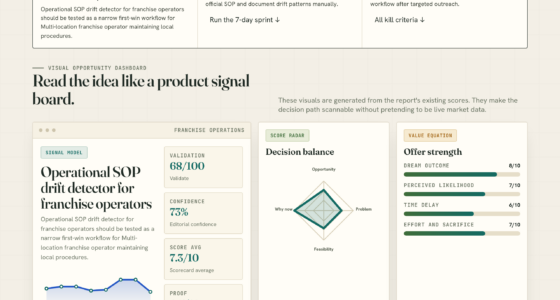

📊 Full opportunity report: The Coding Singularity Is Real — and Steeper Than Clark Presented on ThorstenMeyerAI.com — validation score, market gap, and execution plan.

Get everyday essentials delivered free — and shop member deals
- Fast, free delivery on millions of items
- Access to Prime Big Deal Days deals on October 6–7
- Prime Video, Amazon Music and more included
TL;DR
AI systems now handle most routine coding tasks at near-human levels, accelerating toward a self-improving loop. The ‘coding singularity’ is confirmed but may be occurring faster than previously estimated, with broader deployment still uncertain.
Recent data confirms that AI systems have achieved near-human performance in routine software coding tasks, indicating continued progress toward the ‘coding singularity’—a process where AI systems improve their own development capabilities.
Thorsten Meyer reports that AI models like Claude Mythos Preview now score 93.9% on SWE-Bench, a benchmark measuring coding ability, up from approximately 2% in late 2023. This demonstrates substantial progress in AI coding skills, particularly in familiar, routine tasks.
Furthermore, the deployment landscape shows that many frontier labs and Silicon Valley firms are coding primarily through AI systems, indicating widespread adoption of these capabilities. However, this trend is more bifurcated in practice, with enterprise-level, complex coding still challenging for current models, especially on private, less familiar codebases.
Additionally, the trajectory of AI’s time horizons for completing coding tasks has accelerated. The median forecast for end-2026 now suggests AI can complete complex coding tasks within approximately 24 hours, a significant reduction from earlier estimates of 100 hours, reflecting faster progression than previously anticipated.
The coding singularity is real —
and steeper than Clark presented.
Clark’s data is accurate. The trajectory is plausibly steeper. The deployment is bifurcated. The labor consequence is empirical. The substance is recursive self-improvement.
Jack Clark’s Import AI #455 has a section called “The coding singularity – capabilities over time” that does the heavy lifting for his automated AI R&D thesis. This is the read on Clark’s section from outside the frontier lab. The headline finding: the capability data is real and possibly understated, the deployment reality is more bifurcated than “everyone codes through AI” suggests, and the substantive event is not the coding part — it’s the opening of the recursive self-improvement loop the coding capability makes operational.
Clark’s numbers check out. Post-publication data is sharper.
Both benchmark trajectories Clark cites are publicly verifiable. Both have moved meaningfully in the week since Import AI #455 was published. The trajectory is plausibly steeper than the essay presents.
Five-tool consolidated stack. Bifurcated by segment.
Clark: “frontier-lab researchers code entirely through AI systems.” Correct for frontier labs. Partially correct across the broader market — with substantial segment-level variance. The Cambrian explosion of 2024 has consolidated to five production-grade tools.
24% US/CA
50%+ F500
40% large ent
Cursor usage
professional
Stanford data confirms what Clark’s data implies.
Junior software engineering postings down 40-50% since 2024. Age-inverted hiring relative to historical software engineering patterns. The data is unambiguous on the entry-level segment. The longer-term consequences are unresolved.
“Coding singularity” is the right name.
Clark calls it “the coding singularity.” The phrase is correct. The framing implies the significance is about coding. The actual significance is what the coding capability enables. Coding is the wedge. The thing on the other side is the singularity.
SWE-Bench saturating means the broader AI engineering capability has reached saturation. AI R&D is engineering with model training as the target output. The coding singularity is what you see. The recursive self-improvement loop is what you are looking at.
Five audiences. Five different obligations.
The coding singularity has specific implications by stakeholder. The institutional response cycle in most democracies is longer than the cadence the data implies.
ENGINEERS
BUSINESSES
PROFESSIONALS
INVESTORS
EVERYONE ELSE
The coding singularity is the canary. The mine is what matters. Software engineers and developer-tool investors are paying attention. Alignment researchers and policymakers are paying less attention than the math suggests they should.
Implications of Accelerated AI Coding Capabilities
The confirmed rapid improvement in AI coding ability and deployment indicates that the ‘coding singularity’—the point where AI self-improves recursively—is likely approaching. This development could influence software development processes, reduce human labor in routine coding, and impact the pace of technological innovation. It also raises questions about the future role of human engineers and the timeline for widespread adoption.
As an affiliate, we earn on qualifying purchases.
Progression of AI Coding Capabilities and Deployment Trends
Since late 2023, AI models like Claude and GPT have shown exponential growth in coding benchmarks, with SWE-Bench scores rising from near-zero to over 93% in routine tasks. The trajectory of the METR time horizon has also shortened, with recent measurements indicating that AI can complete complex coding tasks within 24 hours by the end of 2026. These developments support Clark’s thesis about the recursive self-improvement loop but suggest the pace is faster than earlier projections.
While frontier labs widely adopt AI for coding, broader industry deployment, especially for complex, private codebases, remains uneven. The full realization of the singularity depends on how quickly these capabilities can be scaled across diverse, real-world engineering tasks.
“The data confirms that AI models now handle most routine coding tasks at near-human levels, and the trajectory suggests the singularity may be approaching faster than previously thought.”
— Thorsten Meyer
AI development tools for programmers
As an affiliate, we earn on qualifying purchases.
As an affiliate, we earn on qualifying purchases.
Unresolved Questions About Broader Deployment Speed
It remains unclear how quickly AI capabilities will be adopted across the entire software industry, especially for complex, proprietary codebases. The pace of scaling beyond frontier labs is still uncertain, and the exact timing of reaching full autonomous coding at enterprise levels is not yet confirmed.
As an affiliate, we earn on qualifying purchases.
Monitoring AI Progress and Industry Adoption in 2026
Next steps include tracking the continued performance of AI models on more challenging benchmarks, observing deployment trends across various industries, and assessing how quickly complex, private codebases are integrated with AI coding tools. Researchers and industry leaders will also monitor developments related to recursive self-improvement capabilities and their potential impact on the industry.
As an affiliate, we earn on qualifying purchases.
Key Questions
What is the ‘coding singularity’?
The ‘coding singularity’ refers to a point where AI systems can autonomously improve their coding capabilities recursively, leading to rapid, exponential progress in software development.
How confident are experts that the singularity is near?
Based on recent data, many experts believe the singularity could occur within the next 12 to 24 months, though there remains uncertainty about the full industry-wide adoption and impact.
Will human programmers become obsolete?
While AI is automating routine tasks, human oversight and complex architectural decisions are expected to remain important for the foreseeable future, though the roles of software engineers may evolve.
What are the risks associated with this rapid AI development?
Potential risks include unintended consequences of autonomous code generation, security vulnerabilities, and economic impacts on employment. Ongoing research and policy discussions aim to address these concerns.
Source: ThorstenMeyerAI.com
Fall Picks
fall essentials
As an affiliate, we earn on qualifying purchases.