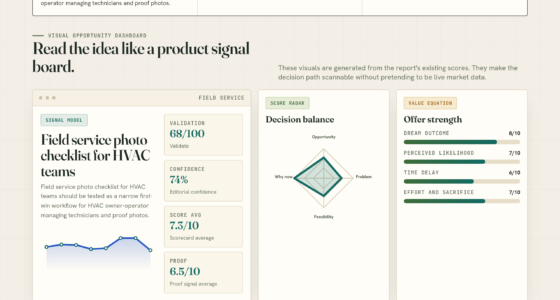

📊 Full opportunity report: The 27% Problem: Why Google Wrote a $750M Check to Catch Anthropic on ThorstenMeyerAI.com — validation score, market gap, and execution plan.

Get everyday essentials delivered free with Prime
- Fast, free delivery on millions of items
- Prime Video, Amazon Music and more included
- Member-only deals all year
TL;DR
Google announced a $750 million fund and rebranded Vertex AI as Gemini Enterprise Agent Platform to compete with Anthropic’s dominant 40% enterprise AI share. The move aims to strengthen Google’s enterprise AI distribution amidst shifting market dynamics.
Google announced a $750 million partner fund and rebranded its Vertex AI platform as the Gemini Enterprise Agent Platform on April 22, 2026, in a move aimed at recapturing enterprise AI market share from Anthropic, which currently holds 40% of the market.
The move follows a significant shift in enterprise AI market share, where OpenAI’s share declined from 50% in early 2023 to 27% in the first quarter of 2026, while Anthropic surged to 40%. Google’s new fund is designed to accelerate enterprise adoption through partner enablement, prototyping subsidies, workforce training, and high-visibility launches like Merck’s partnership. The platform rebranding signals a strategic shift to focus on governance and control of AI agent sprawl, which has become a critical issue for large enterprises managing dozens of AI deployments.
Google’s investment aims to leverage its existing infrastructure, including models like Gemini 2.5+, TPU v6 chips, and its widespread ecosystem—Workspace, Cloud, Android—to increase its enterprise AI footprint. The company’s strategy focuses on distribution dominance, betting that capturing enterprise lock-in will outweigh model accumulation, which Anthropic has led for the past three years.
Google’s $750M Bet on Enterprise AI Distribution
This development marks a strategic escalation in the enterprise AI race, with Google investing heavily to regain market share from Anthropic. The move underscores the importance of distribution, governance, and ecosystem control over model performance alone. If successful, Google could reshape enterprise AI adoption, influencing how organizations deploy and govern AI agents, with long-term implications for market leadership and innovation.
As an affiliate, we earn on qualifying purchases.
Since 2023, the enterprise AI landscape has seen a dramatic shift. OpenAI’s share of enterprise API usage declined from 50% to 27%, while Anthropic’s surged to 40%. This shift is attributed to Anthropic’s focus on safety, alignment, and predictable behavior, which resonated with enterprise buyers, especially for mission-critical workflows. Meanwhile, OpenAI struggled with trust and product positioning, focusing on consumer markets initially. Google’s late entry with Vertex AI and now Gemini aims to reverse this trend by emphasizing governance and distribution channels.
Prior to this, Google’s enterprise AI efforts lagged behind Anthropic and OpenAI in lock-in and ecosystem integration. The April 22 announcement signals a strategic pivot to address this gap, recognizing that controlling enterprise distribution is now the key battleground in AI dominance.
“Google’s $750 million fund is structured around four levers: partner enablement, prototyping subsidies, workforce training, and high-visibility launches, all aimed at increasing enterprise share.”
— Thorsten Meyer
As an affiliate, we earn on qualifying purchases.
Unclear Impact of Google’s Investment and Market Response
It remains uncertain whether Google’s $750 million fund will succeed in reversing the current market share trends within the next 24 months. The effectiveness of its partner ecosystem, the pace of enterprise adoption, and Anthropic’s potential counter-moves—such as aggressive discounting or vertical specialization—are still developing. Additionally, the actual impact on enterprise governance and agent sprawl management remains to be seen as the platform matures.
As an affiliate, we earn on qualifying purchases.
Next Steps in Google’s Enterprise AI Strategy
Google will likely focus on deploying its partner enablement programs, expanding high-profile enterprise launches like Merck, and refining its Gemini platform’s governance features. Monitoring enterprise adoption rates and competitive responses from Anthropic and OpenAI over the coming months will be critical. The next major milestone is the 24-month period following the fund announcement, where shifts in market share and enterprise engagement will become clearer.
As an affiliate, we earn on qualifying purchases.
Key Questions
Can Google truly catch up with Anthropic’s market lead?
It is uncertain. Google’s $750 million investment aims to accelerate distribution and governance, but success depends on enterprise adoption and competitive responses, which are still unfolding.
What does the platform rebranding signify for enterprise AI governance?
The rebranding to Gemini Enterprise Agent Platform emphasizes governance and control over AI agent sprawl, which is a key concern for large organizations managing multiple AI deployments.
It may delay challenges but is unlikely to prevent Google’s broader distribution push. Anthropic’s advantage is real but not invulnerable, especially if Google’s ecosystem expansion succeeds.
How will OpenAI respond to Google’s new investment?
OpenAI may pursue aggressive pricing, accelerate GPT-6 development, or enhance enterprise governance tools, but its response remains uncertain as it balances consumer and enterprise markets.
Source: ThorstenMeyerAI.com
Halloween Picks
halloween
As an affiliate, we earn on qualifying purchases.