
TL;DR

Get everyday essentials delivered free with Prime
- Fast, free delivery on millions of items
- Prime Video, Amazon Music and more included
- Member-only deals all year
IdeaClyst acts as a digital war room—an AI-powered, local-first workspace for founders to develop, challenge, and refine ideas. It combines traditional visual collaboration with cutting-edge AI and keeps everything private and on your own machine, boosting confidence and speed. You can learn more about AI content creation strategies that enhance this process.
Imagine having a dedicated war room just for your ideas—only it’s on your laptop, not a large wall covered in sticky notes. That’s exactly what IdeaClyst offers: a private, AI-powered workspace designed to turn chaos into clarity. As a founder, your biggest challenge isn’t just building; it’s choosing the right thing to build. With so many ideas swirling, you need a space—virtual or real—that keeps your focus sharp and your decisions grounded.
This isn’t just about organizing ideas. It’s about creating a strategic, visual battleground where your team, your data, and your intuition come together. Whether you’re sketching a new feature, testing a market hypothesis, or debating architecture, IdeaClyst acts like a digital war room—only smarter, more private, and tailored to your needs.
A war room for your next idea
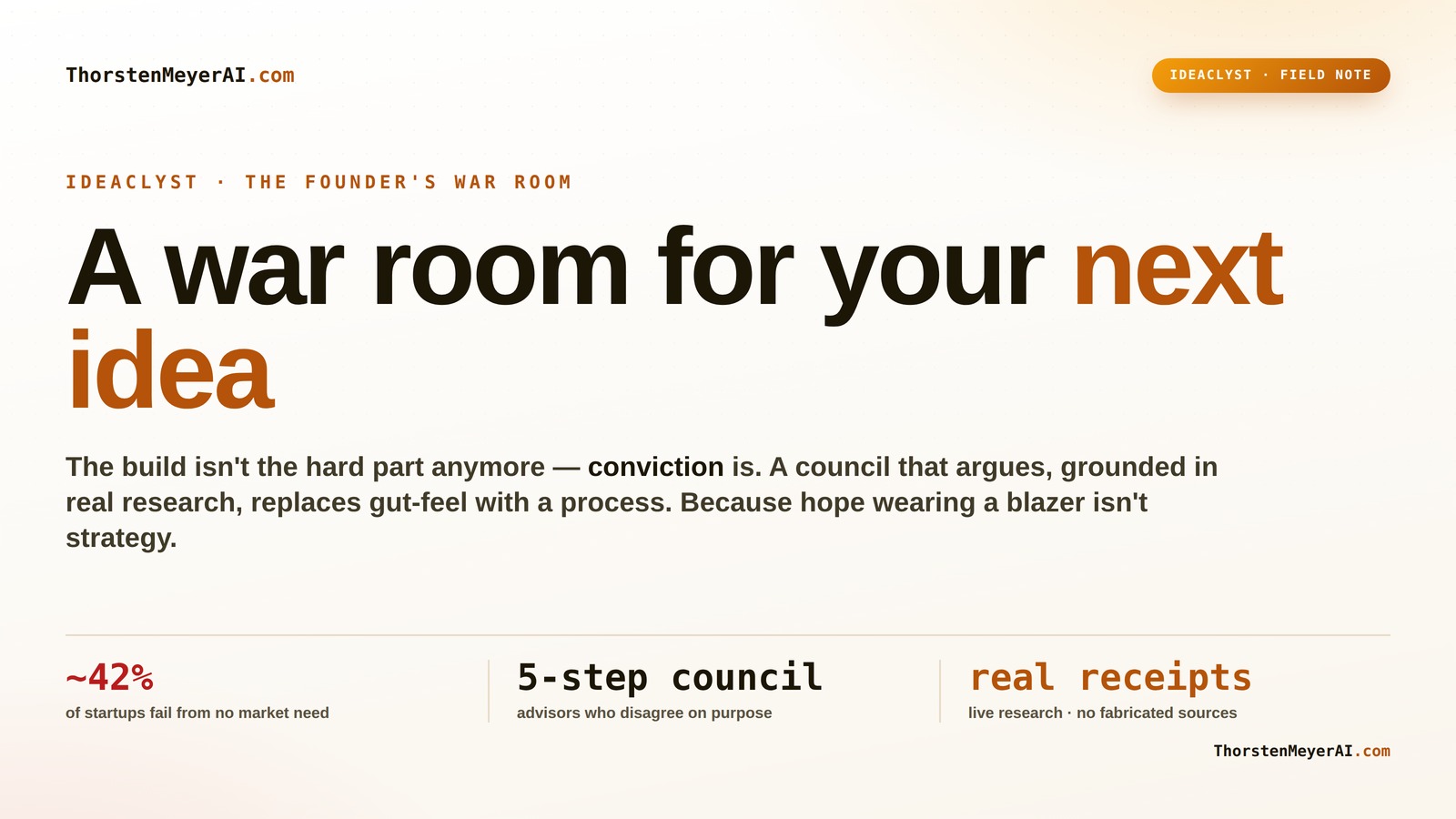
The build isn’t the hard part anymore — conviction is. Knowing which idea deserves the next six months, and being able to defend it. Most founders answer with gut feel and optimistic math. That’s hope wearing a blazer. IdeaClyst replaces it with a process.
The most expensive decision is what to build
The single most valuable thing a tool can do is talk you out of the wrong six months. The numbers make the case better than any pitch.
Three tools in one — on your own machine
Strip away the framing and IdeaClyst is three things at once, all running locally with nothing leaving your laptop.
An AI council
Pressure-tests an idea you bring it — advisors who argue on purpose.
A discovery engine
Finds ideas you didn’t know to look for by hunting real demand signals.
A founder’s workspace
Carries winners from “interesting” all the way to “ready to build.”
Advisors who disagree on purpose
Not one confident, agreeable answer — a structured five-step deliberation where models play different roles and turn on their own work. The disagreement is the feature.
The five-step deliberation
A council that leads with the bad news surfaces the objections you’d otherwise find the expensive way, on month five.
Product strategy
Who’s it for, what’s the wedge, why now, what’s the business model.
Technical architecture
What would it actually take to build — and where’s the risk.
Critique pass
The council turns on its own work. Where’s the hand-waving? What kills this?
Second, independent critique
A different voice, a different angle — so blind spots don’t survive.
Final synthesis
Everything into one coherent founder packet: strategy, architecture, validation, plan.
When IdeaClyst cites a source, it actually fetched it
The hard departure from “ask an AI what it thinks of my startup.” It runs in a strict, real-data-only mode — if it can’t gather genuine evidence, it says so plainly rather than inventing a plausible paragraph.
Confidence with receipts
No fabricated statistics, no imaginary competitors, no made-up citations. The packet survives a skeptical co-founder or a sharp investor because the reasoning has receipts.
Market research first
Scouts the landscape before the council reasons about anything.
Competitor read
Real positioning, pricing signals, feature claims — differentiation vs. reality.
Validation with links
Not “talk to customers” — concrete signals & sources you can click.
From the blank page to build-ready
Evaluation is half the problem; the blank page is the other half. And a plan is worthless if it dies in a tab you never reopen.
Bring a space, not an idea
“AI for accountants,” “tools for indie game studios” — plus your goal and real capacity. It hunts demand signals across HN, Reddit, Product Hunt, GitHub, pricing pages.
- An honest market read — leads with the bad news when a space is hard
- An opportunity map — high pain, thin competition
- Ranked candidates — wedge, who pays, effort, risk, confidence
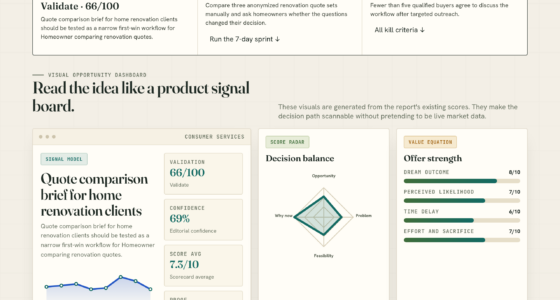
- each with KILL CRITERIA — when to walk away
A home and a forward path
Every promising idea gets carried forward, with every artifact in plain files on your disk.
- Validation tooling — sprint board, interview list, evidence browser
- Founder profile — a personal-fit lens; same discovery, different advice
- Build workspaces — funnel, personas, landing draft, version history
- “Build this idea” → a PRD + task queue, ready for a coding agent
Key Takeaways
- A war room is a dedicated visual workspace that accelerates decision-making by making ideas and progress visible.
- IdeaClyst replicates this environment digitally, offering private, local-first AI critique and collaboration tools.
- Structured debate between AI models surfaces weaknesses early, saving time and resources.
- Hybrid setups combining physical and digital war rooms boost flexibility and team engagement.
- Start small: create a dedicated space for your ideas, challenge them with AI, and refine continuously.
Products Worth Considering

Jackery Explorer 300 Portable Power Station, 292Wh

Jackery Explorer 2000 v2 Portable Power Station with Two 200W Solar Panels

Samsung 27-Inch Odyssey QD-OLED G8 4K 240Hz Gaming Monitor
As an affiliate, we earn on qualifying purchases.
What a War Room Really Is — and Why It Works for Ideas
A war room is a dedicated space where teams gather to focus intensely on a project, visualize progress, and make rapid decisions. Think of it as a command center—big whiteboards, sticky notes, sketches, and constant discussion. It works because it turns scattered thoughts into a shared memory, speeding up progress and reducing misunderstandings.
For ideas, this concept means creating a space where your team’s insights, research, and strategies are visible and accessible. It’s not just a meeting room; it’s a hub for active development, where every scrap of information fuels your next move. For more insights on effective digital war rooms, this structure helps prevent miscommunication and keeps everyone on the same page.
How IdeaClyst Brings War Room Power to Your Laptop
IdeaClyst transforms the physical war room into a digital, local-first environment. It’s like having a whiteboard, sticky notes, and a team of advisors all on your machine. No cloud, no subscriptions, just your ideas and honest feedback stored safely on your disk.
Here’s how it works: You bring an idea—half-formed or fully fleshed out—and the AI council challenges it from multiple angles. It simulates a team of advisors debating strategy, tech risks, and market fit. This process isn’t just about critique; it’s about revealing hidden assumptions and biases that you might overlook. For more on AI-driven idea validation, see AI critique tools that help you anticipate potential pitfalls before they become costly mistakes.
Why a Digital War Room Boosts Confidence and Speed
In startup land, speed and confidence can make or break your next move. A digital war room like IdeaClyst offers a clear advantage: it consolidates research, feedback, and planning into one visible, evolving space. This centralization reduces the risk of losing critical insights scattered across various tools or notes, which often leads to delays and duplicated efforts. When your ideas are organized visually and updated in real time, you can quickly identify gaps, contradictions, or weak points—before they escalate into costly mistakes.
For example, a founder testing a new feature can quickly see the gaps in their logic, challenge assumptions, and get real-time critique—without waiting days for feedback. This immediacy shrinks the cycle from weeks to hours, allowing rapid iteration and smarter pivots. The structured debate between AI models surfaces weaknesses you might overlook—like technical risks or market flaws—before pouring resources into development. This preemptive critique reduces the risk of building the wrong thing or investing in flawed assumptions, ultimately saving time and money. The implication is that teams become more agile and confident, making better decisions faster. The tradeoff is that relying on AI critiques requires trust in the system and an understanding that it complements, rather than replaces, human judgment—so active engagement remains essential.
The Modern Twist: Hybrid and Portable War Rooms
Traditional war rooms are physical spaces—large whiteboards, walls covered in notes. But in today’s distributed work culture, digital and hybrid setups matter more. IdeaClyst fits perfectly into this shift by offering a portable, private workspace that travels with you. Discover more about AI and remote work strategies that support flexible idea development.
Some teams even use a combination: physical boards for quick brainstorming, and IdeaClyst for deep analysis and validation. This hybrid approach enhances flexibility—physical spaces offer tactile immediacy, while digital tools provide structure, permanence, and the ability to revisit and refine ideas over time. The key is that hybrid setups allow teams to leverage the strengths of both environments, creating a more resilient and adaptable idea development process. Research from [2] emphasizes that visual thinking tools—whether physical or digital—boost clarity and team alignment. The key is flexibility and visibility. A digital war room like IdeaClyst supports both, making your idea process seamless and scalable, especially as teams grow or shift working styles.
Practical Tips for Setting Up Your Digital War Room
Want your own version of a war room? Here are some tips:
- Keep your workspace clutter-free—digital or physical. Focus on the core idea and the critical questions to avoid distraction and maintain clarity.
- Use visual structures—diagrams, charts, timelines—to map out ideas and risks. Visuals help encode complex information quickly, making it easier to identify connections and gaps.
- Designate a space—digital or real—that’s dedicated solely to project work. Consistency in location fosters discipline and signals to your team that this is the focus zone.
- Regularly review and update your canvas. Keeping the workspace current encourages active engagement and prevents stagnation.
- Leverage AI critiques and structured debates—like IdeaClyst—to surface blind spots early. This continuous challenge sharpens your ideas and builds confidence.
For example, allocate a specific Markdown file as your “battle map,” and update it daily. This habit ensures your team remains aligned and your ideas stay fresh, enabling quicker iteration and more informed decisions.
What You Need to Build Your Own War Room — and Why IdeaClyst Stands Out
All you need is a digital workspace, a few visual tools, and a way to challenge your ideas. But most solutions lack the structured debate and private, local-first design that makes IdeaClyst unique.
While tools like Miro or Notion support visual thinking, they often lack integrated AI-driven critique and the ability to keep everything private on your machine. These limitations can lead to scattered workflows and security concerns. IdeaClyst combines visual collaboration, AI debate, and local-first control into one package—addressing these gaps. This integration allows you to focus on strategic thinking without worrying about data privacy or cloud dependencies, which are often tradeoffs with other tools. For founders, this means more control over their ideas and a more secure environment for sensitive strategies. IdeaClyst is developed privately and is not publicly available.
Your Next Step: Making a War Room Your Secret Weapon
If you’re serious about building something meaningful, a war room is non-negotiable. It’s where ideas grow, clash, and get refined. With IdeaClyst, you get a private, AI-powered space that adapts to your workflow and keeps your work safe.
Start small: create a dedicated folder, sketch out your first idea, and challenge it with the AI council. Notice how the process of testing and refining ideas becomes more deliberate and confident. This environment fosters disciplined thinking—forcing you to articulate assumptions clearly and evaluate them critically. Over time, this practice builds a habit of strategic reflection, which is essential for high-stakes innovation. Remember, the best ideas don’t emerge from luck but from a disciplined process of testing, challenging, and iterating in a dedicated space. Your war room becomes the backbone of this process, helping you stay focused and aligned as your ideas evolve into tangible products or strategies.
Making your own digital war room isn’t just about tools; it’s about cultivating a mindset of intentionality and continuous improvement. With consistent use, your war room will become an indispensable part of your entrepreneurial toolkit, giving you the confidence to move faster and with greater clarity.
Frequently Asked Questions
What exactly is a digital war room?
A digital war room is an organized, private workspace on your computer that combines visual planning, real-time critique, and structured debate—mimicking a physical war room but in a portable, online environment.How does IdeaClyst differ from other project tools like Notion or Miro?
While Notion and Miro support visual thinking, IdeaClyst adds AI-driven council debates, structured critiques, and keeps everything local-first. It’s built specifically for founders who want private, strategic decision-making without cloud dependencies.Can I use IdeaClyst if I work with a team?
Yes. You can share your Markdown files, collaborate on ideas, and challenge each other within the local environment. For remote teams, it’s a private hub that everyone can access on their own machines, keeping your discussions secure.What are the key features that make a war room effective?
Large writable surfaces, clear visual structures, dedicated project zones, and a space for honest critique. IdeaClyst adapts these features digitally, offering a central hub for focused, visual development.Is a physical war room better, or can a digital one suffice?
A physical war room offers tactile, immediate collaboration. But a digital war room like IdeaClyst offers flexibility, privacy, and the ability to work asynchronously—making it equally powerful, especially for distributed teams.Conclusion
Think of IdeaClyst as your personal war room—a private, smart space where ideas are tested, challenged, and shaped into real plans. It’s the strategic hub that keeps your focus laser-sharp and your confidence high. In a world racing toward faster innovation, having your own digital war room isn’t just smart; it’s essential.
So, what’s the first idea you’ll bring to your new war room? The future belongs to those who build with clarity and conviction. Make your workspace your secret weapon—and start shaping your next big breakthrough today.