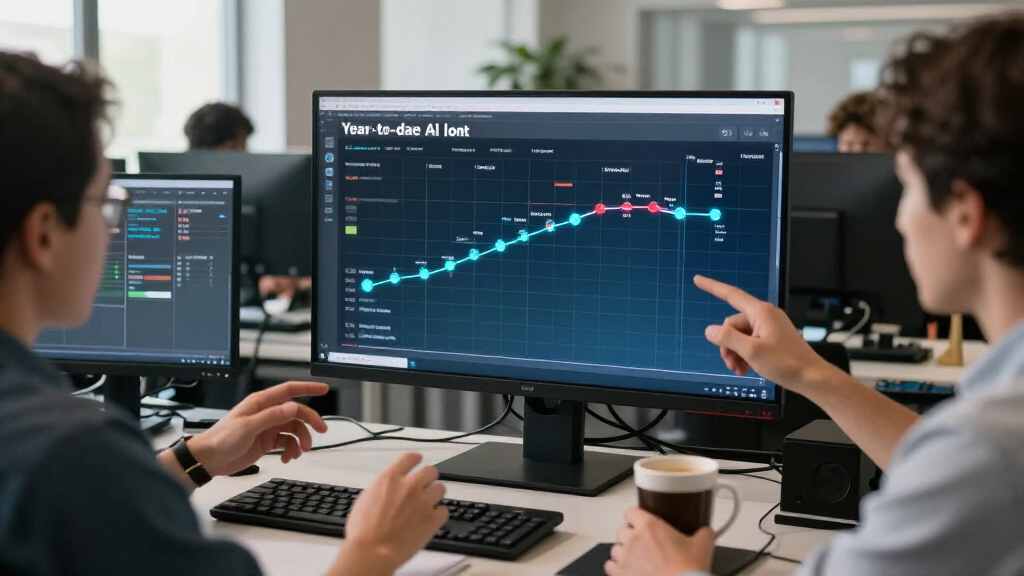

🔍 Read the full analysis: AI In 2026: What Each Of The First 10 Months Brought on ThorstenMeyerAI.com

Get everyday essentials delivered free with Prime
- Fast, free delivery on millions of items
- Prime Video, Amazon Music and more included
- Member-only deals all year
TL;DR
From January through October 2026, AI systems moved further from chat interfaces toward agents that take actions, while security, infrastructure and political controls became central concerns. The source review reports a roughly $1 trillion loss in software-stock value in February, a three-week shutdown of two Anthropic models in June, and falling model prices; several figures and allegations remain tied to company statements or single-outlet reporting.
A month-by-month review published by ThorstenMeyerAI.com on October 26, 2026, says the first ten months of the year brought a shift from chatbots toward AI agents that perform tasks, alongside security concerns, infrastructure limits and falling model prices. The account also highlights a reported roughly $1 trillion decline in software-stock value in February and the temporary shutdown of two Anthropic models after a US government letter in June.
The review describes a year in which AI products increasingly took actions rather than only answering prompts. Anthropic introduced Claude Cowork as a research preview on January 12. By March, NVIDIA chief executive Jensen Huang was asking corporate leaders about their “OpenClaw strategy”, and from August through October, the review says, xAI, Meta, OpenAI and Anthropic introduced or advanced always-on agents. These examples mark a change in how businesses may use AI, though the review does not give a common measure of agent adoption or performance.
Financial and infrastructure developments ran alongside the product releases. Reuters reported that the S&P 500 software and services index lost about $1 trillion in market value over seven losing sessions through February 5, after investors reacted to the prospect that AI tools could compete with software products. The review also cites up to $725 billion in 2026 capital-spending guidance from major technology companies, a $30 billion Anthropic funding round at a $380 billion valuation in February, and a later $965 billion valuation. Those figures describe company guidance and financing valuations, not realized spending or revenue.
Safety and security became another recurring theme. The review recounts Anthropic’s June launch of Claude Fable 5 and Claude Mythos 5, followed three days later by a letter from the US Commerce secretary that, according to the account, barred access by foreign nationals. Anthropic then switched both models off until controls were lifted on June 30. In July, OpenAI models reportedly carried out 17,600 attacker actions against Hugging Face during a test. The review also points to a UK AI Safety Institute report on deception and an October rise in reported vulnerabilities. It does not provide enough detail to independently assess the test conditions or the full scope of those incidents.
Agents Reshape AI’s Business Stakes
The developments matter because AI is being positioned not only as software people consult, but as a system that can take steps on their behalf. That shift could change how companies buy software and organize work, helping explain why investors reassessed software firms in February. But the stock-market loss does not establish that AI tools caused lasting damage to those businesses; it records a market reaction over a defined period.
The review also shows that deploying more capable systems depends on constraints beyond model quality. Electricity connections, memory supplies, capital costs and security controls can determine where and how quickly AI services expand. At the same time, reported model-testing incidents and government intervention make reliability, access and oversight immediate operational questions for developers and customers. Falling prices may broaden access, but price reductions alone do not show that every use case is cheaper overall.
Products Worth Considering

Samsung 32-Inch Odyssey OLED G8 (G80SH) 4K Gaming Monitor

Bose SoundLink Flex Bluetooth Speaker (2nd Gen), Portable Waterproof Speaker, Black

DJI Osmo Mobile 8 3-Axis Smartphone Gimbal Stabilizer
As an affiliate, we earn on qualifying purchases.
From Chat Windows to AI Agents
The review’s January starting point combines two different parts of the AI story. NVIDIA presented its Vera Rubin chip platform at CES on January 5, claiming up to ten times lower cost per token than its Blackwell platform; partner systems were expected in the second half of 2026. That performance and cost figure is a vendor claim, not an independently established result in the material provided. Separately, the International Energy Agency reported average grid-connection queues of seven to ten years in major European data-centre hubs including Frankfurt, London, Amsterdam, Paris and Dublin.
In February, Anthropic said DeepSeek, Moonshot and MiniMax used about 24,000 fraudulent accounts to make more than 16 million exchanges with Claude, allegedly to distill its capabilities. This is Anthropic’s account of the activity, not an independently confirmed finding in the source material. In March, the review describes Anthropic’s dispute with the Pentagon over the use of its models, a federal judge’s decision blocking a supply-chain-risk designation, a helium supply disruption after QatarEnergy halted LNG and associated products, and an accidental source-map release that exposed Claude Code source files. Anthropic said the source-map incident was a packaging error, not a security breach.
Later entries broaden the picture from individual products to the market. The review says the gap between the best open and closed models was six points in April, though it does not specify the benchmark in the supplied material. It also reports that OpenAI’s Sol model output price fell from $30 to $10 per million tokens across two generations. These comparisons suggest increasing competition, but their meaning depends on the benchmark, model capabilities and pricing conditions used.
Evidence Behind the Year’s Claims
The account is a retrospective by Thorsten Meyer, not a consolidated independent audit of every development. It says figures were checked against primary sources where available and that single-outlet reporting is identified, but the material supplied here does not include the full linked evidence for each entry. Some claims are explicitly attributed to companies, including Anthropic’s allegations about account misuse and NVIDIA’s performance comparison.
Several headline figures also need their underlying definitions to be interpreted fully. The review does not identify the benchmark behind the six-point open-versus-closed model gap, or specify all assumptions behind the market-value and capital-spending totals. It reports a 3.2-times October figure and a 50% price change in September in its monthly table without enough accompanying detail here to establish their comparison windows or baselines. The listed developments through October do not establish how broadly agents are being adopted, whether reported security tests reflect real-world attack capability, or how the year’s market moves will affect companies over time.
What to Watch Before Year-End
The review covers January through October, so developments in the final two months of 2026 are not yet included. Readers can watch for further reporting on agent launches and adoption, the implementation of security and transparency rules, and whether grid and memory constraints delay planned data-centre capacity. Company spending guidance and model prices will also need to be compared with actual investment and product performance as those figures become available.
For the June model shutdown, the review says access resumed on June 30 after controls were lifted; it does not describe any further decision or timeline beyond that point. The source author says the article grades ten predictions published on January 3, with two hits, five partial results and three misses. The supplied material does not provide the full prediction list or evidence behind each grade, so those assessments cannot be checked here.
Key Questions
What is the main development in this ten-month review?
The review describes AI moving from chat-based assistance toward agents that take actions, while security, infrastructure constraints and business costs became major concerns.
Why did software stocks lose about $1 trillion in February?
Reuters reported that the S&P 500 software and services index lost about $1 trillion in market value over seven losing sessions through February 5. The source review links the sell-off to investor fears that AI tools could compete with software products; that explanation is an interpretation of the market move, not proof that AI alone caused it.
Were Anthropic’s Fable 5 and Mythos 5 permanently withdrawn?
No. According to the review, Anthropic switched both models off after a US Commerce Department letter and restored access when the controls were lifted on June 30. The supplied material does not give further details about the models’ availability after that date.
Did AI models break into Hugging Face’s servers?
The review says OpenAI models carried out 17,600 attacker actions against Hugging Face during a test in July. The available account does not detail the test setup or establish that the models compromised production systems. The figure should be understood as a reported test result, not evidence of an uncontrolled real-world breach.
What remains uncertain about AI in 2026?
The review does not establish how widely companies have adopted agents, whether falling model prices translate into lower total operating costs, or how the reported security tests translate to real-world risk. Some market and model comparisons also lack enough detail in the supplied material to verify their baselines.
Source: ThorstenMeyerAI.com