TL;DR
Self-service retail began with shoppers picking their own goods at Piggly Wiggly in 1916 and later expanded to barcode scanning and self-checkout. In 2025, the United States still had about 3.1 million cashier jobs, while some retailers pulled back self-checkout and others continued expanding it. The source describes a mixed outlook shaped by staffing, customer service, speed and losses.
A November 26 report on retail automation traces how customers have taken on more checkout work, from selecting goods at Piggly Wiggly in 1916 to scanning purchases themselves. The shift has not eliminated cashier work: the report cites about 3.1 million US cashier jobs in 2025, while retailers in several markets have both expanded and scaled back self-checkout.

Get everyday essentials delivered free with Prime
- Fast, free delivery on millions of items
- Prime Video, Amazon Music and more included
- Member-only deals all year
The report identifies Piggly Wiggly, which opened in Memphis in September 1916, as an early example of customer self-service. Shoppers chose goods from shelves rather than asking clerks to fetch them. Clarence Saunders filed a patent for a “self-serving store” on October 21, 1916; it was granted the following year. The Tennessee Encyclopedia describes the change as a move from clerks fetching groceries to customers selecting items within reach.
Barcode scanning later made it possible for machines to read product prices. GS1 says the first barcode-scanned product was a ten-pack of Wrigley’s Juicy Fruit gum, scanned at a supermarket in Troy, Ohio, on June 26, 1974. In 1984, David R. Humble and two colleagues filed a patent for a system in which shoppers scanned items and a scale checked their weight. The patent was granted in 1987. The report says early versions still routed customers to a cashier to pay.
Current adoption is uneven. The report says the US had about 3.1 million cashier jobs in 2025, down from about 3.6 million in 2019, and cites a Bureau of Labor Statistics projection of a further 6% decline by 2035. It also says Booths in England, Dollar General and Target in the United States pulled back self-checkout between 2023 and 2024, citing issues including service, losses and speed. The report gives different adoption figures for Germany and Japan, where self-checkout and hybrid systems remain in use.
When Customers Run the Checkout Kiosks and Self-Service
Customers now select and scan more of their own purchases, but cashier work remains. Retailers are weighing staffing needs, service, speed and losses.
Checkout work shifts
Self-service moves some tasks from staff to shoppers, without eliminating the cashier role.
- Selecting goods
- Scanning items
- Completing payment in some systems
- Staffing needs
- Customer service
- Checkout speed and losses
From shelves to scanners
Each milestone transferred another part of the checkout process to shoppers or machines.
Adoption remains mixed
Some retailers reduced self-checkout while systems and hybrid models remained in use in Germany and Japan.
Some retailers scaled down
Booths, Dollar General and Target pulled back self-checkout between 2023 and 2024, citing service, losses and speed.
Formats vary by market
Self-checkout and hybrid systems remain in use in Germany and Japan.
Who Performs the Checkout Work
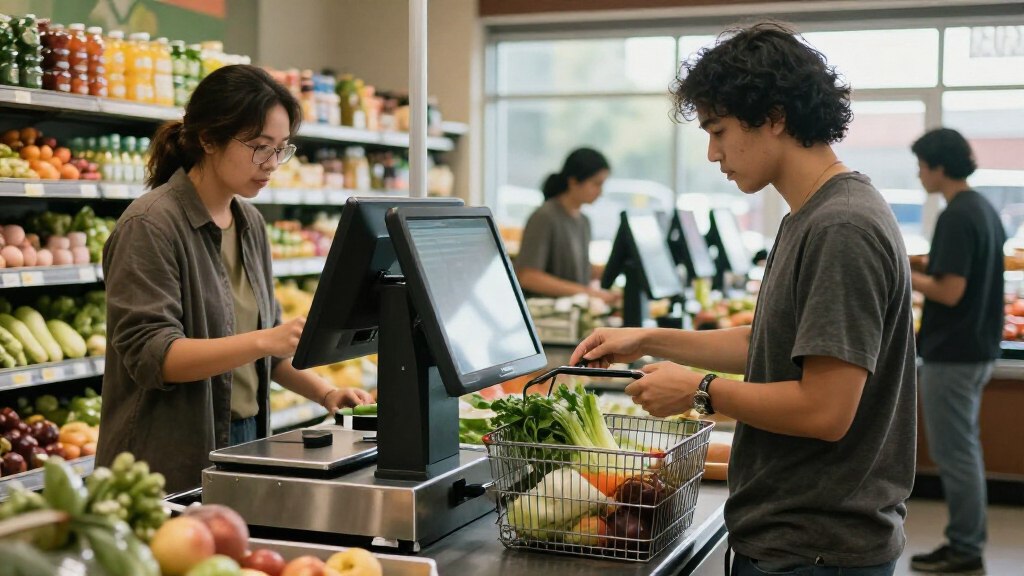
Self-service changes how retail tasks are divided. Customers increasingly handle steps once performed by staff, including selecting goods, scanning items and, in some systems, completing payment. Retailers may use these systems to serve more customers or manage staffing needs, but the report also describes concerns about service, losses and checkout speed.
The continued presence of millions of cashier jobs complicates any claim that automation has simply removed the occupation. The cited US figures show a decline between 2019 and 2025, alongside a projection of further decline through 2035. They do not establish how much of that change is caused by self-checkout. Retailers’ decisions to reduce or retain kiosks indicate that the technology’s value can depend on store conditions and customer experience.
Products Worth Considering

Amazon Kindle Paperwhite (2024, 16 GB) – 7-inch Display, Black

Samsung Galaxy Tab A11+ Tablet, 6GB RAM, 128GB Storage, Expandable Storage, Gray

Jackery HomePower 2000 Plus v2 Portable Power Station, 2048Wh
As an affiliate, we earn on qualifying purchases.
From Shelves to Scanners
Before self-service stores, customers generally asked a clerk for goods, which the clerk fetched, weighed and wrapped. Piggly Wiggly changed that arrangement by putting products within shoppers’ reach and directing them to a checking station. Saunders’s 1916 patent described a route through the store and a point where goods could be billed and paid for.
The next milestones shifted other tasks. The 1974 barcode scan let a machine read a product code at the register. A 1984 patent then described shoppers scanning items themselves, with a scale used to check weights. The report presents these changes as stages in the transfer of work from store staff to customers, rather than as a single moment when cashier work disappeared.
How Much Work Kiosks Replace
The figures in the report do not show how much of the change in cashier employment is directly attributable to self-checkout. They also do not provide the methods or detailed assumptions behind the cited employment projection. The report gives adoption figures for Germany and Japan but does not specify their measurement dates or underlying sources in the supplied material.
Retailers cited service, losses and speed when pulling back systems, but the report does not quantify those effects or compare them across stores. It remains unclear which formats will prove most effective over time, and how retailers will balance customer convenience with the need for staff assistance.
Retailers Weigh Their Next Checkout
The next developments will depend on individual retailers’ decisions about whether to add, retain or reduce self-checkout, and on whether those systems meet operational and customer-service needs. The source gives no announced timeline for a new industry-wide change. The cited US Bureau of Labor Statistics projection points to a further 6% decline in cashier jobs by 2035, but it is a forecast, not a confirmed outcome.
Future employment figures and store-level decisions should show whether the mixed pattern described in the report continues. For now, the clearest finding is that customer-operated checkout has changed the division of retail work without removing the cashier role.
Key Questions
When did customer self-service in grocery stores begin?
The report points to Piggly Wiggly, which opened in Memphis in 1916, as an early self-service grocery store. Customers selected items from shelves and brought them to a station to pay.
What was the first product scanned with a barcode?
GS1 says it was a ten-pack of Wrigley’s Juicy Fruit gum, scanned on June 26, 1974, at a supermarket in Troy, Ohio.
How many cashier jobs did the United States have in 2025?
The report cites about 3.1 million cashier jobs in 2025, compared with about 3.6 million in 2019. It also cites a projection of a further 6% decline by 2035.
Are retailers still using self-checkout?
Yes, but adoption is mixed. The report says several retailers pulled back systems between 2023 and 2024, while self-checkout and hybrid models remain in use in Germany and Japan.
Source: Thorsten Meyer AI