TL;DR
Labour MP Jess Asato’s High Court claim says Grok enabled users to create sexualised fake images of her, including a video. Grok’s maker, SpaceX Super Intelligence LLC, denies liability and argues the images were recognisably fictitious. No ruling has been made, and the case’s outcome remains uncertain.
Asato filed her claim on June 3, 2026, seeking damages, a declaration and an order requiring the company to introduce “effective and permanent technical measures” to prevent Grok from creating manipulated images of her, according to her lawyers at AWO. The claim alleges misuse of private information and breaches of data protection law. AWO says Grok was used to manipulate images of Asato in early January.

Get everyday essentials delivered free with Prime
- Fast, free delivery on millions of items
- Prime Video, Amazon Music and more included
- Member-only deals all year
SpaceXSI denies liability, Reuters reports. Its defence says the images at issue “would be understood by reasonable and sensible persons viewing that content to be AI-generated, fictitious and implausible … rather than as realistic images.” It also says the company “did not determine the content of the relevant users’ prompts” and argues Asato is not entitled to the order she seeks. Those are the company’s arguments, not findings by the court.
Asato’s lawyers dispute the company’s position. Her response, quoted in the source material, says: “SpaceX SI wants to have it both ways.” The case concerns which legal responsibilities may fall on the person requesting an image, the platform distributing it and the company that builds and operates the model. No court has decided the UK claim.
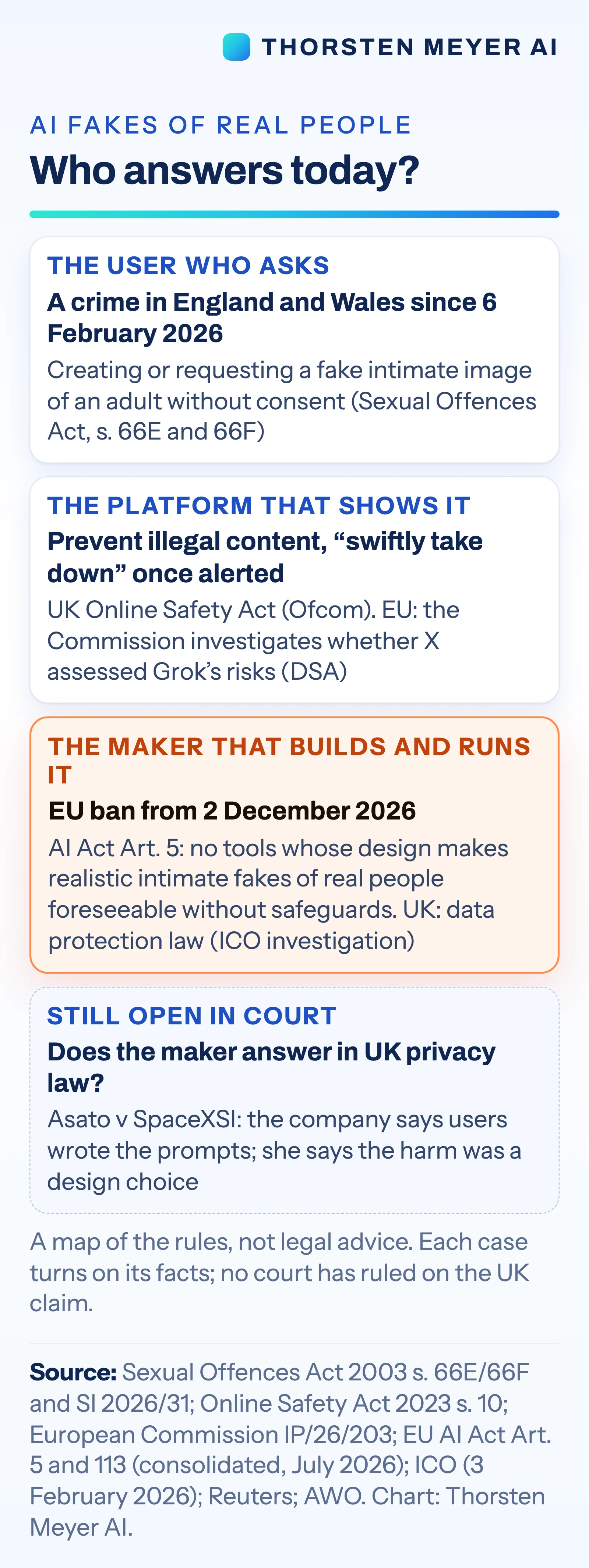
Who May Answer for Grok’s Outputs
The case puts a practical question before a UK court: can the maker of an image-generation system be liable for harm caused by outputs users request, or does responsibility rest with those users? The answer could affect how courts assess privacy and data protection claims when a tool generates manipulated images of identifiable people.
For AI companies and businesses offering image tools, the dispute brings system design, safeguards and response to complaints into focus. The defence points to user prompts and the images’ apparent artificiality; Asato’s claim challenges the role played by the system itself. The court’s eventual assessment may help clarify how those arguments apply under existing law.
For people targeted by sexualised fakes, the case tests whether current legal remedies can address both the creation of the material and the operation of the tool used to make it. The claim itself does not establish liability, and its outcome will depend on the evidence and the court’s application of the law.
Products Worth Considering

LG UltraGear 34G600A-B 34-Inch Curved WQHD Gaming Monitor

Sony WH-1000XM6 Wireless Noise-Cancelling Headphones – Midnight Blue

Apple AirPods Pro (1st Generation) with MagSafe Charging Case
As an affiliate, we earn on qualifying purchases.
From January Images to October Defence
According to AWO, Grok was used to manipulate images of Asato in early January 2026. On January 7, the UK Information Commissioner’s Office said it had contacted X and xAI to seek information about their safeguards under UK data protection law. The European Commission opened a Digital Services Act investigation concerning X and Grok on January 26. On February 3, the ICO announced formal investigations into X and X.AI LLC.
An Amsterdam court issued an order on March 26 barring Grok and X from creating or distributing undressed images, according to the source material. Asato filed her High Court claim on June 3. The company’s defence is dated October 29 and was reported by Reuters on November 19. These regulatory and court developments are separate from the UK claim; none, on the information provided, resolves whether SpaceXSI is liable to Asato.
There are also changes to the law and regulation on the calendar. The source material says that creating or requesting a fake intimate image of an adult without consent has been a crime in England and Wales since February 6, 2026. It says the EU AI Act’s ban on certain AI systems that generate realistic intimate images of identifiable people without consent is due to apply from December 2, 2026, where the outcome is foreseeable from the system’s design and safeguards are missing.
““did not determine the content of the relevant users’ prompts””
— SpaceX Super Intelligence LLC, in its written defence as reported by Reuters
The Court Has Yet to Decide
The High Court has not ruled on whether SpaceXSI breached privacy or data protection law, whether it is responsible for the system’s design, or whether Asato should receive the remedies she seeks. The company’s defence sets out its position; it is not a court finding. The source material does not provide a hearing date or the company’s full defence.
It is also unclear what evidence the court will examine about Grok’s design, the safeguards in place when the images were generated, how the system responded to user prompts, or how quickly the images were removed. The source material says the company removed images of Asato that breached its terms, but does not specify which images, when they were removed or whether all relevant copies were taken down.
The investigations and orders mentioned in the timeline have distinct legal processes and parties. Their progress and outcomes may develop separately from Asato’s claim.
Court Proceedings and EU Rules Ahead
The UK claim remains before the High Court, but the material available here does not identify its next hearing or a timetable for judgment. The court will need to consider the parties’ evidence and legal arguments before deciding whether the company is liable or whether to grant any requested remedy.
The EU AI Act provisions described in the source material are scheduled to apply from December 2, 2026. Regulators in the UK and EU have also been investigating aspects of Grok and X. Any future findings, enforcement measures or court decisions could add to the legal picture, but their timing and effects on Asato’s case are not established here.
Key Questions
What is Jess Asato suing Grok’s maker over?
Asato alleges that users generated sexualised fake images of her, including a video, using Grok. Her June 3, 2026 High Court claim seeks damages, a declaration and an order requiring safeguards to prevent manipulated images of her.
What does SpaceXSI say in its defence?
The company denies liability. It argues that viewers would recognise the images as AI-generated and implausible, says users supplied the prompts, and disputes Asato’s entitlement to the order she seeks.
Has a court found SpaceXSI liable?
No. The High Court has not ruled on Asato’s claim. The allegations and the company’s defence remain the parties’ positions.
What other rules or investigations are relevant?
The source material says UK law criminalised creating or requesting a fake intimate image of an adult without consent from February 6, 2026. It also says specified EU AI Act restrictions are due to apply from December 2, 2026. UK and EU regulators have separately investigated aspects of Grok and X.
Source: Thorsten Meyer AI