
📊 Full opportunity report: How To Identify The Right Workflows To Automate on IdeaNavigator AI — validation score, market gap, and execution plan.

Get everyday essentials delivered free with Prime
- Fast, free delivery on millions of items
- Prime Video, Amazon Music and more included
- Member-only deals all year
TL;DR
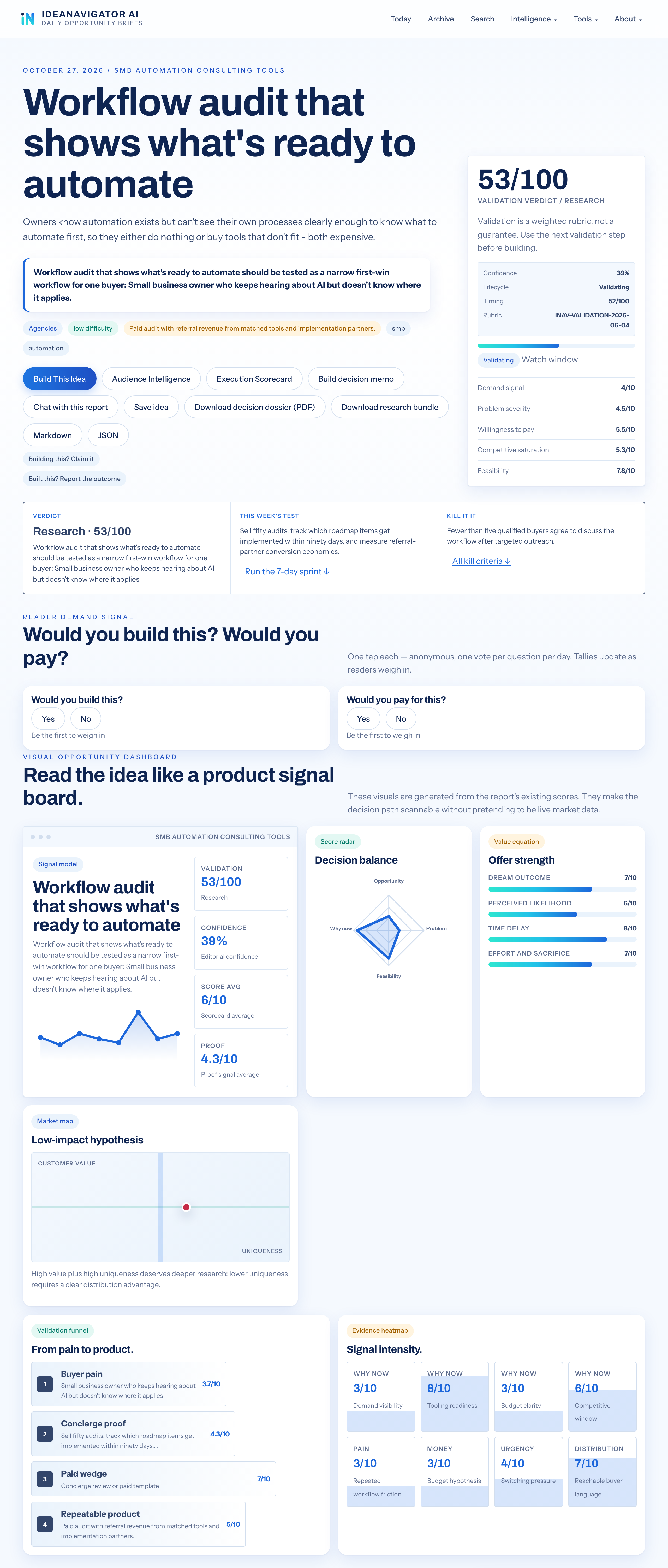
IdeaNavigator AI outlines a proposed workflow-audit service for small-business owners who are unsure what to automate. The concept would map operations, score processes and suggest a 90-day implementation plan; the proposed test is to sell 50 audits and track implementation and referral results.
IdeaNavigator AI has proposed a paid workflow audit to help small-business owners determine which parts of their operations may be suitable for automation. The concept would turn an interview about a business’s processes into a scored process map, matched tool suggestions and a sequenced 90-day roadmap; no evidence is provided that the service has launched or been tested.
The proposed service is aimed at owners who hear about AI and automation but do not know where those technologies fit into their own businesses, a challenge also addressed by AI tools for workflow automation. The problem identified in the proposal is not simply a lack of software: owners may have difficulty seeing and comparing their day-to-day processes well enough to choose a first task. That can leave them doing nothing or purchasing tools that do not match their needs.
The minimum viable product would use a guided interview to gather information about business operations and produce a process map. Each process would be scored for automation readiness, potential return on investment and difficulty. The audit would then rank possible projects into a 90-day plan and recommend tools for each step.
The proposed business model combines fees for the audit with possible referral revenue from software providers and implementation partners. The suggested validation test is to sell 50 audits, then track which roadmap recommendations customers implement within 90 days and how referrals convert. These are proposed measures, not reported sales, adoption or revenue results.
Choosing a Practical First Automation
For small businesses, the central question is often not whether automation exists, but whether a particular process is suitable and worth changing. A structured audit could help owners compare possible projects before committing money or staff time to a tool. The proposal puts process selection ahead of software selection, an approach intended to reduce the risk of buying a product that does not fit how a business works.
The suggested scoring system also makes the trade-offs visible: a process might be technically automatable but difficult to implement, or relatively easy to change but offer limited return. A roadmap could help an owner prioritize manageable work rather than attempt a broad technology overhaul. Whether that guidance produces better decisions is not yet established; the proposed 90-day tracking would provide an initial measure of whether customers act on the recommendations.
The referral component creates a commercial incentive to connect customers with tools and implementation services. That may make the service easier to monetize, but it also makes the quality and independence of recommendations relevant to buyers. The proposal does not specify how tool matches would be selected or how referral relationships would be disclosed.
Products Worth Considering

Bose QuietComfort Wireless Noise-Cancelling Headphones, Sandstone

Logitech MX Keys S Combo Wireless Keyboard and Mouse, Graphite

DJI Osmo 360 Motorcycle Handlebar POV Combo
As an affiliate, we earn on qualifying purchases.
From AI Interest to Process Mapping
The concept is framed around a mismatch: small-business owners are hearing more about AI tools, while still lacking a clear way to identify tasks within their own operations that could benefit from automation. The proposal argues that guided process-mapping interviews may now be easier to automate with large language models. That is the rationale offered for the timing, not evidence that an automated interview can reliably capture every business’s workflow.
The proposed product sits within the small-business automation consulting tools market. Rather than begin with a specific software product, it would gather operational details and recommend possible next steps. Its planned first test is deliberately limited: sell 50 audits, assess implementation over 90 days and examine referral-partner conversion. No customer feedback, pricing, audit results or comparison with existing consulting services is included in the proposal.
Evidence Still Needed From Buyers
The proposal does not establish whether small-business owners will pay for an audit, whether the interview can produce accurate process maps, or whether its readiness and return scores will predict successful implementation. It also provides no pricing, examples of completed audits, customer results or details about how the scoring model would work.
It remains unclear how the service would protect business information shared during interviews, verify its tool recommendations or handle potential conflicts created by referral fees. The proposed 50-audit test could shed light on demand and implementation behavior, but no results or timeline are available. Referral conversion alone would not show whether a recommended tool delivered lasting value to a business.
Testing Demand and 90-Day Adoption
The next stated step is to offer 50 paid audits and follow customers’ roadmap choices for 90 days. The proposed evaluation would record which recommendations are implemented and measure conversion economics for referral partners. Those results could indicate whether owners find the audit useful and whether the revenue model is viable, although the proposal does not say when the test will begin or what would count as a successful outcome.
Further reporting would need to establish the audit’s price, the quality of its recommendations and whether customers achieve measurable operational benefits after implementation. Until those details are available, the product should be understood as a proposed business idea rather than a validated service.
Source: IdeaNavigator AI
Key Questions
What is the proposed workflow audit?
It is a paid service concept that would interview a small-business owner about operations, map processes and rank possible automation projects.
What would the audit provide?
The proposed output includes a process map scored for automation readiness, potential return and difficulty, plus tool suggestions and a 90-day roadmap.
Has the service been launched or tested?
No launch, completed sales or customer results are reported. The proposal suggests selling 50 audits as a validation test.
How would the proposed service make money?
The planned model combines fees for audits with referral revenue from matched software tools and implementation partners. The proposal does not provide pricing or referral terms.
How would its effectiveness be measured?
The suggested test would track which roadmap items customers implement within 90 days and measure referral-partner conversion. The proposal does not define success thresholds or report results.
Source: IdeaNavigator AI