
🔍 Read the full analysis: The Connection Between AI And Credits In “After Action” on ThorstenMeyerAI.com

Get everyday essentials delivered free — and shop member deals
- Fast, free delivery on millions of items
- Access to Prime Big Deal Days deals on October 6–7
- Prime Video, Amazon Music and more included
TL;DR
After Action is a fictional, AI-built exhibition that presents 24 web experiences as productions in a continuous, navigable end-credit roll. Its source description details how JavaScript controls the credits, CSS builds miniature scenes, and a stationary linked index provides another way to explore the material.
After Action is an AI-built exhibition that turns a collection of 24 fictional web experiences into the closing credits of an imagined Wing V theater, rather than a conventional gallery of project cards. The original analysis sets out how the site combines a controllable credit roll, code-built miniature scenes and a separate linked index to make browsing part of the exhibit.
The project’s premise is a nearly empty cinema where the credits serve as the main display. The source describes Wing V as fictional and says the site is not a real company or an account of military activity. Its military-coded imagery is presented as small, toy-scale machinery and terrain, with the emphasis placed on web design and interaction rather than violence.
The central feature is a continuous roll naming the 24 rooms as productions. According to the description, this is not a decorative marquee: JavaScript tracks elapsed time and moves a single credit track using a transform. Chapter stops connect the time display, locator line, section label and jump controls, allowing visitors to pause or move between sections. The moving names are removed from keyboard focus; a stationary, linked register after the theater gives visitors an alternate route to the same projects.
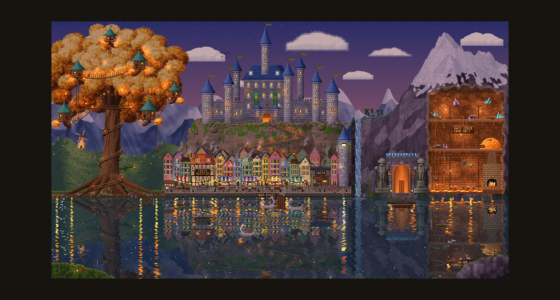
Between groups of about eight productions, the roll gives way to CSS-built dioramas. The listed scenes include a shield formation, a catapult arc and two keys approaching a shared lock. Tilted terrain, contour gradients and raised markers create the miniature effect without requiring a separate image for each scene. The page also layers projector-style effects over a locally stored still image; the source says the planned ambient video was unavailable in the described build.
A Different Way to Browse Web Projects
After Action makes the navigation itself part of the presentation. Instead of asking visitors to choose among a grid of thumbnails, it gives them a timed sequence with chapter controls and a text-based index. That approach links the exhibition’s subject—web projects imagined as productions—to the way the visitor encounters them.
The implementation details also show how an AI-directed visual concept can be translated into a working interface. The source describes distinct roles for JavaScript, CSS and local assets: code governs the roll and scene effects, while a stored still image supplies the theater’s hero visual. The stated design choices address practical issues too, including keyboard access, reduced-motion preferences and pausing animation when the page is hidden.
Those details matter because a cinematic effect can make a site harder to use if it offers no controls or alternative path. Here, the stationary register and manual-scroll option are described as counterparts to the moving presentation. The source does not provide user testing or performance measurements, so the accessibility and speed goals should be understood as design provisions, not independently verified outcomes.
As an affiliate, we earn on qualifying purchases.
From Art Direction to Interface
The source presents After Action as room 125 of a planned 175-room collection, identified as “After Action — Wing V Debrief Theater.” It includes an art-direction brief for a single-page showcase, specifying a cinema-and-sand-table aesthetic, a continuous roll, miniature scenes, and a final title card reading “War, staged. Craft, real. — WING V / FABLE 125.” The brief names the 24 project slugs and calls for a plain-text index.
The brief also specifies a technical approach: HTML, CSS and JavaScript, with no frameworks, build step, content delivery networks or external requests. It calls for responsive layouts at 390, 834 and 1,440 pixels, visible keyboard focus, large tap targets and reduced-motion support. These are requirements in the supplied brief; the source does not include an independent audit or screenshots confirming every target was met.
In the described version, the intended background video was not available. Rather than treating the atmosphere as video footage, the page uses a local still with subtle motion and visual overlays, and returns to the still for reduced-motion users. The distinction between code-generated scene elements and the locally stored hero image is part of the project’s account of how it was made.
“The credits become the exhibit.”
— The supplied description of the exhibition
As an affiliate, we earn on qualifying purchases.
What the Description Does Not Verify
The supplied material describes the site and its intended behavior, but it does not include an independent technical review, accessibility audit, browser testing results or measured frame rates. Claims such as smooth performance, responsive behavior and successful operation at specified screen widths therefore remain unverified by the source material.
The account says the intended ambient video was unavailable and that a local still image was used instead. It does not explain why the video could not be used, whether it might be added later, or whether all features in the art-direction brief are present on the live site. The brief describes a planned final card and a 24-project index; the description does not separately confirm each item’s current implementation.
The source identifies the work as AI-built, but offers no detailed account of which AI tools generated which parts, how much code was written or revised by people, or how the project was evaluated. Its statements about process and design are attributable descriptions, not evidence of a particular level of automation or of audience response.
As an affiliate, we earn on qualifying purchases.
The Live Room and Its Index
The supplied description directs readers to the live After Action room at the FABLE/175 site, where they can inspect the presentation and its navigation directly. The stationary project register is described as the way to browse without following the moving roll, while chapter controls offer a way to jump through the sequence.
No launch date, update schedule or upcoming milestone is given in the source. It also does not say whether the unavailable video will be restored or whether the room will receive changes. For now, the clearest next step for readers is to compare the live page with the documented design brief and check how the controls, index and reduced-motion behavior work in their own browser.
As an affiliate, we earn on qualifying purchases.
Key Questions
What is After Action?
After Action is an AI-built exhibition website that presents 24 fictional web experiences as productions in an imagined Wing V theater. The source says it is not a real company or a record of military activity.
How does the credit roll work?
The description says JavaScript tracks elapsed time and moves a continuous credit track. Chapter stops, a time display, a locator and jump controls let visitors pause or move through the sequence.
Are the miniature scenes photographs or video?
The scenes between credit sections are described as CSS-built dioramas, made from tilted terrain, gradients and markers. The theater’s hero uses a local still image with visual effects; the planned ambient video was unavailable in the described build.
What accessibility options are described?
The source describes a stationary linked register after the theater, a manual-scroll alternative for reduced-motion users, and animation that pauses when the page is hidden. It does not provide an independent accessibility audit confirming how these features perform.
Has the site been independently tested?
The supplied material gives design requirements for responsiveness, focus visibility and performance, but includes no independent test results. It is not possible from the source alone to confirm that every requirement has been met.
Source: ThorstenMeyerAI.com
Fall Picks
fall essentials
As an affiliate, we earn on qualifying purchases.