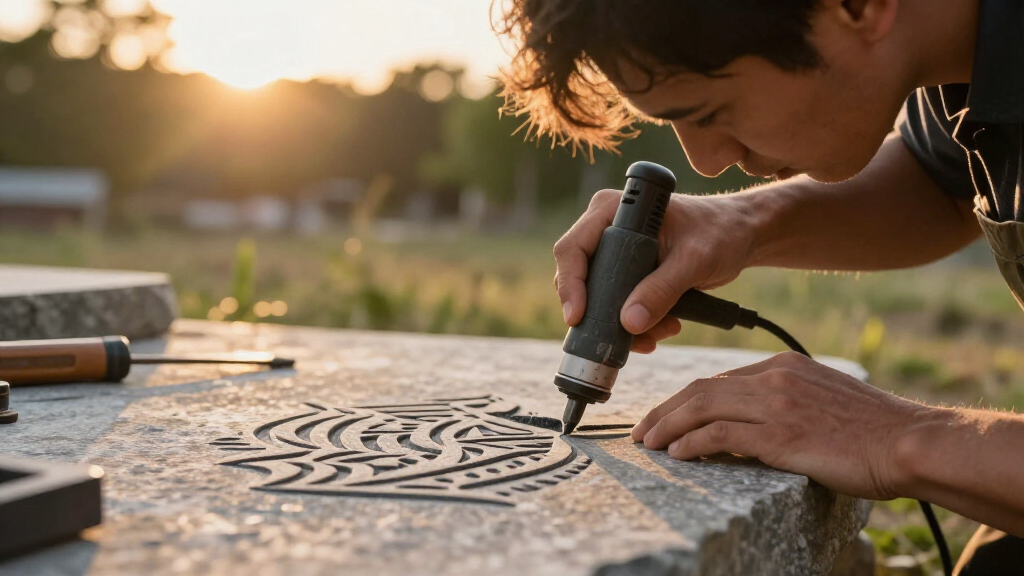

🔍 Read the full analysis: The Making Of 'The Runestone Field': AI's Role In SVG Carving Animation on ThorstenMeyerAI.com
TL;DR
An innovative project uses AI to animate SVG carvings of runestones, creating an immersive digital storytelling experience. This approach bridges history and modern automation, showcasing new possibilities in visual design.
The Making of ‘The Runestone Field’: AI’s Role in SVG Carving Animation
An innovative project by Thorsten Meyer’s team uses artificial intelligence to animate SVG carvings of runic stones — transforming static ancient art into a dynamic, immersive digital storytelling experience that bridges history and modern automation.
From Static Carving to Living Story
Digital Capture
Detailed digital models of runic stones are created, preserving every intricate carving line.
AI Path Generation
Algorithms analyze the carving geometry and generate fluid SVG animation paths automatically.
Carving Simulation
Viewers watch the runes being “carved” in real time, stroke by stroke, on screen.
Immersive Narrative
Animations are woven into a storytelling experience that merges craft with automation.
An Innovative Fusion of Ancient Art and Modern AI
History, Reanimated
The project opens new avenues for cultural preservation, allowing historical art forms like runic carvings to be experienced interactively and dynamically rather than as static reproductions.
A Scalable Method
For designers and technologists, it demonstrates a scalable way to animate detailed graphics efficiently — potentially influencing future digital art and educational tools.
Every Detail Explored
The immersive nature of the animation invites viewers to explore every detail of the carvings, fostering a deeper appreciation of historical craftsmanship and AI-driven automation.
How Far Automation Has Come
Prior efforts included static digital reproductions and limited animations, but the integration of AI for automating detailed SVG carving animations marks a significant step forward — aligning with broader trends in digital heritage preservation.
“This project demonstrates how AI can elevate traditional craftsmanship, transforming static carvings into dynamic stories that breathe new life into ancient art.” — Thorsten Meyer
Open Questions & Future Developments
Scalability & Fidelity
It is not yet clear how scalable the AI-driven process is for larger or more complex projects, or to what extent AI can replicate nuanced artisan craftsmanship without human oversight. Long-term preservation details are still emerging.
Interactive Creation
The team plans to add user interaction features, letting viewers customize or generate their own runestone animations — plus improved AI accuracy for complex carvings.
Museums, VR & Education
Future research targets educational tools, virtual reality, and cultural heritage preservation, with collaborations alongside museums and educational institutions to bring the technology into broader public use.
Frequently Asked
How does the AI animate the runestone carvings?
The AI generates smooth SVG carving animations using algorithms, simulating stones being carved in real time based on detailed digital models of the runes.
Can this technology be used for other historical art?
Yes — the underlying techniques adapt to engravings, sculptures, and paintings, offering new ways to preserve and present cultural heritage.
What are the main challenges?
Ensuring the AI accurately replicates intricate carving details, and scaling the process to larger or more complex artworks without sacrificing quality.
Is the project accessible to the public?
Yes, it is live for public viewing, with a full case study available online covering technical steps, challenges, and breakthroughs.
Innovative Fusion of Ancient Art and Modern AI
This project exemplifies how artificial intelligence can revolutionize digital storytelling by automating complex artistic processes. It opens new avenues for cultural preservation, allowing historical art forms like runic carvings to be experienced interactively and dynamically. For designers and technologists, it demonstrates a scalable method to animate detailed graphics efficiently, potentially influencing future digital art and educational tools. The immersive nature of the animation invites viewers to explore every detail of the carvings, fostering a deeper appreciation of historical craftsmanship while showcasing the potential of AI-driven automation in creative fields.As an affiliate, we earn on qualifying purchases.
The Evolution of Digital Art and Automation in Cultural Projects
Traditional runic carvings have long been a symbol of ancient storytelling and craftsmanship. Recent years have seen increasing interest in digitizing and preserving such art forms through technological means. Prior efforts have included static digital reproductions and limited animations, but the integration of AI for automating detailed SVG carving animations marks a significant step forward. Thorsten Meyer’s team has been exploring how automation can replicate the precision and artistry of manual carving, making the process scalable and accessible. This project builds upon previous innovations in SVG animation and digital preservation, pushing boundaries by combining these with AI’s capabilities to generate fluid, realistic carving effects. The development aligns with broader trends in digital heritage preservation, where technology enhances both education and engagement with historical artifacts.“This project demonstrates how AI can elevate traditional craftsmanship, transforming static carvings into dynamic stories that breathe new life into ancient art.”
— Thorsten Meyer
As an affiliate, we earn on qualifying purchases.
Unanswered Questions About Technical Scalability and Artistic Fidelity
It is not yet clear how scalable the AI-driven SVG carving process is for larger or more complex projects. Additionally, questions remain about the extent to which AI can replicate the nuanced craftsmanship of traditional artisans without human oversight. Details about long-term preservation of the digital artifacts and potential limitations of the automation process are still emerging.As an affiliate, we earn on qualifying purchases.
Future Developments and Broader Applications of AI Carving Animation
Thorsten Meyer’s team plans to expand the project by integrating user interaction features, allowing viewers to customize or generate their own runestone animations. Further research is expected to focus on improving AI accuracy for complex carvings and exploring applications in educational tools, virtual reality, and cultural heritage preservation. The team also aims to collaborate with museums and educational institutions to bring this technology into broader public use.As an affiliate, we earn on qualifying purchases.
Key Questions
How does the AI animate the runestone carvings?
The AI uses algorithms to generate smooth SVG carving animations, simulating the process of stones being carved in real time, based on detailed digital models of the runes.Can this technology be used for other types of historical art?
Yes, the underlying techniques can be adapted to animate various forms of traditional art, including engravings, sculptures, and paintings, offering new ways to preserve and present cultural heritage.What are the main challenges faced in this project?
Key challenges include ensuring the AI accurately replicates the intricate details of traditional carvings and scaling the process for larger or more complex artworks without sacrificing quality.Is this project accessible to the general public?
Yes, the project is currently live for public viewing, and the full case study is available online for those interested in the technical details and artistic process.What impact could this have on digital art and preservation?
It could significantly enhance digital preservation efforts, enable interactive educational experiences, and inspire new forms of artistic expression that blend craftsmanship with automation.Source: ThorstenMeyerAI.com