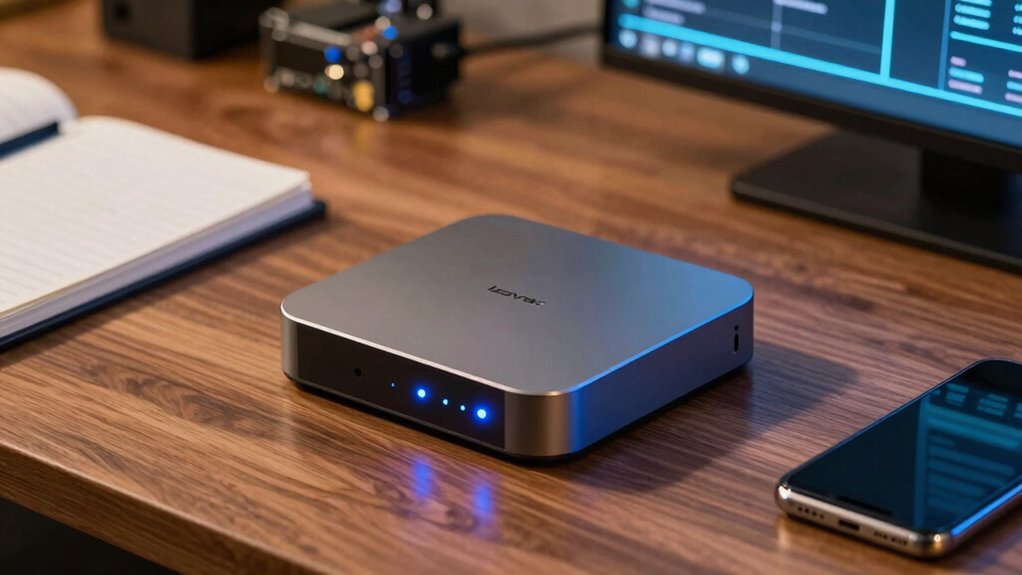
Edge devices make AI feel faster and more private because they process data locally, reducing delays from sending information elsewhere. You get quicker responses, especially in real-time scenarios like autonomous vehicles or smart cameras. They also keep sensitive data secure by avoiding transmission over the internet and enabling strict security measures. Plus, they work reliably even without internet, ensuring continuous operation. To discover more about how this boosts AI performance, keep exploring the details below.
Key Takeaways
- Edge devices process data locally, ensuring faster AI responses and reducing latency.
- They keep sensitive information within the device, enhancing data privacy and security.
- Local processing minimizes data transmission, lowering interception risks and cyber threats.
- Combining edge with cloud allows quick insights while maintaining privacy and scalability.
- They enable reliable AI operation even with poor or interrupted internet connectivity.
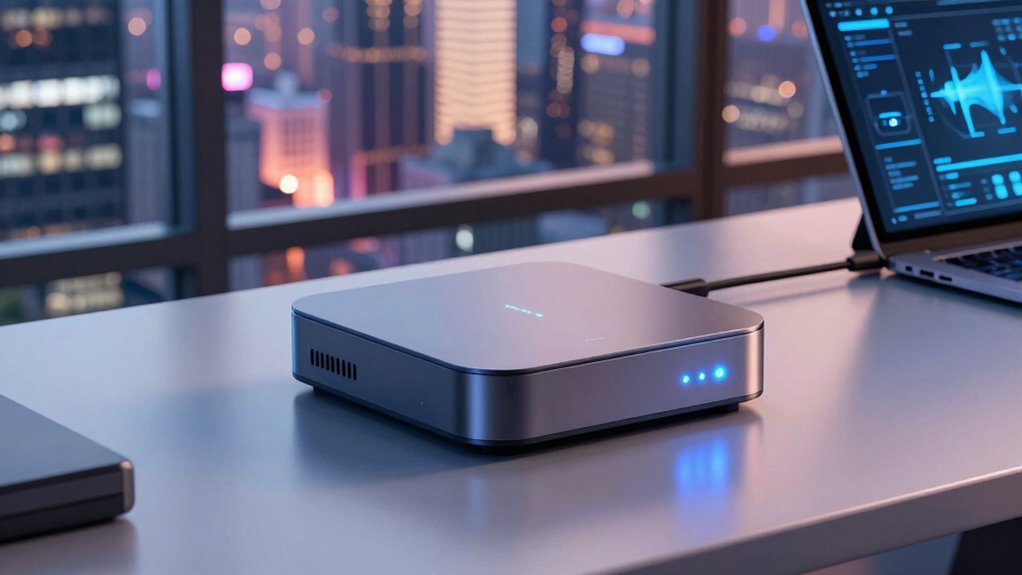
Edge devices are transforming the way artificial intelligence (AI) is deployed by bringing processing power closer to the data source. Instead of relying solely on distant cloud servers, you now have the ability to process data locally, which markedly reduces latency and speeds up decision-making. This proximity means your AI applications can respond instantly, making everything from smart cameras to industrial sensors more efficient and effective. When you integrate these devices with cloud services, you get a seamless blend of local processing and cloud scalability, allowing you to manage workloads dynamically. Cloud integration ensures that complex tasks can still leverage cloud computing power when necessary, without sacrificing the speed and privacy benefits of edge processing.
One of the biggest advantages of edge devices is how they enhance data security. Since sensitive data doesn’t have to travel over the internet to reach a cloud server, you reduce the risk of interception or breaches during transmission. This keeps your data safer, especially in environments where privacy is critical, like healthcare or financial sectors. By processing data locally, edge devices minimize exposure to cyber threats, giving you greater control over what data is shared and stored. You can set strict security protocols at the device level, encrypting data at rest and in transit, which improves compliance with privacy regulations. Additionally, local data processing allows for better customization of security measures tailored to specific needs.
Moreover, because data is analyzed on the spot, you get faster insights without the delay of sending large amounts of information to the cloud and waiting for responses. This immediacy is essential for applications like autonomous vehicles or industrial automation, where every millisecond counts. With edge devices, you’re not just making AI feel faster; you’re making it more responsive and reliable. The reduced dependence on cloud connectivity also means your AI solutions can continue functioning smoothly even when internet connections are weak or interrupted. This resilience is indispensable for remote locations or mission-critical operations where uptime is paramount.

reComputer J4011-Edge AI Device with NVIDIA Jetson Orin™ NX 8GB Module, 4xUSB 3.2, M.2 Key E & Key M Slot, Aluminum case, Pre-Installed Jetpack System with NVIDIA Jetpack™ on 128GB NVMe SSD
Brilliant AI Performance for production: on-device processing with up to 70 TOPS AI performance with low power and…
As an affiliate, we earn on qualifying purchases.
As an affiliate, we earn on qualifying purchases.
Frequently Asked Questions
How Do Edge Devices Handle AI Updates and Model Training Locally?
You handle AI updates and model training locally on edge devices through local data processing and on-device learning. This means the device processes data directly without sending it to the cloud, ensuring privacy. You update models by downloading small updates or retraining models with new data stored locally. This approach allows real-time learning, reduces latency, and keeps sensitive information secure, all while maintaining an efficient, private AI experience.
What Are the Main Security Risks With Edge AI Devices?
About 60% of data breaches stem from physical security flaws or weak data encryption. With edge AI devices, your main risks include unauthorized physical access and data interception. If someone gains physical access, they can tamper with hardware or steal sensitive information. Ensuring robust data encryption and physical security measures, like locks and tamper-proof cases, helps keep your devices safe and your data private from potential threats.
How Do Edge Devices Compare in Energy Consumption to Cloud-Based AI?
You’ll find edge devices generally more energy-efficient than cloud-based AI because they have lower power consumption for processing data locally. This reduces the need to transmit large amounts of data over networks, saving energy and decreasing latency. Their design emphasizes energy efficiency, making them ideal for continuous, real-time applications. Overall, edge devices help you achieve smarter, faster AI with less energy use compared to relying solely on cloud-based solutions.
Can Edge Devices Support Real-Time AI Processing for All Applications?
Imagine a lightning bolt zipping across the sky—edge devices deliver that same speed for real-time AI processing in many applications. They excel at latency reduction, providing instant responses, and maintaining user privacy by processing data locally. While they support a wide range of tasks, complex or data-heavy applications might still need cloud backup. Overall, edge devices make real-time AI faster and more private for most everyday uses.
What Limitations Do Edge Devices Face Regarding AI Complexity?
You’ll find edge devices face limitations in handling complex AI tasks due to hardware constraints and computational limitations. These devices typically have less processing power and memory compared to cloud servers, which restricts their ability to run advanced algorithms. As a result, you might notice slower performance or simplified models on edge devices, making them less suitable for highly complex AI applications that demand significant computational resources.

NEOSIGN Hidden Camera Detector, Anti-Spy Camera Finder RF Signal & WiFi Scanner Hidden Devices Detector for GPS Trackers,5 Levels Sensitivity 4 Modes,Signal Scanner for Hotels,Car, Office, Travel
【4-in-1 Multi Functional Detector】 This portable device integrates wireless signal scanning, infrared detection, magnetic GPS tracking, a built-in…
As an affiliate, we earn on qualifying purchases.
As an affiliate, we earn on qualifying purchases.
Conclusion
Think of edge devices as the lighthouse guiding AI safely through the stormy seas of data. They light your path with privacy and speed, making AI feel closer and more personal. As you navigate this digital landscape, remember that these devices are the steady beacons, shining brightly to keep your information secure while delivering lightning-fast insights. Embrace them as your guiding stars—symbols of trust and agility—leading you into a smarter, safer future.

AI & Edge Computing: Practical Projects for Deploying Machine Learning Models on Raspberry Pi and Local Devices
As an affiliate, we earn on qualifying purchases.
As an affiliate, we earn on qualifying purchases.

Design Controls for the Medical Device Industry, Third Edition
As an affiliate, we earn on qualifying purchases.
As an affiliate, we earn on qualifying purchases.